Grandfatering for Your Florida Mold License has Ended!

March 2, 2011

Grandfathering Ended Yesterday!

If you didn’t apply for your Florida Mold License under the Grandfathering clause you’ve run out of time.

The requirements for grandfathering as amended by House Bill 713 include submission of an application to the department by March 1, 2011, whether postmarked or delivered by that date. Applicants must meet the following licensure requirements:

Applicants applying for their Florida Mold Assessor or Mold Remediator License will now be required to either apply through Exam or Endorsement.

1. Mold Assessor – Initial License by Examination

This application is used by individuals who have passed at least one of the examinations offered by The American Council for Accredited Certification (ACAC). The department has approved the following examinations: Council-certified Indoor Environmentalist (CIE) examination, Council-certified Indoor Environmental Consultant (CIEC) examination, and Council-certified Microbial Consultant (CMC) examination.

Application Requirements:

•  EXAMINATION: Individuals seeking licensure as a mold assessor must first take and pass one of the examinations approved by the department and administered by the American Council for Accredited Certification (ACAC), in computer based testing format. To contact the American Council for Accredited Certification please call 1-888-808-8381 or go to the website at http://www.acac.org. Please refer to the application instructions for information regarding the administration of the examination.

•  EDUCATION/EXPERIENCE: A copy of a transcript is required demonstrating an Associate of Arts degree or higher with at least 30 credit hours in microbiology, engineering, architecture, industrial hygiene or occupational safety or related field of science from an accredited institution. The applicant must also demonstrate a minimum of 1 year of documented field experience in microbial sampling or investigations, and documented training in water, mold and respiratory protection;

or

a high school diploma and 4 years of experience under the supervision of a Florida licensed mold assessor or remediator. This is not a complete listing of educational and experience requirements. Please see the application instructions page for complete information.

•  FINGERPRINTS: An applicant must have a background check as part of the licensing process. To learn more about fingerprinting, please visit our fingerprint FAQs.

•  INSURANCE: Applicants for a Mold Assessor license are required to attest that they have obtained general liability and errors and omissions insurance for both preliminary and post remediation mold assessment in the amount of no less than $1 million dollars as determined by statute.

•  FEE: Pay the required fee as provided in the application, payable to the Department of Business and Professional Regulation.

•  APPLICATION: Complete the application by clicking on the “Printable Application” link at the bottom of the page.

•  MORE INFORMATION: Learn more about this profession’s application requirements (use the back button or arrow to return to this page).

2.  Mold Assessor – Initial License for Out-of-state Applicants (Endorsement)

This application is used by individuals who qualify for licensure by having passed a certification examination offered by a nationally recognized organization that is substantially equivalent to Florida’s examination; or hold a valid license by another state or territory of the United States whose criteria for licensure are substantially equivalent to Florida’s licensing requirements.

Application Requirements:

•  DEFINITION: Endorsement is licensure of individuals who hold a valid license in another state and would like to become licensed in Florida based on their out-of-state license or provide proof of passing a certification examination offered by a nationally recognized organization that certifies persons in mold remediation or assessment, and the examination has been approved by the department as substantially equivalent to Florida’s examination.

•  OUT-OF-STATE LICENSE: Submit proof of licensure in another state whose criteria for licensure are substantially equivalent to Florida’s requirements

or

NATIONALLY RECOGNIZED ORGANIZATION: Provide proof of passing a certification examination offered by a nationally recognized organization that is substantially equivalent to Florida’s examination that is recognized by the department. If you passed a certification examination by a nationally recognized organization that is substantially equivalent to the Florida’s examination and you do not have an out-of-state license, then you must submit:

•  a copy of a transcript demonstrating an Associate of Arts degree or higher in microbiology, engineering, architecture, industrial hygiene or occupational safety or related field of science from an accredited institution. The applicant must also demonstrate a minimum of 1 year of documented field experience in microbial sampling or investigations;

or

•  a high school diploma and provide proof of 4 years experience under the supervision of a Florida licensed mold assessor or remediator; This is not a complete listing of educational and experience requirements. Please see the application instructions page for complete information.

•  EDUCATION/EXPERIENCE: If you passed a certification examination by a nationally recognized organization that is substantially equivalent to the Florida’s examination and you do not have an out-of-state license, then you must submit a copy of a transcript demonstrating an Associate of Arts degree or higher in microbiology, engineering, architecture, industrial hygiene or occupational safety or related field of science from an accredited institution. The applicant must also demonstrate a minimum of 1 year of documented field experience in microbial sampling or investigations;

or

a high school diploma and provide proof of 4 years experience under the supervision of a Florida licensed mold assessor or remediator. This is not a complete listing of educational and experience requirements. Please see the application instructions page for complete information.

•  FINGERPRINTS: An applicant must have a background check as part of the licensing process. To learn more about fingerprinting, please visit our fingerprint FAQs.

•  INSURANCE: Applicants for a Mold Assessor license are required to attest that they have obtained general liability and errors and omissions insurance for both preliminary and post remediation mold assessment in the amount of $1 million dollars as determined by statute.

•  FEE: Pay the required fee as provided in the application, payable to the Department of Business and Professional Regulation.

•  APPLICATION: Complete the application by clicking on the “Printable Application” link at the bottom of the page.

•  MORE INFORMATION: Learn more about this profession’s application requirements (use the back button or arrow to return to this page).


John P. Lapotaire, CIEC
•Certified Indoor Environmental Consultant
•Microshield Environmental Services, LLC
www.Microshield-ES.com


LEED v3 IEQ 3.2 What and how to measure?

March 1, 2011

Is Green Really Low VOC?

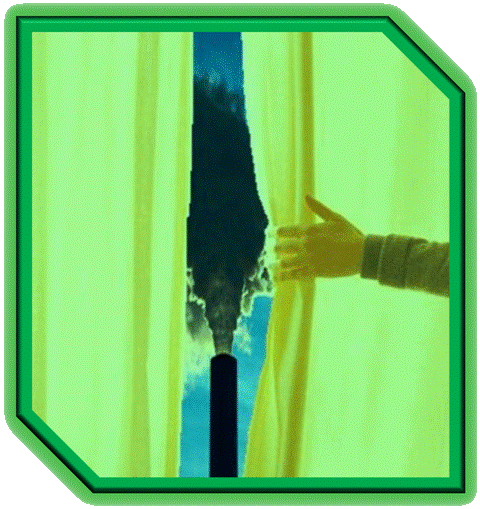
Just what is behind the LEED Green Curtain?

I do my very best to stay off the soap box when it comes to USGBC LEED and IEQ or more specifically IAQ.  I usually stay clear of this topic but I just can’t avoid speaking up once again.

LEED v3 for New Construction IEQ Credit 3.2   (page 64)

<https://www.usgbc.org/ShowFile.aspx?DocumentID=8868>

Intent of this credit isn’t to confirm, as you may think, the buildings actual use of the USGBC prescribed Low-Emitting Materials described in IEQ Credit 4.1, but to reduce indoor air quality (IAQ) problems resulting from construction or renovation and to promote the comfort and well-being of construction workers and building occupants. As described in the LEED documents page 66,

It may sound the same but until the IEQ Credit 3.2 becomes a Prerequisite it just a nice thought that looks good in print.

If the requirement did become a Prerequisite the sampling method would then need to be enforced.  Yes enforced.  The use of a MiniRae PID in a few locations doesn’t even come close the the methods described in the USGBC .Rating System Updated February 2011.

I have been working with LEED from the very beginning and I have provided LEED

3.2 testing in accordance with the Rating System many times.  I have provided many LEED and Indoor Air Quality presentations and discussions to USGBC Chapters and National Assoc. of Home Builders Chapters discussing these very issues.  The concern with the builders and general contractors is paying for the testing that may actually show that the building has an elevation in one or more of the USGBC Rating System Contaminant Maximum Concentration limits.  This actually happens much, much more that most would admit.  The result is that most simply ignore if not avoid the 3.2 Credit option 2 Air Sampling.

As a result of this avoidance, due to recent developments, and even though USGBC officially does not endorse one method over another,  the USGBC has allowed the use of handheld PID’s to measure TVOC’s.  The USGBC does this even though they have been made aware that using photoionization detectors (PID’s) to measure TVOC’s in buildings does not meet the minimum 4-hour sampling period required in the Rating System page 65.

This was an effort on behalf of the USGBC to encourage more contractors to actually pursue the 1 point in the entire USGBC Rating System that can confirm the use of the USGBC prescribed Low-Emitting Materials.  Something they are currently in serious need of confirming.

I continue to provide the LEED 3.2 point to my clients who are to actually wanting to earn the credit and confirm the buildings IEQ status using the USGBC required sampling methods.

I refuse to change my sampling protocols to those recently being used by others that require only a snapshot of the indoor environment using handheld PID samplers.

I choose not to provide anything less than the sampling methods that meet the USGBC’s Rating System requirements as described on page 65 of the LEED v3 LEED for New Construction launched on April 27, 2009, including an upgrade of LEED for New Construction under the suite of LEED 2009 rating systems. LEED for New Construction 2009 is served by the Green Building Design and Construction Reference Guide.

Pass or Fail the USGBC set their Standard.  I only measure the indoor environment according to their standard and encourage all others to do the same thing.

Go ahead take a peek at what is actually behind the curtain.


The USGBC sampling is described as follows.

OPTION 2. Air Testing

Conduct baseline IAQ testing after construction ends and prior to occupancy using testing protocols consistent with the EPA Compendium of Methods for the Determination of Air Pollutants in Indoor Air and as additionally detailed in the LEED Reference Guide for Green Building Design and Construction, 2009 Edition.

Demonstrate that the contaminant maximum concentration levels listed below are not exceeded:

Contaminant Maximum Concentration

•Formaldehyde 27 parts per billion

•Particulates (PM10) 50 micrograms per cubic meter

•Total volatile organic compounds (TVOCs) 500 micrograms per cubic meter

•4-Phenylcyclohexene (4-PCH)* 6.5 micrograms per cubic meter

•Carbon monoxide (CO) 9 part per million and no greater than 2 parts per million above outdoor levels

For each sampling point where the maximum concentration limits are exceeded, conduct an additional flush-out with outside air and retest the non-compliant concentrations. Repeat until all requirements are met. When retesting non-compliant building areas, take samples from the same locations as in the first test, although it is not required.

Conduct the air sample testing as follows:

•All measurements must be conducted prior to occupancy, but during normal occupied hours with the building ventilation system started at the normal daily start time and operated at the minimum outside air flow rate for the occupied mode throughout the test.

•All interior finishes must be installed, including but not limited to millwork, doors, paint, carpet and acoustic tiles. Movable furnishings such as workstations and partitions should be in place for the testing, although it is not required.

•The number of sampling locations will depend on the size of the building and number of ventilation systems. For each portion of the building served by a separate ventilation system, the number of sampling points must not be less than 1 per 25,000 sq ft or for each contiguous floor area, whichever is larger.

•Include areas with the least ventilation and greatest presumed source strength.

•Air samples must be collected between 3 and 6 feet from the floor to represent the breathing zone of occupants, and over a minimum 4-hour period.


John P. Lapotaire, CIEC
•Certified Indoor Environmental Consultant
•Microshield Environmental Services, LLC
www.Microshield-ES.com


Florida Mold Licensing Grandfathering Program Ends Today

March 1, 2011

Grandfathering Ends Today!

If you haven’t applied for your Florida Mold License under the Grandfathering clause You’re about to run out of time.

The requirements for grandfathering as amended by House Bill 713 include submission of an application to the department by March 1, 2011, whether postmarked or delivered by that date. Applicants must meet the following licensure requirements:

  • Certification by a state or national association that requires successful completion of a proctored exam for certification and completion of at least 60 hours of verifiable education for an assessor and 30 hours of education for a remediator;

or

  • At the time of application, have at least 3 years of experience as a mold assessor or mold remediator. To establish the 3 years of experience, an applicant must submit at least 40 invoices for mold assessment or mold remediation prepared by the applicant. The department may investigate the validity of a mold invoice and, if the applicant submits a false invoice, may take disciplinary action.

An applicant for licensure must submit to a criminal background check and be of good moral character. Mold assessors must also obtain a $1,000,000 insurance policy to cover both preliminary and post-remediation assessment.

An applicant may not qualify for licensure by grandfathering if he or she has had a mold assessor or remediator license or a license in any related field from Florida or any other state revoked at any time or suspended within the previous 5 years or has been assessed a fine that exceeds $500 within the previous 5 years. A license in a related field includes, but is not limited to, licensure in real estate, construction, home inspections services, or building code administration or inspection.


John P. Lapotaire, CIEC
•Certified Indoor Environmental Consultant
•Microshield Environmental Services, LLC
www.Microshield-ES.com