The EPA RRP Renovation, Repair and Painting Rule

June 28, 2013

ImageEPA‘s RRP Rule requires anyone (remodeling, renovation and painting contractors and most other trades) who works in pre-1978 housing for compensation and who might disturb painted surfaces to become an EPA Certified Renovator by taking a “Lead Safe Work Practices” RRP class from an EPA accredited training provider.

Why is the RRP Rule important? 

When lead paint is sanded or scraped or disturbed, microscopic particles of the metal mingle with the dust that is created. That “lead-containing” dust is what can seriously impact people’s health, especially children and pregnant women.

Lead causes a long list of problems, including learning and behavioral problems, kidney disease, high blood pressure, miscarriage and birth defects.  Lead can even cause depression and aggressive behavior.  Experts say lead poisoning doubles the number of children in special education classes. Studies show it plays a major role in crime rates. Any amount of lead is bad for you. There is no safe level. 

There has been a lot of publicity about toys and other consumer products containing lead.  But, problems caused by all of those products put together is a drop in the bucket compared to the number of people harmed when contractors disturb old paint in pre-1978 buildings without taking some simple precautions. That’s why EPA and the State of California require contractors to protect people they work for. 

To whom does the RRP Rule apply?

The RRP rule applies to anyone who works for compensation in pre-1978 housing and child-occupied facilities, including:

* General contractors

* Demolition workers

* Remodeling contractors

* Maintenance workers in multi-family housing

* Painters, plumbers and most specialty trades.

The RRP rule covers a lot of jobs: renovation, remodeling, painting, window replacement, plumbing, electrical work, heating & air-conditioning, demolition, plus work performed by trades like carpenters, electricians and handymen.  The rule also applies to persons working for rental property owners, schools, and day care providers.  And, it also applies to non-profits and governmental agencies.

Where does the RRP Rule apply?

The RRP rule applies to “Target Housing” and “Child-Occupied Facilities.”

Definition: Target Housing – is a house or apartment (including mobile homes) built before January 1, 1978 except for: 

1)   0-bedroom units (like dorm rooms or studio apartments)

2)   housing that is officially designated for the elderly or the handicapped

3)   housing that has been tested by a State Certified Lead Inspector and found to be free of lead-based paint.

Definition: Child-Occupied Facility – is a building, or portion of a building, constructed prior to 1978, visited by the same child, 6 years of age or under, on at least 2 different days within any week, provided that each day’s visit lasts at least 3 hours, the combined weekly visit lasts at least 6 hours, and the combined annual visits last at least 60 hours. Such facilities may include, but are not limited to, day-care centers, preschools and kindergarten classrooms.

What does the RRP Rule require?

  1. Pamphlet Distribution – Contractors must give clients a pamphlet called “Renovate Right” and get a signed receipt before beginning a job.

Contractors can call (800) 424-5323 and ask for free copies of “Renovate Right” and the “Small Entity Compliance Guide to Renovate Right” or both can be downloaded as PDF files from the EPA website.

  1. Individual Certification – At least one RRP Certified Renovator is required at each job site. Certification involves taking a 1-day class from an EPA Accredited Training Provider.
  2. Firm Certification – In addition to individual certification, each firm, agency or non-profit must also become RRP certified. (Note: This includes city agencies and school districts as well as small “one-man-band” handymen and owners of rental property.) Firms or “entities” must submit an application and pay EPA a fee ($300) which is good for 5 years.

The EPA Firm Certification Register your firm online at EPA web site. You do not need individual certification to submit a Firm Application. Firms should apply as soon as possible.

According to the EPA, after April 22, 2010, “… no firm working in target housing or child-occupied facilities, where lead-based paint will be affected by the work, may perform, offer or claim to perform renovations without EPA Firm Certification.”

Firm certification is NOT the same as individual certification attained by successful completion of an RRP course. There is no training requirement for Firm Certification.

www.FloridaIAQ.com

– See more at: http://activerain.com/blogs/jlapotaire#sthash.rcj3Sh16.dpuf


Spray Polyurethane Foam (SPF) Insulation Nuisance Odor Investigations, It’s not always the Foam

June 2, 2013

Indoor Air Quality Solutions, IAQSWith the rapid increase in the “Green” movement and the push for more energy efficient homes spray polyurethane foam SPF insulation is growing substantially.  As with most new building products the industry has had its own set of unique challenges that include the recognized need for training and certification for installers. Along with the recognized need for training are the results of inadequate applicator training, nuisance odors and occupant sensitivity.  These occupant related complaints have led to a rise in SPF insulation investigations by many who have little understanding of SPF insulation and how it can alter the indoor environment even when correctly installed.

When it comes to the investigation of nuisance odors associated with the application of spray polyurethane foam SPF insulation, I’ve found that most of the investigations typically involve little more than varied attempts at trying to chemically associate the odor with the off-gassing of the SPF.

I’ve been assessing spray polyurethane foam insulation SPF for several years on too many properties to list. I’ve assessed a dozen or so product lines both closed and open cell for manufactures, builders, homeowners, and applicators. The properties ranged from universities, community centers, offices, homes, both new construction and retrofit applications.

In my experience, SPF investigations can be categorized in three distinct categories. The first two seem to be the primary areas of SPFI investigations. The first category is simply miss-applied SPF, the second is presence of pre-existing or recently introduced contaminants and the third would be occupant exposure and sensitization during SPF application.

By using these three assessment categories, I have had great luck in identifying the catalyst of the odor and associated complaint.  It has also helped raise awareness that it’s not always the SPF.

The first category – Category 1 Miss-applied SPF Insulation category

These nuisance odors are directly associated with incorrectly applied SPF insulation and can be addressed by either correcting the areas of miss-applied foam or by removing and re-insulating the areas. Miss-Applied includes improper ventilation during the application, incomplete application, off ratio application, and also includes the SPF in direct contact with recessed can lights in the attic, keyless light fixtures bulbs, dryer vents, and/or chimney flues, all of which can heat the SPF and cause a tremendous amount of chemical odors.

Category 1 is relatively cut and dry and requires the onsite inspection of the SPF and the collection of no air samples.  The inspection of the foam and the determination of correct and complete installation is a critical first step.

I‘ve been on SPF insulation investigations where other Indoor Environmental Professionals (IEP’s) who were hired to assess the SPF insulation never looked at the SPF insulation.  Most have no knowledge of how to assess the correct or complete installation of the SPF insulation.  Most IEP’s show up with all manner of air sampling equipment and begin and end their investigation with the collection of air samples intending to identify the chemical signature of miss-applied SPF insulation.  But that’s just not going to happen.

For all who want to conduct SPF insulation inspections, start with understanding what correct and complete installation is according to the manufacturer who produced the foam you are inspecting.

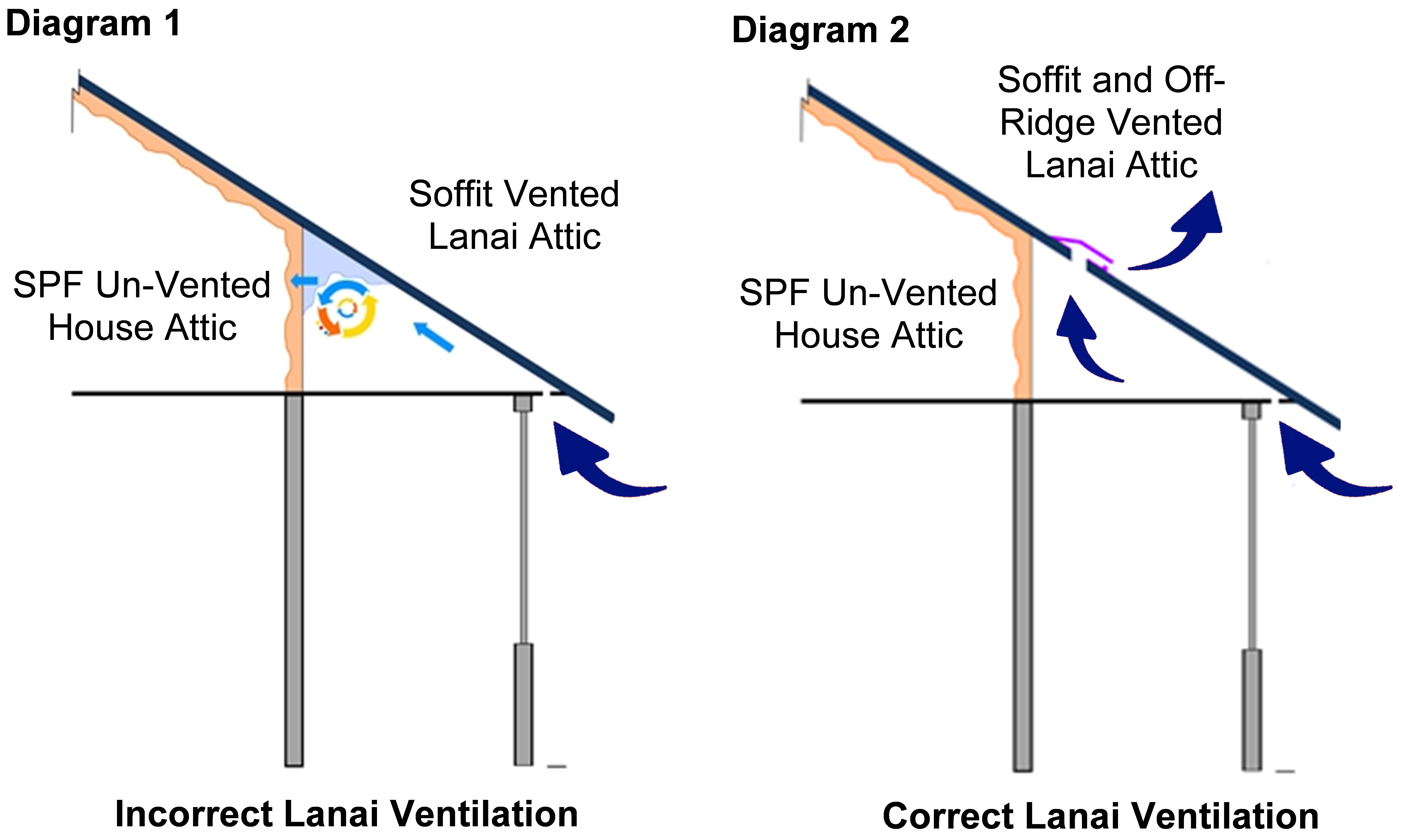
Below is an example of a home with retro-fit SPF insulation installed in the attic.  The homeowners hired an IEP to help establish and/or confirm that the SPF insulation was making them sick.  The home was traditionally ventilated with a large rear lanai.   As with typical SPF insulation landscape fabric was used to separate the lanai attic from the sealed SPF insulation attic.  However, the large Lanai attic space was not properly ventilated as shown in Diagram 1.

Image

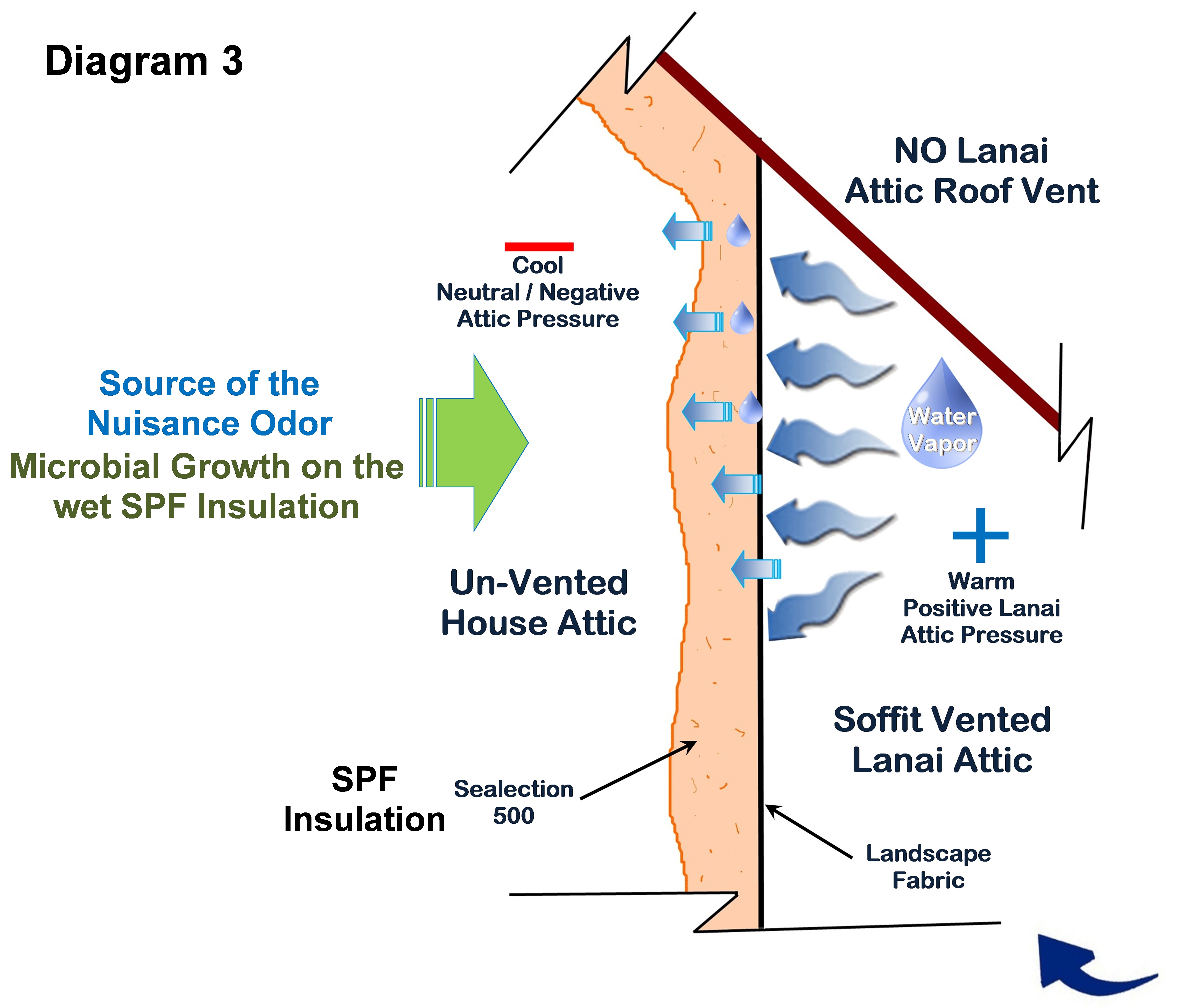
The lanai had soffit vents and no off ridge vents hence the incomplete attic ventilation.  The outdoor air pressure (wind) was moving the hot humid Florida air into the attic and into the sealed SPF insulation attic through the landscape fabric and SPF insulation as shown in Diagram 3.  The moisture was supporting microbial growth that was the actual odor identified within the home.  The correction was to first relieve the lanai attic pressure by installing an off ridge vent as shown in Diagram 2 and then by removing and replacing the mold damaged SPF insulation.

Image

Unfortunately, thousands of dollars were spent on the hunt for the infamous miss-applied chemical signature of the off-gassing SPF insulation.  Of course to no avail.  This is just one example of the easily overlooked yet painfully obvious issues with incomplete or incorrect SPF insulation.

The second category – Category 2 pre-existing or recently introduced contributors

This category cannot be stress enough to the professionals that are investigating SPFI.  This category runs the gamut and can include some rather odd contributors to occupant discomfort and nuisance odors that become much more concentrated when the SPFI is installed.   These include the HVAC system, air exchange rate, storage of materials in the now sealed space, insect and or rodent activity, routine pest control applications, the previous insulation condition and material, proper ducting of kitchen and bath fans.  The possibilities are endless and all must be considered.  Remember that what has accumulated in the attic is now semi-conditioned air that is shared with the attic and living space of the home.

For example if the home is a 60 year old ranch that had open cell SPFI installed at the roof sheathing and the attic was not cleaned to help save a few bucks, the bath fans are ducted to the attic space, and the home once had a rodent issue that was treated with poisons.  Well to say the least you have a huge list of contributors to occupant discomfort and nuisance odors.  Most of the SPF insulation investigations I am called in to review all of these issues were overlooked simply because of the recent application of SPFI.

It’s not necessarily the SPF insulation that is producing the odor or contaminate that is causing occupant discomfort but the SPF insulation is what eliminated the natural ventilation of the attic which prevented the odors and contaminants from entering the home.  The SPF insulation has now trapped the odors and contaminants within the semi-conditioned space.

In this case, the home also had no outdoor air and the home was accumulating VOC’s from daily use products.

The home was blower-door tested and didn’t even come close to the minimum ASHRAE air exchange rate. That attic air is now a part of the occupied space as semi-conditioned space and has 60 years of accumulated who knows what.  Easily it could include the accumulation of dust, debris, fiberglass, rodent and insect activity, prior application of pesticides, maybe even vermiculite.

This is a huge aspect of an SPF insulation investigation that I find all too often overlooked. As a professional investigating SPF insulation you have to ask questions beyond the obvious who was the demon SPF insulation manufacturer.

You have to ask relevant questions such as;

  • “What is the condition of the new semi-conditioned space?”
  • “What have the occupants been sealed in with?”
  • “How is the air exchange rate being met?”
  • “How is the semi-conditioned space actually being semi-conditioned?”

Sometimes it’s best to keep it simple, particles, pathway, and pressure.  Remember to keep an opened mind; it’s not always the SPF insulation.

On a retrofit SPF insulation investigation where there was an odor described as rotten eggs or sulfur the home owner hired an IEP to help establish that the SPF insulation was making them sick.  The IEP’s hired to find the odor focused on TO-15 sample collection throughout the home.  They were confident they identified the miss-applied SPF insulation chemical signature.  Not quite. Just under $5,000 later it was determined that the samples identified a chemical cocktail that could have been the result of just about everything used within the home over the last year since the SPF insulation was applied.  With no outdoor air supply and poor ventilation the VOC’s created within the home stayed in the home.  What the IEP’s didn’t notice was a failed air admittance valve in the attic over the area where the odor was the strongest.  At a cost of twenty bucks for a new air admittance valve the odor was eliminated.

On a new construction SPF insulation investigation, the IEP’s hired to establish that the SPF insulation was making the homeowners sick once again set up the VOC sample collection center and collected four TO-15 8 hour summa canisters and 8 sorbent tubes from a single story 2,200 square foot home.

The homeowners reported that after about a year the home began to make them feel worse when home than when away.  The culprit in their mind was the SPF insulation.  When I asked them how they came to that conclusion they said Google. They then hire an IEP to help them prove to the builder that the SPF insulation was making them sick.

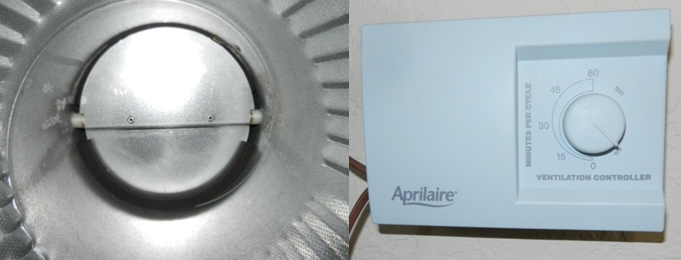
As the IEP was setting up their summa canisters, I began my investigation that started with the condition and settings of the homes ventilation system.  I knew the home had outdoor air supply.  I simply wanted to determine the thermostat and Aprilaire settings and establish the amount of outdoor air being supplied to the home.  As shown in the photo the Aprilaire ventilation controller was set to “Off”.

Image

When the 8 hour sampling period was over and the IEP was collecting their equipment I cranked up the AC and opened the Aprilaire ventilator to 30 minutes per cycle. During the sampling period of 8 hours the carbon dioxide levels were measured above 2000 ppm and the tVOC’s were measured at a mere 700 to 800 ppb.  After 1 hour of proper ventilation the carbon dioxide and tVOC levels were reduced by more than 50%. Amazingly the issue proved to be accumulation and not production of VOC’s.  Once again a complete investigation identified an issue with the ventilation that was misdiagnosed as SPF insulation.

On another SPF insulation investigation were the homeowner had spent thousands on sampling with an IEP who felt he had established the connection between the SPF and the occupant symptoms.  Again review by the PhD’s and chemist found no such connection that could be corroborated.  However the interview found that the homeowner was in the second floor master bedroom during the application of the SPF insulation.  The access to the attic was in the master closet, nice.  The applicator didn’t want to use landscape fabric to separate the large covered second story balcony just outside of the master bedroom so the applicator just applied the SPF insulation to the ceiling of the balcony.

Image

The photos above show two of the nine recessed can light fixtures that were covered in the foam from completely covered to just shy of completely covered.  The homeowner liked to sit outside in the evening and look out over the lake.  However, he reported that he could no longer spend the evenings on his beloved balcony because he was so sensitive to the SPF insulation. Yes he had become sensitized to the SPF insulation because he was in the home during the application but the trigger or catalyst to the odor was the heating of the SPF insulation just outside his master bedroom and just above his beloved balcony each time he turned on the balcony lights.

Sometimes as IEP’s we are hired to provide a very specific service.  I’ll use mold as an example.  When some IEP’s are hired to provide a mold inspection they often become far too focused on looking for one potential contributor and often overlook the many other and often obvious contributors.  Samples for mold spores are collected and moisture is hunted with a vengeance but not much else is looked at or investigated.   SPF insulation investigations are the same.  Are we hired to help the homeowner identify what in their home may be contributing to their symptoms or are we there to prove their hypothesis that it is or isn’t mold or SPF insulation.

IEP’s often go in with blinders on and lose focus on the true intent of the investigation which in my opinion should be “What is contributing to occupant discomfort and complaint?”   The IEP should approach the home as a system and be open to all potential contributors to occupant complaint.  The chief characteristic that distinguishes the scientific method of investigation from other methods of investigation is that scientists seek to let reality speak for itself, supporting a theory when a theory’s predictions are confirmed and challenging a theory when its predictions prove false.  Scientific investigation is generally intended to be as objective as possible in order to reduce biased interpretations of results. This is often overlooked when the IEP conducts an investigation focused on making the evidence support their hypothesis without objective challenge.

IEP’s must remember that while the SPF insulation may be the issue unless you can say there are no other issues within the home you have not completed your investigation you have just begun.

The third category – Category 3 Sensitization due to exposure

This category includes all occupants who have become sensitized or allergic to the odors given off from SPFI. With sensitization occupants have either re-entered the property shortly after the foam is applied, well before the manufacturer recommended re-occupancy time of 24 to 48 hours while the SPF insulation is still curing and off-gassing, or in the most severe cases of occupant sensitivity the exposure was actually took place during the application of the SPF insulation.

I had one case where the sensitized occupant was also the general contractor that built the home.  During the interview with the owner builder, I asked what he knew as a builder about the SPF insulation.  He admitted to not knowing anything until he began to react to the SPF insulation in his home.  I asked if he had the MSDS to review and he informed me that he did not.  Interesting, I asked if he maintained all of the building material MDS onsite.  He happily sad no that’s up to the subcontractors, interesting.

I then asked him if he was curious as to how the SPF insulation was applied and he of course told me that he was very curious.  He told me that he was in the attic while it was being applied.  Incredible right, you can’t make this up.

I asked if he thought it was odd that the applicator was in full protective equipment with supplied air and he was just watching in street clothes.  I also asked if the contractor told him that he shouldn’t be watching without personal protective equipment.  He told me that the contractor told him that he shouldn’t be up there when it was being applied but it was his house and he was the builder so he was going to do what he wanted.  I asked how long he was up there and he said about 30 minutes and then he began to get a huge headache.  Unbelievable, he was incredibly sensitized to the foam and no amount of miss-applied SPF insulation removal was going to provide him any relief.

Sensitization of the occupants can be a result of many issues such as occupants that don’t want to spend the money for a hotel stay, early re-entry or occupancy, the curious application observer, to the painfully stupid like the builder above.  However occupant sensitization can also be the result of the lack of proper ventilation during the application.  Venting of the off-gassing of the SPF insulation during application is critical and often not conducted at all. In all cases of occupant sensitization that I have been involved with the SPF insulation application was not properly vented to the exterior which created a substantial accumulation of the off-gassing chemicals within the property. These trapped volatile organic chemicals VOC’s are what sensitizes the occupants who have either re-occupied too early or were present during the SPFI application.

Sensitization occurs when the occupants are overexposed to the trapped volatile organic chemicals VOC’s and become sensitized. From that point on, any exposure to even a minute amount of the chemical causes a reaction. The process of sensitization can make a home unlivable for people who become sensitized.

Homes that have improper ventilation during the application process of the SPF insulation are also included in the miss-applied category and almost always have identified areas of miss-applied SPF insulation (SPFI).

This category is unique in that any attempt at reducing the occupant’s exposure to the SPF insulation that they are now sensitized to may not be of any relief.  I have had no luck in providing sensitized occupants relief from the home they are now sensitive to.  I have been involved in everything from the introduction of outdoor air through a pre-filter and dehumidifier to control the temperature, humidity, particles, path, and pressure to full removal of the SPF insulation. Unfortunately that bell can’t be un-rung.

Steps in the Right Direction

SPFA’s The Spray Polyurethane Foam Professional Certification Program (“SPFA PCP”) launched at the SprayFoam 2013 Convention & ExpoImage

To become certified under SPFA’s new program, you must pass the exam and meet the criteria for any level of Certification you would like to achieve. It is a progressive program with each level based on the candidate passing the exam for the previous level. In other words, EVERYONE must begin with SPF Assistant criteria. If your ultimate goal is to be a Certified Project Manager, you must meet the requirements for Assistant, then Installer, then Master Installer, then Project Manager to become a Certified SPF Project Manager. http://www.sprayfoam.org/

Connecticut House Bill No. 5908; An act requiring safety and certification standards for the spray foam insulation industry

ASTM WK30960 is intended to establish safe re-entry times for occupants following spray polyurethane foam insulation application.

ASTM WK30960 – New Practice for Spraying, Sampling, and Packaging Spray Polyurethane Foam (SPF) Insulation Samples for Environmental Chamber Emissions Testing

The CAN/ULC S705.1 National Standard requires that the spray polyurethane foam material be installed in accordance with the CAN/ULC S705.2 standard for Thermal insulation – Spray applied rigid polyurethane foam, medium density – Application.

The CAN/ULC S705.2 Application Standard lists a number of requirements for the manufacturer (seller of the two liquid components), the contractor (the corporation who has the contract to perform the installation) and the installer (the worker who actually sprays the components to form spray polyurethane foam on the job site).

The CAN/ULC S705.2 Application Standard sets forth requirements for environmental conditions suitable for spraying, substrate requirements, installation requirements, daily testing of the installed products and documentation requirements.

The Licensed Contractor is required to use applicators that are trained and certified under the SPF Quality Assurance Program used by CUFCA. Each installer is issued a plastic photo-identification card every July 1. The installer is required to carry this card with him during the complete installation period.

John P. Lapotaire, CIEC
Certified Indoor Environmental Consultant
Indoor Air Quality Solutions, IAQS
Microshield Environmental Services, LLC
Certification by American Council for Accredited Certification ACAC CIEC #0711048
Council-certified Environmental Thermography Consultant ACAC CETC #1005013
Accreditation by Council for Engineering and Scientific Specialty Boards (CESB)
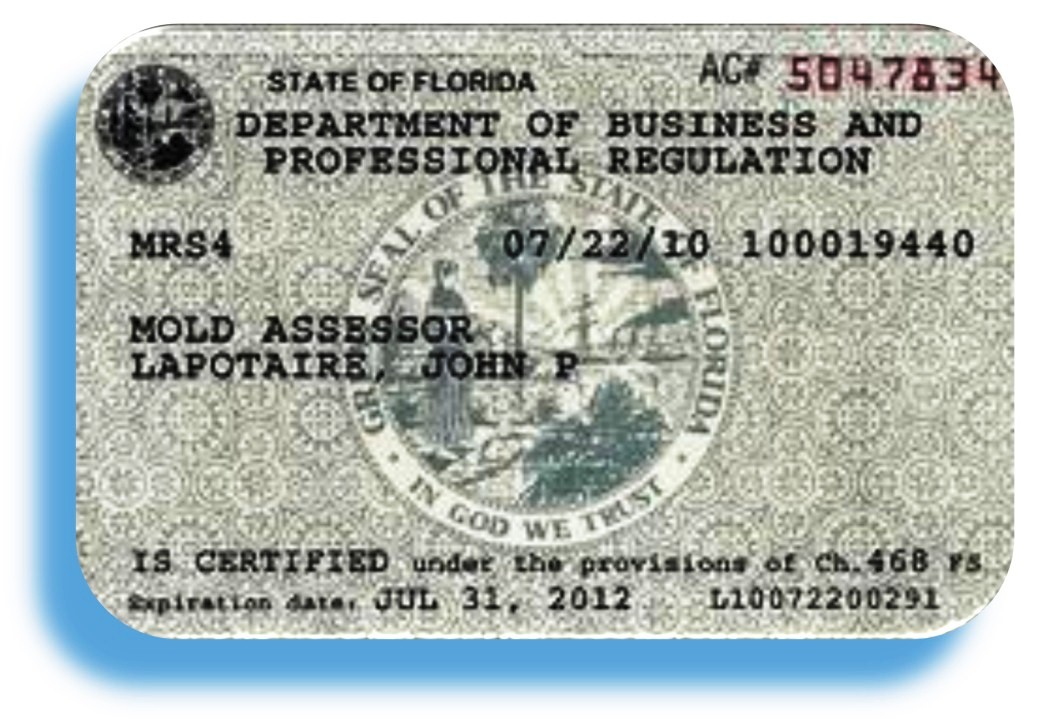
Florida State License Mold Assessor MRSA #4

www.FloridaIAQ.com

http://www.microshield-es.com/sprayfoam.html

http://www.microshield-es.com/moldinspectiontesting.html

www.microshield-es.com

Image


What is a Licensed Florida Mold Assessment?

May 9, 2013

ImageI raise this question because once again I’ve been called in to provide a peer review of a mold remediator that is advertising and providing assessment and remediation on the same job.  Oddly the remediator who is not licensed as a mold assessor states on his website “With the Florida Mold Law in effect, it is (finally!) illegal to test and remediation the same property in the State of Florida.” Wrong!  Assess and Remediate, which is not limited to testing.

So apparently this mold remediator who isn’t licensed as a mold assessor thinks that a mold assessment is limited to the “testing” or sampling for mold.

The question of just what is a mold assessment is a frustrating and surprisingly hard question to answer for many licensed professional.  That’s right; many mold professionals just don’t know their own industry and the laws governing them.  Many believe that a mold assessment is simply testing for mold.  Wow, for an industry professional that is trained, licensed and insured how is it possible to not know what a mold assessment is? Incredible.

So for the benefit of those who still don’t know what a mold assessment is I have included the Florida Statute Definitions of Mold Assessment and Mold Remediation and the links to the Florida Mold Related Services Statute.

Please read the sections below that clearly describe the services a mold professional can provide and the clear separating between mold assessment and mold remediation.

More importantly I would stress that a mold assessment is NOT the collection of mold samples or testing for mold.  It may include the collection of mold samples but the collection of mold samples is NOT, on its own, a mold assessment.

If you hire a licensed mold assessor you should receive a written report signed by the licensed mold assessor that performed the assessment.  Not by someone in another location that never visited you home or office.  When you hire a licensed mold assessor you should receive the written report signed by the licensed mold assessor that performed the assessment and never be required to pay an additional fee for a written report.

See the recent channel 9 news sting where three companies sent out unlicensed mold assessors to provide an assessment with one actually requiring additional payment for a written report.  Action 9 hidden camera mold investigation

That’s ridicules, what are you paying for if you aren’t receiving a written mold assessment report from your licensed assessor.

So what should the written mold assessment report include?

A detailed evaluation of data obtained from a building history and inspection to formulate an initial hypothesis about the

  • origin,
  • identity, location,
  • and extent of amplification of mold growth

The written report can then be provided to licensed mold remediators that can then provide you with a written estimate for the remediation.

Which brings us to the question of “What is Mold Remediation?”

The Florida Statute states that “Mold remediation” means the

  • removal,
  • cleaning,
  • sanitizing,
  • demolition,
  • or other treatment, including preventive activities, of mold or mold-contaminated matter.

Cut and dry.  No gray area in the definition of mold assessment and mold remediation.

I hope this information helps when you find yourself in need of a qualified mold professional.

Finally I close with questions you should ask your mold assessor before you hire them.

  • Are you licensed by the State of Florida? FL DBPR Verify a License
  • What qualifications do you have to perform mold inspection and/or testing?
  • What certifications do and your company have?
  • Are you familiar with the IICRC S-520?
  • Will I be getting a written report from you or the laboratory?
  • Will you be conducting a visual inspection or just mold testing?
  • How do you interpret the laboratory results?
    •  (Tip: You’re looking for conflicts of interest here. If they also perform remediation, they have a vested interest in finding mold to clean up.)
  • Do you have references from clients within the past year that I can call to ask how the inspection went?
    • (Tip: Be cautious of anyone new to the business and doesn’t have references.)
  • Do you perform mold remediation?
    • (Tip: Never hire anyone providing both mold assessment and mold remediation it’s a direct conflict of interest and against the law in Florida.)

The 2012 Florida Statutes Chapter 468 468.8411 Definitions

(3) “Mold Assessment” means a process performed by a mold assessor that includes the physical sampling and detailed evaluation of data obtained from a building history and inspection to formulate an initial hypothesis about the origin, identity, location, and extent of amplification of mold growth of greater than 10 square feet.

(4) “Mold Assessor” means any person who performs or directly supervises a mold assessment.

(5) “Mold Remediation” means the removal, cleaning, sanitizing, demolition, or other treatment, including preventive activities, of mold or mold-contaminated matter of greater than 10 square feet that was not purposely grown at that location; however, such removal, cleaning, sanitizing, demolition, or other treatment, including preventive activities, may not be work that requires a license under chapter 489 unless performed by a person who is licensed under that chapter or the work complies with that chapter.

(6) “Mold Remediator” means any person who performs mold remediation. A mold remediator may not perform any work that requires a license under chapter 489 unless the mold remediator is also licensed under that chapter or complies with that chapter.

The 2012 Florida Statutes Chapter 468 468.8419 Prohibitions; penalties.—

(1) A person may not:

(a) Effective July 1, 2011, perform or offer to perform any mold assessment unless the mold assessor has documented training in water, mold, and respiratory protection under s. 468.8414(2).

(b) Effective July 1, 2011, perform or offer to perform any mold assessment unless the person has complied with the provisions of this part.

(c) Use the name or title “certified mold assessor,” “registered mold assessor,” “licensed mold assessor,” “mold assessor,” “professional mold assessor,” or any combination thereof unless the person has complied with the provisions of this part.

(d) Perform or offer to perform any mold remediation to a structure on which the mold assessor or the mold assessor’s company provided a mold assessment within the last 12 months.

(e) Inspect for a fee any property in which the assessor or the assessor’s company has any financial or transfer interest.

(f) Accept any compensation, inducement, or reward from a mold remediator or mold remediator’s company for the referral of any business to the mold remediator or the mold remediator’s company.

(g) Offer any compensation, inducement, or reward to a mold remediator or mold remediator’s company for the referral of any business from the mold remediator or the mold remediator’s company.

(h) Accept an engagement to make an omission of the assessment or conduct an assessment in which the assessment itself, or the fee payable for the assessment, is contingent upon the conclusions of the assessment.

(2) A mold remediator, a company that employs a mold remediator, or a company that is controlled by a company that also has a financial interest in a company employing a mold remediator may not:

(a) Perform or offer to perform any mold remediation unless the remediator has documented training in water, mold, and respiratory protection under s. 468.8414(2).

(b) Perform or offer to perform any mold remediation unless the person has complied with the provisions of this part.

(c) Use the name or title “certified mold remediator,” “registered mold remediator,” “licensed mold remediator,” “mold remediator,” “professional mold remediator,” or any combination thereof unless the person has complied with the provisions of this part.

(d) Perform or offer to perform any mold assessment to a structure on which the mold remediator or the mold remediator’s company provided a mold remediation within the last 12 months.

(e) Remediate for a fee any property in which the mold remediator or the mold remediator’s company has any financial or transfer interest.

(f) Accept any compensation, inducement, or reward from a mold assessor or mold assessor’s company for the referral of any business from the mold assessor or the mold assessor’s company.

(g) Offer any compensation, inducement, or reward to a mold assessor or mold assessor’s company for the referral of any business from the mold assessor or the mold assessor’s company.

(3) Any person who violates any provision of this section commits:

(a) A misdemeanor of the second degree for a first violation, punishable as provided in s. 775.082 or s. 775.083.

(b) A misdemeanor of the first degree for a second violation, punishable as provided in s. 775.082 or s. 775.083.

(c) A felony of the third degree for a third or subsequent violation, punishable as provided in s. 775.082, s. 775.083, or s. 775.084.


http://www.microshield-es.com/moldinspectiontesting.html
www.Microshield-ES.com

The Florida Mold Licensing Law Confusion

May 7, 2013

M.A.R.C. Mold Assessment & Remediation Coalition of Florida

M.A.R.C. Mold Assessment & Remediation Coalition of Florida

It seems that there remains some confusion on just who is required to have a mold license as well as just what direct supervision is. 

Let’s tackle the first question as to who is required to have a mold license. 

Simply stated: Anyone who performs mold assessments or mold remediation must either have a mold license or be directly supervised by a licensed mold assessor or licensed mold remediator.  Seems pretty straight forward doesn’t it. 

The Florida Department of Business and Professional Regulation has it straight. 

Representative Workman was clear in his drafting the law. 

Several thousand mold professionals have it clear.

So why do many in the industry continue to provide unlicensed mold assessments and mold remediation?  Why is it that many continue to print their license number on someone else business card?  Could it be ignorance of the law or is it just greed at the consumer’s expense?

I personally believe that it’s greed.  It’s easy to send an unlicensed assessor to a home to collect a few mold samples or walk a dog through the home waiting for alerts.  There is very little investment in an untrained assessor or a trained mold sniffing dog compared to a truly trained, licensed, and insured mold professional that can actually provide a written mold report or professional mold remediation.

And yes I’m called to review the unlicensed pump jockey’s poor attempts at passing off a lab report as a mold assessment all the time.  I peer review botched assessments from unlicensed mold assessors and botched remediation from unlicensed mold remediators every week.  And unfortunately I’ve been receiving calls from clients that paid to have a mold dog walked through their home and receive nothing more than areas of alert from an unlicensed dog handler. 

I guess the handler expected the license requirement to be the dog’s responsibility. 

Which brings us to the direct supervision confusion.  Yes the dog is exempt from the requirement of a mold license but only if he is directly supervised by a licensed mold assessor.  However some feel that direct supervision can be provided from Miami while the unsupervised can be performing an assessment in Orlando.  Not quite.

Let’s put it this way.  I’ll provide your children, let’s say ages 2 and 3, direct supervision at a local theme park.  I’ll begin with asking you to drop them off at the gate because my direct supervision will be via my office chair across town.  Not going to happen.  No confusion regarding direct supervision in that scenario.  How about going to the beach and seeing a sign on the lifeguard chair stating that the direct supervision is at lunch.  Is he still providing direct supervision in his absence?   Not a chance.  Again no confusion regarding direct supervision in that scenario.

So why is it that a remediation contractor in south Florida thinks that he can directly supervise remediation in north Florida?  Greed gets my vote again, greed at the consumer’s expense.  It’s easier to send an unlicensed, untrained, uninsured mold remediator to provide unsupervised remediation than to train, license, and insure the professional remediators.  Let’s face it many in the unlicensed world of mold professionals spend all their money on wrapping their flashy vans not training their employees.

So now it has become necessary for the state to attempt to add two words to the law in an attempt to make direct supervision a bit more clear to those still looking for a licensing loop hole.  The two words are “on site”.  That’s right we will be attempting to make the intent of the law more clear by adding the two words on site to the law.  It would read on site direct supervision.  That should clear that up.

But what about the Division 1 Contractor exclusion and apparent confusion.  The law states the following.

(1) A person may not:

(d) Perform or offer to perform any mold remediation to a structure on which the mold assessor or the mold assessor’s company provided a mold assessment within the last 12 months. This paragraph does not apply to a certified contractor who is classified in s. 489.105(3) as a Division I contractor. However, the department may adopt rules requiring that, if such contractor performs the mold assessment and offers to perform the mold remediation, the contract for mold remediation provided to the homeowner discloses that he or she has the right to request competitive bids.

This is the part of the law that GC’s refer to when they attempt to justify their not requiring a mold license. 

It is interesting that they can find 468.8419 Prohibitions; penalties — section 1 paragraph (d) and overlook section 1 paragraph (a), (b), and (c)

(1) A person may not:

(a) Effective July 1, 2011, perform or offer to perform any mold assessment unless the mold assessor has documented training in water, mold, and respiratory protection under s. 468.8414(2).

(b) Effective July 1, 2011, perform or offer to perform any mold assessment unless the person has complied with the provisions of this part.

(c) Use the name or title “certified mold assessor,” “registered mold assessor,” “licensed mold assessor,” “mold assessor,” “professional mold assessor,” or any combination thereof unless the person has complied with the provisions of this part.

Just how do they miss that section?

What about the well-publicized FL GC – Mold Law Declaratory Statement 10-12-2011

The declaratory statement provides clarification on the fact that a Division 1 contractor can provide mold remediation so long as it is within his scope of work as a Division 1 contractor.  A Division 1 contractor cannot provide mold remediation following a written mold remediation protocol under a general contractor’s license. The division 1 contractor is no longer working within the scope of a Division 1 contractor.  The Division 1 contractor is working within the scope of a mold remediator which requires a mold remediator’s license.

So guys let’s just get licensed and provide direct supervision for the good of the Florida consumers that are paying for our professional services.

www.FloridaIAQ.com


Who is Required to have a Florida Mold License?

May 5, 2013

Florida Mold LicenseThis question just can’t seem to be answered by those that want to preform mold inspections or mold remediation and are on the hunt for a licensing loop hole.

So who in the State of Florida is required a have license to preform Mold Assessments and/or Mold Remediation. The answer is simple.

Anyone who advertises themselves as a professional providing mold assessments and/or mold remediation.


Mold Assessment

If you provide mold assessments and you advertise your company or yourself as a mold inspection company or inspector you must be licensed by the state as a mold assessor.

  • You cannot add someone else’s license number to your business card.  That’s not legal, honest, or ethical.  These actions will be reported to the State as unlicensed activity.
  • You cannot call the collection of air samples for mold spores an indoor air quality test to avoid the need to obtain a mold assessors license. The collection of air samples for mold spores is a mold sample not an indoor air quality test so let’s just be honest with our clients and call it what it is and get licensed.
  • You cannot assess the extent of mold damage on a home where you intend to provide the remediation.  The law is very clear on this and is one of the primary reasons for the law, conflict of interest.  Just call an independent licensed assessor to provide an assessment and then you can provide your estimate.


Mold Remediation

If you provide mold remediation and you advertise your company as a mold remediation and emergency services company you must have a Mold Remediation license and the license holder must be onsite supervising the mold remediation.

  • You cannot provide mold remediation under a general contractor’s license if you are advertising yourself as a mold remediator.
  • You cannot provide mold remediation following a written mold remediation protocol under a general contractor’s license.  You are no longer working within the scope of a Division 1 contractor.  You are working within the scope of a mold remediator that requires a mold remediator’s license.
  • You cannot provide mold remediation outside of a Division 1 Contractors scope of work FL GC – Mold Law Declaratory Statement 10-12-2011


So why did the state of Florida decided to require a license for mold related services?

The Florida Legislature finds it necessary in the interest of the public safety and welfare, to prevent damage to real and personal property, to avert economic injury to the residents of this state, and to regulate persons and companies that hold themselves out to the public as qualified to perform mold-related services.

Now let’s get to the individuals that believe they don’t require a mold license. First home inspectors and the answer is yes, a home inspector requires a mold assessor’s license to conduct a mold inspection and yes the collection of samples to identify the presence of mold requires a mold assessor’s license.

As for the duct cleaners and air conditioning contractors, the answer is also yes. Anyone removing or identifying mold in a home or business requires a mold assessment or mold remediation license and that includes those in the air conditioning and duct cleaning business.

There are exceptions to the law and those are listed below. Which brings us to the general contractor? Does the GC need a mold license? No. As the law currently states the prohibitions in the law do not apply to a Division 1 contractor as stated below.

468.8419 Prohibitions; penalties.—

(1) A person may not:

(d) Perform or offer to perform any mold assessment to a structure on which the mold remediator or the mold remediator’s company provided a mold remediation within the last 12 months. This paragraph does not apply to a certified contractor who is classified in s. 489.105(3) as a Division I contractor. However, the department may adopt rules requiring that, if such contractor performs the mold remediation and offers to perform the mold assessment, the contract for mold assessment provided to the homeowner disclose that he or she has the right to request competitive bids.

(d) Perform or offer to perform any mold remediation to a structure on which the mold assessor or the mold assessor’s company provided a mold assessment within the last 12 months. This paragraph does not apply to a certified contractor who is classified in s. 489.105(3) as a Division I contractor. However, the department may adopt rules requiring that, if such contractor performs the mold assessment and offers to perform the mold remediation, the contract for mold remediation provided to the homeowner disclose that he or she has the right to request competitive bids.

You may want to ensure that your GC is actually trained in Mold Assessment or Mold Remediation before you hire him. Currently the law requires nothing in the form of mold assessment or mold remediation training for a GC.

A Florida Licensed Mold Assessor or Mold Remediator must first take and pass one of the examinations approved by the department and administered by the American Council for Accredited Certification (ACAC).

The ACAC has certifications for both the Assessor and Remediator, such as the CIEC Council-certified Indoor Environmental Consultant Required: 8 years’ experience consulting on indoor environmental issues including asbestos, lead, HVAC, building science, chemicals, mold and microbial contamination, or the CMC Council-certified Microbial Consultant Required: 8 years’ experience in designing and conducting microbial sampling regimens, or the CMRS Council-certified Microbial Remediation Supervisor Required: 5 years’ experience remediating microbial issues in the indoor environment, and the CMR Council-certified Microbial Remediator Required: 2 years, experience remediating microbial issues in the indoor environment.

I would much prefer that my Mold Assessor or Mold Remediator be Licensed by the state and have the ACAC qualifications.

Mold assessment is a process performed by a mold assessor that includes the physical sampling and detailed evaluation of data obtained from a building history and inspection to formulate an initial hypothesis about the origin, identity, location, and extent of amplification of mold growth of greater than 10 square feet.

Mold remediation is the removal, cleaning, sanitizing, demolition, or other treatment, including preventive activities, of mold or mold-contaminated matter of greater than 10 square feet that was not purposely grown at that location; however, such removal, cleaning, sanitizing, demolition, or other treatment, including preventive activities, may not be work that requires a license under Chapter 489, Florida Statutes, unless performed by a person who is licensed under that chapter or the work complies with that chapter.

These items are offered as examples of services you do need to hire a person with a Florida license and services you do not need to hire a person with a Florida license. The list is not all inclusive. If you have specific questions, please contact the department at 850.487.1395 or review the rules for the profession at http://www.myfloridalicense.com. You should also check with your county or city to learn whether or not a local business tax receipt or certificate of competency is required for services that do not require a state license. Please visit our Unlicensed Activity page to learn more about how you can help us combat Unlicensed Activity.

Needs a License Does not need a License

Advertising or representing oneself to be a Mold Assessor or Remediator.

A residential property owner who performs mold assessment on his or her own property.

Taking samples for purposes of testing for the presence of mold.

A person who performs mold assessment on property owned or leased by the person, the person’s employer, or an entity affiliated with the person’s employer through common ownership. This exemption does not apply if the person, employer, or affiliated entity engages in the business of performing mold assessment for the public.

A person who performs mold assessment on property operated or managed by the person’s employer or an entity affiliated with the person’s employer through common ownership. This exemption does not apply if the person, employer, or affiliated entity engages in the business of performing mold assessment for the public.

A person working solely as an officer or employee of a governmental entity.


Here are some Florida Mold License FAQ’s Frequently Asked Questions and Answers.

Q   What are the statutes and rules that govern the mold-related services Profession?

A    Chapter 468, Part XVI of the Florida Statutes and Rule 61-31 of the Florida Administrative Code

Q   What are the statutes and rules that govern the Home Inspection Profession?

A    Chapter 468 Part XV of the Florida Statutes and Rule 61-30 of the Florida Administrative Code.

Q   Where can I obtain the laws and rules of the profession?

A    The laws and rules may be obtained on the website at www.MyFloridaLicense.com > Our Businesses & Professions > the license you are looking for > Statutes and Rules.  If you need further assistance, you may call the Customer Contact Center at 850.487.1395

Q   If my company does both Mold Assessments and Mold Remediations, will I be required to get two (2) licenses (one for Mold Assessor and one for Mold Remediator?

A    Yes, in addition, please note Section 468.8419(1)(d), F.S., provides that an assessor may not “perform or offer to perform any remediation to a structure on which the mold assessor or the assessor’s company provided a mold assessment within the last 12 months.” Section 468.8419(2)(d), F.S., provides that a remediator may not “perform or offer to perform any assessment to a structure on which the mold remediator or the remediator’s company provided a mold remediation within the last 12 months.”

Q   Will there be additional requirements by DBPR to have an “applicators” license if the mold remediator applies chemicals to contaminated surfaces during a remediation?

A    No, please see the definition of remediators as it allows the remediator to treat and do preventive activities.

Q   Is there a provision that would allow those licensed by the Construction Industry Licensing Board (CILB) to perform mold related services as long as they stay within the scope of their current licenses?

A    Yes, Section 468.841 F.S., exempts persons from the provisions of Chapter 468, Part XVI, when acting within their authorized scope of practice as licensed under Federal, state or local codes or statutes. Any person acting on this exemption must not hold himself or herself out for hire as a licensed assessor or remediator or any title implying licensure under Chapter 468, Part XVI.

468.8419 Prohibitions; penalties.—

(1) A person may not:

(a) Effective July 1, 2011, perform or offer to perform any mold assessment unless the mold assessor has documented training in water, mold, and respiratory protection under s. 468.8414(2).

(b) Effective July 1, 2011, perform or offer to perform any mold assessment unless the person has complied with the provisions of this part.

(c) Use the name or title “certified mold assessor,” “registered mold assessor,” “licensed mold assessor,” “mold assessor,” “professional mold assessor,” or any combination thereof unless the person has complied with the provisions of this part.

(d) Perform or offer to perform any mold remediation to a structure on which the mold assessor or the mold assessor’s company provided a mold assessment within the last 12 months. This paragraph does not apply to a certified contractor who is classified in s. 489.105(3) as a Division I contractor. However, the department may adopt rules requiring that, if such contractor performs the mold assessment and offers to perform the mold remediation, the contract for mold remediation provided to the homeowner disclose that he or she has the right to request competitive bids.

(e) Inspect for a fee any property in which the assessor or the assessor’s company has any financial or transfer interest.

(f) Accept any compensation, inducement, or reward from a mold remediator or mold remediator’s company for the referral of any business to the mold remediator or the mold remediator’s company.

(g) Offer any compensation, inducement, or reward to a mold remediator or mold remediator’s company for the referral of any business from the mold remediator or the mold remediator’s company.

(h) Accept an engagement to make an omission of the assessment or conduct an assessment in which the assessment itself, or the fee payable for the assessment, is contingent upon the conclusions of the assessment.

(2) A mold remediator, a company that employs a mold remediator, or a company that is controlled by a company that also has a financial interest in a company employing a mold remediator may not:

(a) Perform or offer to perform any mold remediation unless the remediator has documented training in water, mold, and respiratory protection under s. 468.8414(2).

(b) Perform or offer to perform any mold remediation unless the person has complied with the provisions of this part.

(c) Use the name or title “certified mold remediator,” “registered mold remediator,” “licensed mold remediator,” “mold remediator,” “professional mold remediator,” or any combination thereof unless the person has complied with the provisions of this part.

(d) Perform or offer to perform any mold assessment to a structure on which the mold remediator or the mold remediator’s company provided a mold remediation within the last 12 months. This paragraph does not apply to a certified contractor who is classified in s. 489.105(3) as a Division I contractor. However, the department may adopt rules requiring that, if such contractor performs the mold remediation and offers to perform the mold assessment, the contract for mold assessment provided to the homeowner disclose that he or she has the right to request competitive bids.

(e) Remediate for a fee any property in which the mold remediator or the mold remediator’s company has any financial or transfer interest.

(f) Accept any compensation, inducement, or reward from a mold assessor or mold assessor’s company for the referral of any business from the mold assessor or the mold assessor’s company.

(g) Offer any compensation, inducement, or reward to a mold assessor or mold assessor’s company for the referral of any business from the mold assessor or the mold assessor’s company.

(3) Any person who violates any provision of this section commits:

(a) A misdemeanor of the second degree for a first violation, punishable as provided in s. 775.082 or s. 775.083.

(b) A misdemeanor of the first degree for a second violation, punishable as provided in s. 775.082 or s. 775.083.

(c) A felony of the third degree for a third or subsequent violation, punishable as provided in s. 775.082, s. 775.083, or s. 775.084.

468.841 Exemptions.—

(1) The following persons are not required to comply with any provisions of this part relating to mold assessment:

(a) A residential property owner who performs mold assessment on his or her own property.

(b) A person who performs mold assessment on property owned or leased by the person, the person’s employer, or an entity affiliated with the person’s employer through common ownership, or on property operated or managed by the person’s employer or an entity affiliated with the person’s employer through common ownership. This exemption does not apply if the person, employer, or affiliated entity engages in the business of performing mold assessment for the public.

(c) An employee of a mold assessor while directly supervised by the mold assessor.

(d) Persons or business organizations acting within the scope of the respective licenses required under part XV of this chapter, chapter 471, part I of chapter 481, chapter 482, or chapter 489 1are acting on behalf of an insurer under part VI of chapter 626, or are persons in the manufactured housing industry who are licensed under chapter 320, except when any such persons or business organizations hold themselves out for hire to the public as a “certified mold assessor,” “registered mold assessor,” “licensed mold assessor,” “mold assessor,” “professional mold assessor,” or any combination thereof stating or implying licensure under this part.

(e) An authorized employee of the United States, this state, or any municipality, county, or other political subdivision, or public or private school and who is conducting mold assessment within the scope of that employment, as long as the employee does not hold out for hire to the general public or otherwise engage in mold assessment.

(2) The following persons are not required to comply with any provisions of this part relating to mold remediation:

(a) A residential property owner who performs mold remediation on his or her own property.

(b) A person who performs mold remediation on property owned or leased by the person, the person’s employer, or an entity affiliated with the person’s employer through common ownership, or on property operated or managed by the person’s employer or an entity affiliated with the person’s employer through common ownership. This exemption does not apply if the person, employer, or affiliated entity engages in the business of performing mold remediation for the public.

(c) An employee of a mold remediator while directly supervised by the mold remediator.

(d) Persons or business organizations that are acting within the scope of the respective licenses required under chapter 471, part I of chapter 481, chapter 482, chapter 489, or part XV of this chapter, are acting on behalf of an insurer under part VI of chapter 626, or are persons in the manufactured housing industry who are licensed under chapter 320, except when any such persons or business organizations hold themselves out for hire to the public as a “certified mold remediator,” “registered mold remediator,” “licensed mold remediator,” “mold remediator,” “professional mold remediator,” or any combination thereof stating or implying licensure under this part.

(e) An authorized employee of the United States, this state, or any municipality, county, or other political subdivision, or public or private school and who is conducting mold remediation within the scope of that employment, as long as the employee does not hold out for hire to the general public or otherwise engage in mold remediation.

John P. Lapotaire, CIEC
Certified Indoor Environmental Consultant

Indoor Air Quality Solutions, IAQS

Microshield Environmental Services, LLC

Certification by American Council for Accredited Certification ACAC CIEC #0711048

Council-certified Environmental Thermography Consultant ACAC CETC #1005013

Accreditation by Council for Engineering and Scientific Specialty Boards (CESB)

Florida State License Mold Assessor MRS4

www.FloridaIAQ.com


Continuing Education Requirements reduced for Activation of an Inactive License

May 2, 2013

Indoor Air Quality Solutions, IAQS

IAQ Solutions

HB 517 was approved by Governor Rick Scott on April 6, 2012 and reduces the continuing education required to activate an inactive license. You now only have to complete one renewal cycle of continuing education instead of completing continuing education for all the renewal cycles your license was in an inactive status. Applicants will need to provide proof of completing the continuing education requirements in effect at the last renewal date immediately prior to their application. Those requirements are included in Chapter 61-31.504, F.A.C.:
61-31.504 Continuing Education Requirements for Biennial Renewal
(1) Prior to the expiration of each biennial licensure period, and as a condition for renewal of the mold assessor and/or mold remediator license, each person licensed pursuant to Chapter 468, Part XVI, Florida Statutes, shall complete a minimum of fourteen (14) hours of continuing education which shall include, at a minimum, all of the following subjects as they relate to the practice of mold assessment and/or mold remediation:
(a) A minimum of six (6) hours of instruction regarding water (moisture intrusion),
(b) A minimum of four (4) hours of instruction regarding mold and mold safety, to include respiratory protection,
(c) A minimum of two (2) hours of instruction regarding report writing,
(d) A minimum of two (2) hours of instruction regarding standards of practice.
(2) Continuing education credits may be obtained for the completion of courses or seminars offered by education providers approved by the department. A list of such providers is available from the department at www.myfloridalicense.com/CESearch.asp?SID=&div=07
(a) A licensee, who is an instructor, may obtain continuing education credits in the amount of the credits allowed for that course or seminar for his/her first presentation of such course or seminar.
(b) No licensee may claim credit until after the credit has been earned by that licensee.
(3) Licensees need not comply with continuing education requirements prior to the licensee’s first full renewal cycle.

www.FloridaIAQ.com


AIHA Position Statement on Mold and Dampness in the Built Environment

April 7, 2013

AIHA Position Statement on Mold and Dampness in the Built Environment - Florida Indoor Air Quality Solutions, IAQ

AIHA Position Statement on Mold and Dampness in the Built Environment – Florida Indoor Air Quality Solutions, IAQ

The approximately 10,000 members of the American Industrial Hygiene Association (AIHA) serve in the occupational and environmental health and safety profession, practicing industrial hygiene in industry, government, labor, academic institutions, and independent organizations, primarily in the United States and Canada. The AIHA is a cognizant authority on all aspects of the profession. AIHA Technical Committees endeavor to ensure that reliable information is provided to all those concerned with the health and safety of people in the workplace and, in some cases, homes.  AIHA members often play the unique role of working with other professionals, as risk managers and risk communicators, to solve problems and to protect the health and wellbeing of workers and the general public.

Since 1996, the AIHA has been a leader in the development of information and best practices on the management of mold and dampness problems in the build environment. This information has been relied upon by officials who develop and
enforce public policy on indoor environmental quality (IEQ) for the non-industrial workplace, including schools. AIHA has also provided accessible information for individuals to enable more informed choices. It is appropriate to make clear the
Association’s positions with respect to reducing the risks associated with indoor microbial growth, and to define and explain the role of AIHA members in such endeavors, to all parties.

MOLD & HEALTH
Modest wetting and drying in buildings and in ventilation systems is normal and generally poses little risk for occupant health. Similarly, very brief episodes of wetting are not usually a problem provided that steps are taken to rapidly dry all materials.(1) “Dampness” is the presence of unwanted and excessive moisture in buildings.(2) This can lead to the growth of mold, fungi, environmental bacteria, and, in homes, house dust mites.

The term “mold” is a colloquial term for a group of filamentous fungi that are common on food or wet materials. Most of these are Ascomycetes that produce a lot of spores. The molds that grow on damp building materials are normally found in the soil and are adapted to grow on a wide variety of materials. Outdoors, molds live in the soil, on plants, and on dead or decaying matter. There are thousands of species of mold and they can be any color. Different mold species are adapted to different moisture conditions, ranging from just damp to very wet. Many times, mold can be detected by a musty odor. Live spores act like seeds, forming new mold growths (colonies) under the right conditions.(3)

Well conducted epidemiology studies in several countries have consistently shown that exposures from building/house dampness and mold have been associated with increased risks for respiratory symptoms, asthma, hypersensitivity pneumonitis, rhinosinusitis, bronchitis, and respiratory infections.(4,5) In studies conducted in the nonindustrial
workplace, individuals with asthma or hypersensitivity pneumonitis were found to be at risk for progression to more severe disease if the relationship between illness and exposure to the damp building was not recognized and exposures continued.(6)

Three recent, high quality, systematic reviews of the available evidence concluded that the implementation of interventions that combine elimination of moisture intrusion and leaks and removal of moldy items help to reduce mold exposure and respiratory symptoms and new onset asthma.(4,5,7) This position has also been taken by National Institute for Occupational Safety and Health (NIOSH) and many State governments (8), Health Canada(9,10) and internationally by the World Health Organization(11).

Based on this evidence, the position of AIHA is that persistent dampness and mold damage in the non-industrial workplace, including schools and residential housing, requires prevention, management and effective remediation. If visible mold is present, it should be remediated, regardless of what species are present. Such actions are likely to reduce new onset asthma, lead to savings in health care costs, and improve public health.

Therefore
1. While the design and location of a building have the greatest impact on the onset of serious mold damage, maintenance and effective management of mold and dampness requires an ongoing strategy involving occupants, building owners and managers, ventilation experts and occupational hygiene professionals.(1,2)

Owners and occupants should take action to detect and correct leaks, condensation problems and floods as soon as they are discovered. The potential for building structural damage, microbial growth and increased adverse health effects can, and
should, be reduced by limiting the buildup of indoor moisture. A formal mold/water prevention program with clear actions and responsibilities is required for an effective response to signs of moisture.(12,13) The actions taken by all stakeholders, including designers, contractors, owners, and occupants of buildings, are critical to effective management of prolonged dampness in buildings. An effective prevention program is evidence of appropriate due diligence to protect both the health of occupants and visitors, and to preserve the building fabric. As new buildings are constructed, or older buildings are subject to major renovation, consistent effort is needed on the part of the architects and engineers involved in the design and construction of the structure, cladding, roof and HVAC system to make the building durable.(1,14)

2. It has long been recognized that, based on the application of existing methods to analyze air or dust samples, there are no quantitative, health-based microbial exposure guidelines or thresholds.(8,10) Sampling data that may be developed during an investigation must be comprehensive and communicated in a form useful to physicians and allied professionals, building occupants and decisionmakers.(15,16)

AIHA recognizes that there are a number of audiences for the reports that are provided pursuant to a mold investigation. Regardless of the nature of the client (homeowner, insurance agent, large property company, government), reports must provide information that can (a) be translated into an action plan for repair and rehabilitation of the space, (b) provide a basis for protecting occupants and remediation workers health and, in certain situations (c) be useful for the personal physician and/or public health officials.

Investigators should provide clear and consistent field notes with sufficient detail to allow the field work and sampling data, if any, to be interpreted, verified, and repeated. The report should include, at a minimum, appropriate documentation of sample handling and reporting results. Ideal documentation should be thorough, detailed, readable, and focused. Additionally, it should present sufficient information to allow the work to be verified and repeated, and it should describe all quality assurance procedures.(17,18)

AIHA recommends that clients verify that the consultant has suitable training and project experience, as well as appropriate and related references.(19) Almost all industrial hygienists (IHs) have college degrees in engineering or the natural sciences, such as biology, chemistry, biochemistry or microbiology. Additionally, 42% have master’s degrees, and 12% have doctoral degrees. Industrial hygienists also have specialized training in ventilation engineering, environmental health, toxicology and microbiology.

Unless this is waived by the client, investigators should be independent of the remediation contractor and testing laboratory associated with the project.(16,19,20) Basic competencies that should be assessed by clients include knowledge and education in exposure characterization, microbiological assessment and remediation, general knowledge of the ecology of fungi and bacteria associated with damp or flooded buildings, building science and problem areas in Heating Ventilation and Air-Conditioning systems.(19,20) If samples are collected, laboratory analytical staff should have specific training and experience in the identification of environmental mold and bacteria, and be able to demonstrate successful participation in an external proficiency testing program.(2,21) Some States have certification requirements and other regulations regarding mold-related activities or remediation. A number of Canadian municipalities have regulations that cover mold damage in residences from illegal marijuana grow operations.

Recent guidelines from the American Academy of Allergy Asthma and Immunology focus on factors that promote allergen and contaminant production (‘facilitating factors’, in this case moisture) and reservoirs.(15) In this context, properly conducted building inspections, which depend on the training and experience of the investigator(s), are essential to physician evaluation. Physicians reviewing such reports should find clearly described key elements and be able to judge the quality of a report. At a minimum, reports should include a statement of purpose and limitations, observations, results of any testing, conclusions, and recommendations. Such reports should not include any speculation or conclusions concerning medical causation.(2,16)

Since current analytical methods do not provide information on the health risks associated with mold exposures in the built environment(8,10), health assessment is primarily based on the nature and extent of the mold and water/moisture damage and the type of reservoirs present (e.g. carpets, soft furniture). In most studies and a recent meta-analysis on the subject, semi-quantitative estimates of the extent of visible mold/dampness has been identified as being the best predictor of long and short-term health outcomes.(5,9,22,23) The investigator’s report needs to present this information in a clear fashion according to methods discussed in the AIHA publication Recognition, Evaluation and Control of Indoor Mold (“The Green Book”).(2) Air and/or settled dust sampling can be used to defend hypotheses about the nature of the contamination, ‘hidden’ sources of contamination, and whether or not the indoor air is similar to outdoor air.(16,24)

3. Investigation and remediation of mold and moisture damage in buildings must be based on an informed inspection augmented by the judicious use of existing sampling methods, primarily for the purpose of detecting any hidden damage.(2,9) The protection of remediation workers and occupants during renovations is essential.(2,9) In case of occupants with more serious pre-existing respiratory conditions, relocation may be appropriate.(25,26)

If mold is suspected, but not visibly detected after a thorough inspection, then microbial air sampling conducted in accordance with guidance documents can be useful.(2,3,24) This sampling may reveal evidence of indoor mold amplification or reservoirs,
particularly of mold that is considered “hidden” behind walls and other building structures. If mold is being removed and there is a question about how far the colonization extends, then surface or bulk sampling, in combination with moisture measurements from affected building materials, may be useful. Sampling for airborne mold spores can indicate whether the mix of indoor molds is “typical” of the outdoor mix or, conversely, “atypical” or unusual at the time of sampling.

Any mold sampling that does occur must be performed by qualified and experienced investigators familiar with current guidelines and, if applicable, local regulations. Samples should not be taken without a clear purpose (i.e., testing a hypothesis) and a sufficient number of samples must be taken to reliably assess the existing conditions. Laboratories vary in experience and proficiency; using an AIHA-LAP, LLC EMLA Paccredited lab or ISO 17025 equivalent is recommended.(3)

4. It is not unusual for buildings to have a number of concurrent problems that affect IEQ or the perception of IEQ. Water and moisture damage can result in the release of gasses from some building materials.(8) Investigations of apparent or suspected mold-related health complaints must consider all possibilities. While mold damage comprises a large percentage of problem situations, studies of occupant complaints find that a high percentage have an outdoor air make up below the American Society for Heating, Refrigeration, and Air-Conditioning Engineers (ASHRAE) standard, inappropriate and inadequate temperature and
humidity levels, inadequate control of contaminants from outdoor air (including ozone, traffic pollutants, etc.), contaminants arising from equipment or activities within the building or house (including cooking activities), and poor air distribution.(22,27,28)

IHs and other IEQ practitioners should approach mold, water intrusion, and IEQ investigations with the same mindset they use when they approach all investigations. The process includes three of the five key industrial hygiene elements: anticipation, recognition, and evaluation. While the IH can reasonably anticipate that there will be mold exposures associated with water intrusion, mold may or may not be the primary cause of any health effect(s) that may be experienced by the occupants. The IH should ensure that, while investigating mold-related complaints, whether apparent or reported, active consideration of other possibilities affecting IEQ in the space is an essential part of the investigation.(29)

In addition to mold-related exposures, contaminants that are both directly and indirectly associated with water-related damages may also be affecting the occupants. These contaminants may include, but are not limited to:

  • particulate and gas/vapor contaminants associated with improper combustion ventilation or improperly operating utilities, such as carbon monoxide, nitrogen and sulfur compounds, soot and other fine particles, fuel and other volatile organic compounds (VOCs), etc.;
  • VOCs from construction product degradation and/or off gassing, such as formaldehyde and other aldehydes, phenolics, and amines;
  • organisms that proliferate under damp conditions or when maintenance is substandard, such as bacteria, amoeba, dust mites, cockroaches, and rodents; and,
  • animal and chemical-based allergens already present and/or exacerbated by the water damage.

Many potential contaminants may be present along with mold damage that can affect health or the safety of investigators, remediation workers, and occupants. For example, failure to recognize the presence of asbestos, radon, or lead-based paint could lead to their disturbance during investigative or remedial activities, unnecessarily creating a new hazard. Finally, there is a need to recognize the potential hazards associated with remedial alternatives that may lead to the introduction of pesticides, ozone, chlorine dioxide, and other chemicals that could exacerbate existing health conditions or lead to new health issues.

www.FloridaIAQ.com


Florida Sewage Damage – The Health Risks it Poses to People

April 7, 2013

Florida Sewage Floods - Florida Indoor Air Quality Solutions, IAQ

Florida Sewage Floods – Florida Indoor Air Quality Solutions, IAQ

By Leo Nov
When we hear of the term sewage, we really have a very clear idea of what it looks like. We know what sewage is and where it comes from. We are so grossed just having to think that it came from our bodies’ excretory system, but then, despite its gross nature, we are still being careless in terms of its disposal.
 
Sewage can cause health risks to people. It is well-known that sewage is the accumulation of human wastes such as feces and urine. Because of its characteristic, it is indeed true enough that it has various pathogens and allergens that can be very harmful to people’s health.
 
There are several diseases are caused by sewage damage. It is important to have an idea of these diseases and the effects of these to our health.
 
The Dangers of Sewage damage to people’s health
 
The people are at great risk of acquiring infectious diseases due to exposure to sewage. Not only are the general public affected, sewage damage also poses risks to workers who usually venture in the remediation process, sewage treatment and other sewage-damage related activities. There is a big possibility for them to acquire chronic respiratory illnesses and other chronic illnesses whether it could be viral, fungal, bacterial and parasitic.
 
There are several diseases that are brought by sewage damage. It is important to have an idea of these diseases and the their effects to our health.
 
Public health
 
The general public is the one being at risk of sewage damage. It is ordinary to hear and read news about cases of hepatitis, cholera and other diseases due to exposure to untreated sewage. Take for example the case of epidemic Hepatitis A in Ocee, Florida on 1988-1989. In the said epidemic, statistics showed that 18 cases had a history of exposure to sewage-contaminated storm water.
 
Over 120 variants of viruses can be seen in human feces, urine and sewage damage which can lead their way to sewage. The 120 viruses can include the following:
 
Rotavirus-causes severe diarrhea in children
Norwalk virus- causes gastroenteritis
Adenoviruses- cause of respiratory and eye infections
 
Parasitic agents such as Giardia and Cryptosporidium can cause chronic intestinal illnesses in children and adults.
 
Bacterial pathogens abound in places with sewage damage can consist of strains of gram-negative organisms like Campylobacter, Salmonella and E. coli. Aside from the strains of gram-negative bacteria, gram-negative bacteria also produce endotoxins which occur at the point of cell’s death and elimination. Endotoxins can manifest in the air through remediation, take for example the cleaning and drying of infected carpets.
 
Public health risks can also be incurred through improper sewage damage disposal and transport from hospitals and other industrial companies. These could leaf to public health’s declining status due to unscrupulous manner of managing their wastes.
 
However, workers from sewage damage remediation and other sewage-related activities are not free from health risks. They are prone to infectious illnesses due to exposure to certain chemicals, allergens, toxic gases, fumes, vapors and endotoxins as well as mycotovins and other infectious agents.
 

Leo Nov is an editorial staff member of RestorationSOS.com, a leading service provider for water damage cleanups.

Article Source: http://EzineArticles.com/1911368

www.FloridaIAQ.com


Meth in Florida: A growing problem both statewide and locally

April 7, 2013

Florida Meth Lab - Florida Indoor Air Quality Solutions, IAQ

Florida Meth Lab – Florida Indoor Air Quality Solutions, IAQ

By SHELDON GARDNER
Sunday, April 7, 2013

Methamphetamine use is growing across Florida, and that trend is reflected in St. Johns County where the number of meth busts has increased for the past few years.
 
St. Johns County’s first meth bust came in the 1970s, and meth labs weren’t discovered regularly again until the early 2000s, according to previous stories.
 
Deputies started finding a few meth labs a year in 2008, said St. Johns County Sheriff’s Cpl. Mike Hartsell. In 2011 and 2012, the Sheriff’s Office found more than three dozen meth labs.
 
“It’s not gonna slow down,” Hartsell said.
 
Meth labs have been found across the county in hotel rooms, homes, backpacks and cars. Many of them are clustered in and around the city limits, but labs have also been found in Hastings, Elkton, Ponte Vedra Beach and off County Road 210 and 208, according to Sheriff’s Office records.
 
Most of them are small-scale, one pot labs, that are highly mobile and produce enough meth for personal use.
 
The same is true statewide. Most labs fit in a Gatorade bottle, small enough so that someone could “start making meth in one county and drive through three counties before it’s done,” said David Gross, special agent supervisor with the Florida Department of Law Enforcement, which monitors trends in drug use.
 
The increase in meth lab discoveries is also happening across the state, but meth is already a nationwide problem, Gross said. Meth has been in Florida since the late 80s or early 90s, but use and production started to pick up in 2008.
 
In 2008, law enforcement agencies across the state reported 180 meth labs, Gross said. That number rose steadily. In 2011, 676 meth labs were found. There were probably more since multiple areas in the state did not file reports. Reporting is on a voluntary basis.
 
In 2012, 930 meth labs were reported statewide.
 
In May 2011, the St. Johns County Sheriff’s Office Clandestine Laboratory Enforcement Team formed to better respond to the growing problem. The team is made up of deputies trained in handling meth labs. Hartsell supervises one of those teams.
 
When the Sheriff’s Office meth team arrives at a scene, officials suit up and remove the lab from the home. That takes four to six hours and costs from $500 to $2,000 depending on the size of the lab, Hartsell said.
 
Meth cooks endanger not only the people cooking them, but surrounding communities. The gases used in the cook are toxic and highly flammable and explosive. In 2010, a Sheriff’s deputy had to be taken to the hospital for an inhalation injury after breathing in the toxic fumes during an investigation, Hartsell said.
 
Meth use also increases criminal activity, affects surrounding communities and costs the county money. As with other drugs, people often steal to support their habit, Hartsell said.
 
Meth labs are toxic to people and homes.
 
Cooking meth or smoking it creates gases that seep into walls, carpets and furniture, he said. If a building is not cleaned properly, the residual gases are still there, and it’s a health risk.
 
Depending on the extent of meth use, decontaminating a building could mean ripping out walls and throwing away furniture, costing thousands to tens of thousands of dollars. Sometimes houses are so badly contaminated that they need to be demolished.
 
St. Johns County Code Enforcement officials recently demolished a mobile home at 1990 Powell Road because meth had been cooked in the home. Two labs had been found there over the past few years. The property owner opted to have the building torn down instead of paying for the clean-up.
 
Officials said meth use will continue to be a problem in the state and the county despite efforts to fight its spread.
 
“Right now that’s the future of narcotics in our county,” Hartsell said. “At least for the time being.”


A few facts about meth
 
Methamphetamine facts from the Drug Enforcement Administration:
 
Street names: Batu, Bikers Coffee, Black Beauties, Chalk, Chicken Feed, Crank, Crystal, Glass, Go-Fast, Hiropon, Ice, Meth, Methlies Quick, Poor Man’s Cocaine, Shabu, Shards, Speed, Stove Top, Tina, Trash, Tweak, Uppers, Ventana, Vidrio, Yaba and Yellow BamLooks.
 
■ How it’s done: Meth can be swallowed, snorted, injected or smoked.
 
■ Affects: Meth creates an intense rush with highs that can last for half a day. The drug releases high levels of dompamine into the pleasure areas of the brain. Long-term abuse can cause addiction, violence, anxiety, confusion, insomnia, paranoia, hallucinations, delusions. Dopamine-producing brain cells and serotonin-containing nerve cells can be damaged by exposure to meth.
 
■ Overdose: Taking too much meth can cause a heart attack, stroke and multiple organ problems as the body temperature is raised to dangerous levels. Overdosing also can cause convulsions.
 
■ Legal: Meth is a Schedule II controlled substance and is prescribed, in very limited use, to treat obesity and attention deficit hyperactivity disorder.
 
■ Where it all started: Mexico produces most of the meth that is imported into cities in the US. Many meth labs found in the U.S. are small scale labs.
 
■ What’s been done: The Combat Methamphetamine Epidemic Act of 2005 requires businesses that sell non-prescription products that contain major ingredients in meth — pseudoephedrine, ephedrine or phenylpropanolamine — to make customers show ID and sign a logbook to purchase the products. They must also keep the products in a locked cabinet.
 
■ Florida has its own laws regarding the sale and purchase of ephedrine and its related compounds. The State Legislature passed a law in 2010 that controls the sale and purchase of the chemical, and created an electronic database for sellers and law enforcement to keep track of who is buying and selling, according to the Florida Department of Law Enforcement.

www.FloridaIAQ.com


IAQ and Humidity

April 5, 2013

Florida Indoor Air Quality Humidity & IAQ

Florida Indoor Air Quality Humidity & IAQ

Maintaining relative humidity below 50% inhibits mold and mildew growth, dust mite infestations, and bacteria. This lower relative humidity also reduces the out-gassing of volatile organic compounds (VOC’s). Molds are incapable of obtaining the moisture needed for their development directly from the atmosphere, but they can obtain it from a substrate, which has absorbed moisture from moist air (60% to 100% relative humidity).

The relative humidity of the air has an indirect effect on fungal growth, and the more hygroscopic a material is, the more susceptible it is to mold growth. The minimum moisture content at which mold growth occurs depends on the material and usually ranges from 10% to 14%. Suitable substrates include carpet fibers, gypsum, concrete, bricks, etc.
Mold spores are everywhere all the time, entering from outdoor air as well as on pets and clothing. A mold spore landing on an indoor surface is likely to be insignificant and amount to little more than a common component of indoor dust, until such a mold spore lands on a moist organic surface (such as drywall.) High indoor humidity causes the surface moisture level to be sufficient for mold sporulation.  Since a mold spore requires moisture to propagate and grow, the indoor humidity level is a key gating factor in the control of indoor mold (and dust mites) in buildings.
Certain common mold genera and species, such as some members of the Aspergillus sp. and others grow readily on common building materials if they also have enough moisture. While there are fungal species that are able to grow under a remarkably wide range of environmental conditions, keeping indoor humidity at the appropriate level will reduce the chances of growth of the most common indoor problem molds.
High indoor humidity can encourage more issues than indoor mold. The same moisture conditions that support growth of problematic indoor molds also encourage the development of bacterial hazards, dust mite populations, mite fecal allergen problem, and possibly other insect problems in buildings.
The same measures of humidity control to prevent mold growth are needed to discourage the dust mite population that exists in all living areas. Measures discussed in this article including choosing and maintaining the proper humidity level to avoid indoor mold will also work to minimize the level of dust mites and dust mite allergens.
Keep the indoor humidity level in the mid-comfort range. A maximum indoor relative humidity of 50% RH may be acceptable, 45% RH better. At 60% indoor RH, we’re entering the indoor mold-formation risk zone of high interior moisture in building wall or ceiling cavities or on wall and floor surfaces, possibly conducive to mold growth.


John Lapotaire

Florida Indoor Air Quality Solutions

www.FloridaIAQ.com