“Is Spray Polyurethane Foam Insulation right for you?”

June 14, 2014

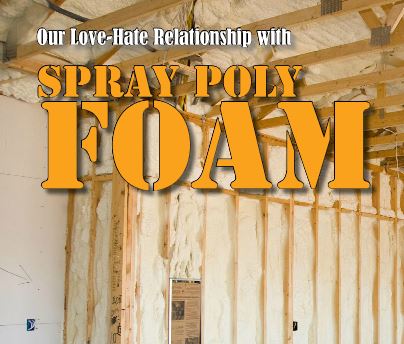
ImageSpray Polyurethane Foam SPF insulation is a great way to tighten up your home and save a few of these precious energy dollars.  We are seeing more SPF use in new construction than ever before and the retrofit market is a boomin.

This article will discuss some of the critical questions all prospective SPF consumers must ask when deciding if Spray Polyurethane Foam Insulation is right for them.  As good as SPF insulation is for energy savings, sometimes it’s just not a good choice for an existing home.

The takeaway… I hope readers understand that there are specific issues that should be taken into consideration when making the decision to install Spray Polyurethane Foam SPF insulation in your home.

We should probably begin with a short explanation of the objective for installing SPF insulation.  It seems simple, right, you’re just adding R-value to your home to save a few energy bucks.  Well, yes and no.  Most importantly is the how you would be improving your home to save those energy bucks.  The SPF will literally seal your home with the intent of preventing air infiltration and exfiltration.   Infiltration is the unintentional or accidental introduction of outside air into a building, typically through cracks in the exterior walls, ceilings, attics, and through use of doors and windows. This outdoor air infiltration is often refered to as air leakage.  In laymans terms, unconditioned outdoor air from getting in your home and conditioned indoor air from escaping your home.

In typical newer U.S. homes, about one-third of the HVAC energy consumption is due to infiltration, so reducing air infiltration saves energy bucks.  Controlling the air infiltration in turn makes it easier for your home’s HVAC Heating Ventilation and Air Conditioning system to heat, cool, and maintain your indoor thermal comfort.  That’s right, were talking about indoor thermal comfort not indoor air quality.

The energy savings is the direct result of substantially reduced air infiltration and exfiltration due to the sealing capability of the SPF insulation.  It truly is great for reducing the amount of energy bucks needed to heat and cool your home.  Your homes HVAC system now only has to contend with the newly sealed indoor environment which now includes the semi-conditioned attic.

We’ll get to the “semi-conditioned” attic in a bit but for now, let’s first talk about something else that is substantially reliant on the home’s air infiltration and exfiltration rate.  That would be the home’s necessary ventilation rate.

The infiltration rate is the volumetric flow rate of outside air into a building, typically in cubic feet per minute (CFM) or liters per second (LPS). The air exchange rate, (I), is the number of interior volume air changes that occur per hour, and has units of 1/h. The air exchange rate is also known as air changes per hour (ACHs).  ACH can be calculated by multiplying the building’s CFM by 60, and then dividing by the building volume. (CFM x 60)/volume.

The American Society of Heating, Refrigerating, and Air-Conditioning Engineers (ASHRAE) has had a residential ventilation standard since 2003, ASHRAE 62.2.  The ASHRAE 62.2 minimum ventilation rate formula was set at 7.5 cfm per person plus 1 cfm per 100 square feet.

The standard assumes that the number of occupants in a home equals the number of bedrooms plus one. The ASHRAE 62.2 asserted that the formula used to determine the minimum airflow rate of ventilation equipment was based on the assumption that all homes deserve an “air infiltration credit” of 2 cfm per 100 square feet.  This was the assumption that the homes in and before 2003 had a good amount of air infiltration.  The homes built today with or without the use of SPF insulation are much tighter and have a substantially reduced air infiltration rate.

So while your home’s recommended minimum ventilation rate remained unchanged for many years, ASHRAE has recognized the tighter construction of today’s homes and 10 years after the initial ASHRAE 6.2, there are new changes to the 2013 version of ASHRAE 62.2.  Under the new formula, newer tightly built homes will need to be ventilated at a much higher rate, namely 7.5 cfm per person plus 3 cfm per 100 square feet. This means that for a tightly built 2,400-square-foot home with 3 bedrooms, the minimum airflow rate of the ventilation equipment has jumped 89%, from 54 cfm to 102 cfm.  Long story short, the 2013 version of ASHRAE 62.2 has eliminated the air infiltration credit on new tightly built homes.  Guess where SPF insulated homes fall?  Right smack dab in the middle of the (as designed) tightly built category.

Questions to Ask Your SPF Contractor Prior to Install
SPF Consumer Question Number 1; How will you determine whether or not my home will meet or exceed the minimum ventilation rate once the SPF insulation is installed?

This is one of the most important questions every prospective SPF consumer must ask.  It involves the necessary air changes per hour (ACHs) to ensure that your home does not accumulate indoor contaminants and you have healthier air to breathe.  With SPF insulation, you will most likely require dedicated outdoor air supply to meet the minimum ventilation rate.  If your newly SPF insulated home does not meet the minimum ventilation rate, your home will accumulate contaminants and there will be occupant complaints.

I’ve inspected homes with reported SPF nusiance odors that are well over 50 years old all the way to homes that are only a year or two old.  The issues with new and old homes by and large remain the same.  The most critical is the ventilation rate of the home.  Unfortunately, the extremely important and necessary ventilation rate of the home is rarely discussed and almost never addressed when the home is changed from traditionally ventilated to sealed and semi-conditioned.  Your home’s HVAC system and ventilation rate must be discussed.

Now let’s talk about the “semi-Conditioned” attic.  Semi-conditioned means that your attic that was once naturally cooled through traditional attic “outdoor” air circulation, soffit, gable, and roof vents, is now cooled or conditioned through “indoor” air circulation.  The code refers to these two attics as vented and unvented attic assemblies.  With your new sealed attic you must seal these soffit, gable, and roof vents.

The unvented or semi-conditioned  state of the attic is critical.  For example, if the old attic insulation is left behind to save a few bucks the attic cannot be properly cooled.  If the home’s attic isn’t properly cleaned, the accumulated attic debris will enter the home and cause issues with the occupants.  To put it to you straight, what’s in the attic will now be circulated within your home.  It’s as simple as that.

SPF Consumer Question Number 2; How will you clean my attic and prepare it to be a semi-conditiond attic space?
Anyone interested in installing SPF in their attic must take into consideration the age of their home and the condition of their attic.  Any home that is retrofit with SPF can have some rather odd contributors to occupant discomfort and nuisance odors that will now become much more concentrated when the SPFI is installed.   Most of these contributors come from the old now sealed and semi-conditioned attic.

Some of these contributors to occupant discomfort include the storage of materials in the now sealed space, attic insects and/or rodent activity, routine household pest control applications, the previous insulation including the condition and material, and the proper ducting of kitchen and bath fans.  The possibilities are endless and all must be considered and reviewed prior to the installation of the SPF.  Remember, what has accumulated in the attic is now trapped within the now sealed semi-conditioned attic.  The semi-conditioned attic now shares circulated air with the living space of the home.

Our Example Home
To help our readers understand the SPF sales process a little better, let’s establish an example home; one that I actually assessed.  Let’s say our example home is a three bedroom, two bathroom, two car garage, 60 year old single story ranch style home.  Our homeowners have lived in the home for the last ten years and have decided to save a few energy bucks on their quest to be greener. Their first step was to install open cell SPF insulation at the roof sheathing.   This was a pricy step in the green direction, but they were able to shave a few bucks off the bottom line by not removing the old insulation or cleaning the attic.  No big deal according to the SPF applicator.

So what, who really cares if the insulation remains in the attic and the attic wasn’t cleaned? It’s really about the energy savings right?

Oh and what about the bathroom exhaust fans in that 60 year old home.  The 60 year old code allowed the bathroom exhaust fans to be ducted to the old ventilated attic and that’s exactly where they are now, ducted to the newly sealed attic.  Many homes built back then also had the kitchen exhaust hood ducted to the attic.  These bathroom exhaust fans must be ducted to the exterior of your home or you may continue to save energy but you’ll slowly be filling your home with humidity and contaminants.

Oh and what about the bathroom exhaust fans in that 60 year old home.  The 60 year old code allowed the bathroom exhaust fans to be ducted to the old ventilated attic and that’s exactly where they are now, ducted to the newly sealed attic.  Many homes built back then also had the kitchen exhaust hood ducted to the attic.  These bathroom exhaust fans must be ducted to the exterior of your home or you may continue to save energy but you’ll slowly be filling your home with humidity and contaminants.

I’m not stretching the example here.  These are real issues with many retrofit SPF applications.

What about the series of rodent issues in that 60 year old home?  Let’s face it; there are a lot of homes out there with rodent and insect issues.  Some pest control companies trap the feisty little critters while others choose to poison them.  In our example home, a liberal use of poisons and traps were used.  There were several remaining bait pods and traps with rat carcasses at different stages of decomposition.  The remaining pesticides can be a serious threat to occupants if not properly cleaned. The rodent urine and fecal matter are a substantial concern when trapped inside a now sealed semi-conditioned attic that shares circulated air with the living space of the home.

Well, to say the least, as with our example home, you can easily have a huge list of contributors to occupant discomfort and nuisance odors if the attic space isn’t properly addressed.

Most of the SPF insulation investigations I am called in to review the above issues were overlooked simply because of the recent application of SPFI.

Indoor Environmental Professionals IEP’s conducting SPF investigations must remain unbiased and open minded and remember that it’s not necessarily the SPF insulation that is producing the odor or contaminate that’s causing occupant discomfort.  It is however the SPF insulation that is now eliminating the natural ventilation of the attic which is now preventing the odors and contaminants from leaving the home.  This causes an accumulation of odors and contaminants if the necessary ventilation rate is not met and the source has not been properly addressed.  In the above examples, that source of the odors and contaminants were the remaining insulation and debris in the now sealed attic.  The SPF was the last change in the home and therefore the scapegoat or go-to cause and origin of the odor, the straw that broke the camel’s bake so to speak.

The newly installed SPF insulation has now trapped the odors and contaminants within the semi-conditioned space.  In the cases above, the home also had no dedicated outdoor air supply necessary to meet the minimum ventilation rate.  If the home met the minimum ventilation rate, the accumulating VOC’s from daily use of products could quite possibly have been adequately diluted ending the nuisance odors and occupant complaints.

So we come to the point where you’ve decided to move forward with your SPF insulation and your contractor has agreed to install dedicated outdoor air supply and thoroughly clean your attic once he has removed all of the old insulation.  Good start.  Now you need to address the issue of exactly how the application contractor will be ventilating your home during the application to prevent the accumulation of the SPF chemicals from entering your home.

SPF Consumer Question Number 3; How will you ventilate my home during the SPF application to prevent the contamination of my home and personal belongings.

There are many factors to consider when planning your SPF installation.  One of the most important is how the application contractor will protect your home while insulating your attic.  Your application contractor should assess the home’s ventilation needs before the job starts and develop a ventilation plan to ensure the SPF chemicals do not enter the home during application.

Understanding ventilation requirements is essential. For example, shut down HVAC systems during a SPF application. System shut-down stops dust, aerosol and vapors from being drawn into the HVAC system. Once the project is completed and the spray area ventilated, SPF odors generally dissipate. Lingering odors may be the result of several contributing factors as previously discussed and can be a combination of numerous sources, making it difficult to identify them. Sources of odors in new construction and retrofit applications can include: SPF; other construction materials, such as paints, cleansers, lumber, finishing treatments; occupant life style; nearby industrial or other emissions; pre-existing (“old house”) odors; construction defects, such as misrouted plumbing vents; or high individual sensitivity.

For interior applications, this can help prevent airborne materials from being distributed from one part of a building to another. Once the HVAC system is shut down, seal the air intakes with plastic sheeting and tape to prevent dust and spray from entering the system. Some SPF manufacturers recommend that the HVAC system stay sealed and inoperable for up to 24 hours after the SPF application.
A home that is not properly protected by correctly ventilating the attic can be irreversably damaged.  The chemical odors can remain for extended periods of time.  Often, occupants can become sensitized to the remaining chemicals.  Proper ventilation during application is necessary.

In many homes, the HVAC system is located in the attic.  If your home’s air handler and ducts are in your attic, you must ensure that they are properly sealed and protected to ensure you don’t end up with an additional and costly repair to your HAVC system.  If your HVAC system isn’t properly shut down, your HVAC sytem can very easily contaminate your home by circulating the SPF chemicals through your air handler directly into your home.

Odors may be noticed within areas of the building; for example, specific rooms, or when taking or examining a core sample. Document the presence of odor, describe its characteristics with specific adjectives such as “fishy,” or “rotten egg,” along with where and under what conditions it was noticed.

U.S. Environmental Protection Agency’s “Ventilation Guidance for Spray Polyurethane Foam Application”: http://www.epa.gov/dfe/pubs/projects/spf/ventilation-guidance.html.

SPF Consumer Question Number 4;  How will you ensure that my home’s HVAC system is shut down and protected during the SPF application?

It is critical that your SPF application contractor turn off your HVAC system and seal the air handler so overspray does not enter the system.  If your home has gas powered equipment, your SPF application contractor must direct the exhaust fumes to an open environment to prevent a buildup of carbon monoxide in the work area.

I’ve seen many air handlers destroyed by overspray and chemicals that were drawn into the air handler and distributed throughout the home.  I’ve even had one contractor tell me that the shut down was not necessary because his SPF was so safe his installers didn’t need to wear protective equipment other than goggles.  By the way, that couldn’t be further from the truth and that application contractor was immediately reported to the manufacturer.

There must be a more than passive attempt at protecting your home and properly ventilating your attic during and after application.  Remember to ask for the application attic ventilation, HVAC shut down and protection plan in writing.  You will want this as a part of your permanent record.  Then prior to the start of application, ask the application contractor to walk you through and show you the ventilation and HVAC protection.  It’s your home and nobody will be as dedicated to the protection of your home and personal property than you.

Then leave your home until the application is complete and do not return until the manufacturers established reoccupancy time has elapsed. No peeking!

SPF Consumer Question Number 5;  When will it be safe for me to return to my home?

Vacate building occupants and non-SPF personnel from the building during the application of SPF and for a period of time following the completion of spraying. Where this is not possible or practical for large commercial buildings, the use of containment and ventilation techniques can be utilized. For residential applications, the homeowner needs to vacate the home and return only after the specified re-occupancy time.

Communicate with other trades working in proximity to the spray application area. Giving notice to other trades is an important aspect on larger commercial projects due to the number and kinds of workers in and around the jobsite.

Provide notice to trades and occupants The focal points for this communication are the general contractor, building owner, home owner, or other responsible personnel for the project. Educate the onsite supervisor or project manager at the start of the project long before the actual spray application starts so  they have a complete understanding of the jobsite safety requirements before the beginning of the spray application process. Critical jobsite safety concerns include proximity of open flame sources and personnel to the spray application area.

If you are present during application or too soon after application, you run the risk of SPF sensitization due to exposure.
With sensitization occupants have either re-entered the property shortly after the foam is applied or well before the manufacturer recommended re-occupancy time of 24 to 48 hours. In the most severe cases of occupant sensitivity, the exposure actually took place during the application of the SPFI.

There are many occupants who have become sensitized or allergic to the odors given off from SPF for simply wanting to see the application, or refusing to leave their home during application, or returning to their home too soon.  Regardless of the reason for the exposure, the SPF application contractor should never continue to apply while anyone is present and must ensure that no body is present or reoccupies before the manufactures reoccupancy time period has elapsed.

Adding to the sensitization of the occupants is the lack of proper ventilation during the application. Venting of the off-gassing of the SPFI during application is critical and often not conducted at all. In all cases of occupant sensitization that I have been involved with, the SPFI application was not properly vented to the exterior which created a substantial accumulation of the off-gassing chemicals within the property. These trapped volatile organic chemicals VOC’s are what sensitizes the occupants who have either re-occupied too early or were present during the SPFI application.

Unfortunately, any attempt at reducing the occupant’s exposure to the newly installed spray polyurethane foam insulation may not provide any relief. I’ve had no luck in helping sensitized occupants. I’ve been involved in everything from the introduction of outdoor air through a pre-filter and dehumidifier to control the temperature, humidity, particles, path, and pressure to full SPF removal.  Unfortunately, some bells can’t be un-rung.

If you’re interested in saving those energy bucks with the application of SPF you must ensure that these steps are taken to ensure the proper application and safety of your family.

So back to our Example House
What exactly went wrong with our 60 year old example home discussed earlier?  Who was responsible for the occupant complaints associated with the newly installed SPF insulation?

Well, the application contractor sold the homeowner SPF for the purpose of greening up the home and saving a few of these elusive energy bucks.  It was an expensive step in the green direction but one that was going to pay off at the end in the form of saving a few energy bucks.  What the contractor didn’t discuss were the issues reviewed in this article.

Here is what our homeowner should have discussed with their application contractor prior to install;
1. The possible need to re-evaluate the homes HVAC system
2. The newly sealed home’s ventilation rate and possible need for dedicated outdoor air supply
3. The condition of the home’s 60 year old attic
4. The removal of the home’s existing insulation
5. The sealing of the existing open soffit and roof vents
6. The possible termination of the bathroom exhaust fans into the attic
7. The possible termination of the kitchen exhaust hood into the attic
8. The sealing of the home’s HVAC system during the application of SPF
9. The ventilation of the home during the application of SPF
10. Occupancy during the application of SPF and Re-occupancy after SPF application

Our example 60 year old home was later blower-door tested and as expected, it didn’t even come close to the minimum ASHRAE air exchange rate.  With the SPF insulation and without dedicated outdoor air supply, the home had no chance of meeting the minimum ventilation rate.  Unfortunately, for the occupants, the semi-conditioned attic had 60 years of accumulated dust, debris, fiberglass, rodent and insect urine, fecal matter, pesticides and who knows what.

In an effort to keep the bottom line sales price of the SPF as low as possible, the SPF contractor sold the SPF insulation without the following additional considerations that would have led to additional expenses and an increased bottom line sales price.  Let’s face it, while most reputable SPF contractors will review all aspects and necessary steps involved with SPF.  There remain some SPF application contractors who are there to sell SPF and don’t want to lose a sale.  Remember to pay attention to the SPF sales rep that has not listed the following in their sales price or stresses that they are unnecessary expenses.

With our example house, the SPF salesman omitted the following;
1. Sealing the existing soffit and roof vents
2. Removing the existing Insulation
3. Properly cleaning the attic
4. Relocating the bath and kitchen exhaust ducts to the exterior of the attic
5. Installing dedicated outdoor air supply to meet the necessary minimum ventilation rate

Remember the ventilation rate and dedicated outdoor air supply is a critical part of SPF insulation.   Unfortunately, I find the ventilation rate all too often overlooked.  As a professional investigating SPF insulation, you have to ask questions beyond the obvious.

You have to ask relevant questions such as;
• “What is the condition of the new semi-conditioned attic space?”
• “What have the occupants been sealed in with?”
• “How is the ASHRAE minimum ventilation rate being met?”
• “How is the semi-conditioned attic space actually being semi-conditioned?”

In addition to these permanent and critical physical changes to our example home, the SPF salesman also omitted several temporary but also very critical steps necessary to protect the occupants, their personal belongings, and the home’s HVAC system.

These very critical and necessary steps included;
1. Sealing the homes HVAC system
2. Properly ventilating the attic during and after application
3. Properly vacating the home during and after application
4. Establishing the necessary reoccupancy times for the occupants

Both the permanent and temporary steps associated with SPF insulation must be addressed for the proper installation of SPF.  Exposure to the old filthy attic can be very unhealthy to occupants.  Exposure to SPF during application or too soon after application can cause irreversible sensitivity to SPF and the related SPF chemicals.

The Bottom Line
When it comes to Spray Polyurethane Foam Insulation, the product, when correctly installed, is great and can be a wonderful energy saving feature to your home new or old.  However, all potential SPF consumers must do their due diligence and ask the right questions to ensure the proper temporary installation steps are followed during application.  In addition, you’ll need to know the questions to ask to identify any possible permanent alterations to your home to ensure that the SPF performs properly and does not have a negative impact on you and your family.

So “Is Spray Polyurethane Foam Insulation right for you?” 

The answer is in the sum of all of the above questions once asked and answered.  Ultimately, you’ll have to weigh the cost associated with properly installing the SPF insulation.  You’ll need to balance that with the possible cost associated with retrofitting your home to ensure your sealed attic and home performs as designed.  To get your long term energy savings and maintain your home’s indoor air quality, you’ll need to pony up these energy bucks up front and reapply the energy savings return over time.

It’s your money and your choice; hopefully, this article helped you make a more informative choice.


To learn more about Mr. Lapotaire or Indoor Air Quality Solutions & Microshield Environmental Services, LLC, please visit www.FloridaIAQ.com, email info@FloridaIAQ.com or call (407) 383-9459.

About Indoor Air Quality Solutions & Microshield Environmental Services, LLC

Since 2001, Florida residents have turned to the indoor environmental experts at Indoor Air Quality Solutions & Microshield Environmental Services, LLC.  The family owned and operated companies, based in the Orlando area, offer a comprehensive approach to identifying and correcting comfort and indoor air quality problems.  Their expert staff utilizes the latest technologies and industry recognized standards to identify and resolve indoor environmental issues.

John P. Lapotaire, CIEC

#IAQS


Spray Polyurethane Foam Insulation

June 13, 2014

ImageWelcome to part one of a four part series on Spray Polyurethane Foam SPF Insulation.  Spray polyurethane foam SPF insulation, the best thing since sliced bread, the greatest energy saving “Green” insulation available, Right?

I can’t remember a building product with such a clearly defined love or hate following.  When I say love, it’s typically described by the “Green” movement as I did above, safe, energy efficient, “Green”, and even healthy. That’s right!  It’s often touted as a product that will improve your indoor air quality.  These guys are hard core supporters and believers, a solid mix of manufactures, applicators, builders, and homeowners.

But if you’re on the hate side of the issue, you’re just as emotionally involved in the product.  You just see things from a different perspective.  Often the hate side of the love-hate relationship evolves from a regrettable spray polyurethane foam insulation experience, a botched job, miss-application, or unfortunate exposure to the SPF chemicals.  If your opinion of SPF is based on any of these issues, then your opinion is based on a vivid and tangible perspective based on a very personal experience.  That will drive passion.

How to ensure that your home has SPF installed properly and what you need to ensure your applicator knows his “stuff” is the reason for this series. While the products are all very similar, it’s the applicator and his or her training and experience that truly matters.  Following at a very close second, is your home and the impact of the sealed attic has on your existing home.
In the next few editions, we are going to discuss the unadvertised side of SPF.  Let’s face it, the industry has a great marketing department and the product works great when properly applied.  So we’ll be discussing the issues with misapplied SPF as well as the design changes that accompany altering a home’s attic from natural (passive) ventilation to a sealed mechanically semi-conditioned attic.

It’s very important to understand the specific changes that take place when you seal your attic.  There are factors that must be considered such as a 50 year old attic with an accumulation of dust, debris, and possibly pesticides that are now a sealed attic and part of the indoor environment. NOT good. I personally don’t feel that any SPF applicator can clean a 50 year old attic well enough for me to feel comfortable breathing the now shared attic air that is now semi-conditioned occupied space.  And that is exactly what will happen when you seal an attic and semi-condition it.

We’ll take a closer look at how to investigate SPF complaints and how to identify miss-applied SPF.  For example, some would prefer to collect air samples to identify the chemicals present in your home and attic as you see in photos A and B.  That will run you somewhere around $5,000.00. Ouch…

Or you can actually inspect the applied SPF and identify areas of unreacted SPF as shown in photo C or SPF on light fixtures as shown in photo D.  This approach will cost you or your builder nothing and the industry provides the guidance documents for the inspection.  Both approaches will provide you with information but the information gathered from the actual inspection of the applied product will provide more relevant information.

Whether you are a lover or a hater, these articles will provide you with solid information for spray pollyurethane foam insulation.
If you are trying to decide if SPF is going to be a part of your home’s remodel, addition, or home improvement, then the article titled “Is Spray Polyurethane Foam Insulation right for you?” will be good information.  This article will help inform you of a few issues with an existing home with a traditionally vented attic that you may be considering reinsulating with SPF.  As good as SPF insulation is, sometimes it’s just not a good choice.

If you want to know how SPF can compromise your indoor air quality even when it is correctly installed then the article titled “Spray Polyurethane Foam Insulation Build it Tight and Ventilate it Right” will be the series article for you.  A tightly sealed home will not meet the required ventilation rate and will require outdoor air supply.  Depending on where you live, this may require the use of an ERV (energy recovery ventilator), an HRV (heat recovery ventilator), or a mechanical dehumidifier.  All three will require alterations to your homes HVAC (heating, ventilation, and air conditioning) system.

If you want to know what it takes to properly inspect applied Spray Polyurethane Foam Insulation, then the article titled “Inspecting Spray Polyurethane Foam Insulation What to Look For” will be perfect for you.  So you have an issue with your installed SPF, what is your next step?  Do you hire a chemist? An IAQ indoor air quality consultant? Well, I believe you should hire someone who is extremely familiar with inspecting the SPF.  Not just someone that has performed several SPF inspections but someone familiar with SPF.  Yes, there is a substantial difference.  Many who provide SPF investigations never look at the SPF.   They simply collect air samples and declare the product as dangerous and in need of removal.  While SPF can be misapplied, the issues with SPF aren’t always the result of misapplied SPF.   This article will help clarify who and how to properly inspect your installed SPF.

Stay tuned for great information regarding the use and misuse of Spray Polyurethane Foam Insulation.


To learn more about Mr. Lapotaire or Indoor Air Quality Solutions & Microshield Environmental Services, LLC, please visit www.FloridaIAQ.com, email info@FloridaIAQ.com or call (407) 383-9459.

About Indoor Air Quality Solutions & Microshield Environmental Services, LLC

Since 2001, Florida residents have turned to the indoor environmental experts at Indoor Air Quality Solutions & Microshield Environmental Services, LLC.  The family owned and operated companies, based in the Orlando area, offer a comprehensive approach to identifying and correcting comfort and indoor air quality problems.  Their expert staff utilizes the latest technologies and industry recognized standards to identify and resolve indoor environmental issues.

John P. Lapotaire, CIEC

#IAQS


Take Control of Your Indoor Air

May 12, 2014

ImageBy John P. Lapotaire, CIEC

Indoor Air Quality (IAQ) is a hot topic today as more of us are acquiring allergies.  We seem to be inundated with allergy statistics graphs and charts reminding us that we can only expect more of the same.  So what can we do to create our own little safe house or sanctuary?  We can take control of the Indoor Air of our homes.  The outdoor Air Quality will change with the seasons and we will need to adjust to the varying allergens introduced into the air.  But when you get home you can relax and enjoy your Indoor Air Quality if you follow a few simple housekeeping suggestions.

We should first understand that Indoor Air Quality is the effect the air inside your home has on you and your family.  Good IAQ means the air in your home has no unwanted gases or particulates at concentrations that could negatively affect you and your family.  That leaves us with poor IAQ which occurs when gasses or particulates are present at an excessive concentration in your home and affects the satisfaction or health of you and your family.

IAQ isn’t that hard to understand or identify.  We can all tell the difference between a cool mountain meadow and a city landfill. Good IAQ, Poor IAQ.  Everything else lies somewhere between the two.  What separates the good from the bad are 3 basic areas of indoor air pollutants described by the Centers for Disease Control and Prevention (CDC) as Particulates, Bioaerosols and Volatile Organic Compounds (VOC’s).  What makes up the air in your home are varying amounts of these three pollutants.

The CDC describes the three pollutants as; Particulates are common indoor air particulates including dirt, dust, fibers, tobacco smoke, and fireplace or wood stove soot. These airborne particles can range from 0.1 microns in size to 100 microns in size.  Bioaerosols are microorganisms or particles, gases, vapors, or fragments of biological origin (i.e., alive or released from a living organism) that are in the air. Bioaerosols are everywhere in the environment. Volatile Organic Compounds (VOC’s) are carbon-based chemicals that easily evaporate at room temperature. Some VOC’s have odors other VOC’s have none. Odor does not indicate the level of risk. There are thousands of different VOC’s produced and used in our daily lives.

To take control of these three pollutants that can create poor indoor air quality in your home I have created 4 primary areas that you can address that will have an immediate impact on the homes indoor air quality.
1.Particulates
2.Humidity
3.Filtration
4.House Keeping.

Let’s start with Particulates. Particulates accumulate in the home from both inside and outside sources that can include:  Some of the common Indoor Particulate Sources include:
o Pet dander
o Candles
o Incense
o Perfume
o House Plants
o Fungal spores
o Pollen
o Tobacco smoke

These sources can be controlled and or eliminated from a home by controlling the source.  That means no smoking in the home.  No air fresheners, candles or incense, these introduce particulates to the home and mask air quality issues that should be addressed directly, not hidden by air fresheners.  I would minimize house plants including plastic and silk.  Live plants live in nice damp soil that is a breeding ground for fungus and mold which can lead to the introduction of spores and plastic and silk plants can hold onto particulate releasing them each time they are disturbed.  Unfortunately these plastic and silk plants are rarely cleaned and the amount of particulates they can introduce when disturbed is substantial.

Next you’ll need to keep a healthy level of humidity in your home.  Dust mites and mold love moisture so keeping humidity around 30%-50% will help keep dust mites and other allergens under control.  The addition of a humidistat and dehumidifier can greatly improve the indoor air quality of your home.  The humidistat turns on the homes air conditioning when the humidity reaches the set relative humidity (preferably not higher than 55%rh) just as the thermostat activates the homes air conditioning when the temperature reaches a set temperature (preferably not higher than 76°F).

Maintaining the proper humidity level helps reduce moisture in the indoor air and can effectively control allergens.  

High humidity levels in Florida can produce musty odor and/or a clammy feeling to the air in the summer and condensation on windows in the winter.

Often the principal source of higher humidity in a home is a family’s living habits. One person’s breathing produces 1/4 cup of water per hour, cooking for a family of four produces approximately five pints of water in 24 hours, showering puts 1/2 pint of water into the air.  Bathing puts 1/8 pint of water into the air.  Adding only four to six pints of water to the air raises the relative humidity in a 1,000 square foot home from 15 to 60 percent, assuming the temperature is constant.

Next on our list is Filtration.   Each time the air conditioning system cycles air into the home, armies of particulates are propelled through the supply ducts and discharged throughout your home into the air your family breathes.  More specifically the air you breathe is filled with the particulates allowed to pass through your air conditioning filter.  The filtration you choose has a tremendous affect on your indoor air quality so you should use the highest level of filtration that your system allows.

There are many filters available on the market today.  The most common are the one inch filters found in supermarkets, hardware stores and home supply retailers. All these filters guarantee a percentage of effectiveness, but that can be misleading. 

Standard throwaway filters are only designed to protect the air handler. And have little or no capability of collecting fine particles.  Washable Filters are very restrictive to airflow and are difficult to clean thoroughly and are rarely maintained at the proper level.  Electronic Air Cleaners are 95% efficient at .3 microns when new and clean. They reduce in efficiency very quickly as they load with particles and are difficult to clean thoroughly.  Many home owners just don’t take the time to properly clean these clean these filters on a regular basis, so they rarely works at the efficiency they were designed for.  Large 4 to 5 Inch Media Filters have a large amount of filter surface and allow for good air flow.  They can collect a large amount of dust and particles above one micron in size and most don’t have to be replaced for 6 to 12 months.  These filters are typically MERV rated at 8 to 11.

So now a I know you are asking Who is Merv and should I trust him with my filter? Well Merv isn’t a “He” MERV is an industry standard.  A standard rating system that can be used to compare filters made by different companies.   The MERV (Minimum Efficiency Reporting Value) rating of a filter describes the size of the holes in the filter that allow air to pass through.  In a nut shell the higher the MERV rating, the smaller the holes in the filter, the higher the efficiency.  Residential filters commonly have MERV ratings of 1-11. The higher the MERV rating, the more efficient the filter is, and the more particles it can filter.
o A MERV rating of 6 means the filter is 35% to 50% minimum efficient at capturing particles, sized 3.0-10.0 microns.
o A MERV rating of 7 means the filter is 50% to 70% minimum efficient at capturing particles, sized 3.0-10.0 microns.
o A MERV rating of 8 means the filter is 70% minimum efficient at capturing particles, sized 3.0-10.0 microns.
o A MERV rating of 11 means the filter is 85% minimum efficient at capturing particles, sized 3.0-10.0 microns. 

Now for the House keeping side of air quality improvement.   You first to reduce the humidity in the home by using your range, bathroom and cooking exhaust fans.  You should also ensure that they are vented to the outside.  You should check your dryer exhaust vent regularly to ensure it isn’t clogged.  Reduce the number of plants in the home and/or water them less so they release less water vapor.  And you can add a humidistat and mechanical dehumidifier to your air conditioning system.  So IAQ is a piece of cake.

Now you need to get rid of those pesky particulates. The key to that is to Collect and Remove.  You can collect and remove particles by using a HEPA vacuum.  Don’t forget to vacuum all porous surfaces including upholstered furniture. For best results, vacuum two or more times each week and change your HEPA filter regularly.  On tile floors you can collect and remove particles by mopping which will collect the dust that your HEPA vacuuming leaves behind. You can skip the soaps and cleaners and just use plain water to capture any lingering dust or allergens. There are also new microfiber mops that reportedly capture more dust and dirt than traditional mops and don’t require any cleaning solutions whatsoever.  Okay there may be a bit of an investment here for a HEPA vacuum, but I can assure you it will be worth it.

For the particle dust build up within the home you will need to collect and remove it as well.  For most people this means dusting using a simple feather duster, or a cloth of some kind, and some kind of dusting spray. This just relocates the dust particulates and introduces bioaerosols & VOC’s into the air.  Remember the key is to collect and remove not relocate.   I recommend using the new microfiber dust cloth that can capture more dust and dirt than traditional fibers and don’t require any cleaning solutions whatsoever.

To help prevent the particulates from entering the home, place large floor mats at every door. People track in all sorts of particles via the dirt on their shoes. A door mat reduces the amount of dirt, pesticides, and other pollutants from getting into your home. If the mat is big enough, even those who don’t wipe their shoes will leave most pollutants on the mat — not the floors in the home.

Don’t forget to change your air conditioning filters every 30 days or as prescribed by the Manufacturer.  Not maintaining your air conditioning filter is a major source of indoor air problems.  Some of the higher MERV rated media filters can be changed as infrequently as every 6 months.   While you are changing that filter check you’re A/C drain line and every 3 months flush it with an algae control cleaner to prevent clogging.

Remember to keep your home dry: Control humidity levels between 35% and 50% to prevent dust mites and an indoor environment that can lead to mold growth.  Fix any leaks you have in your home as soon as you find them.  If you have a flood, take immediate action and dry the area out, including all affected furnishings, within 48 hours to prevent mold growth.

So when asked what you can do about the “Air You Breathe” you will have plenty to say because you know what is in the air you breathe.  And you know that Good IAQ for people already suffering from allergies can reduce the symptoms of those allergies, often reduce medications for allergies, and lead to more relaxing sleep.  You also know that Good Indoor Air Quality can have a substantial impact on our children by preventing allergies, delaying the occurrence of an allergy, or the reduction of allergy symptoms.

Now you can say “Healthier Air Starts Here!”

To learn more about Mr. Lapotaire or Indoor Air Quality Solutions & Microshield Environmental Services, LLC, please visit www.FloridaIAQ.com, email info@FloridaIAQ.com or call (407) 383-9459.

About Indoor Air Quality Solutions & Microshield Environmental Services, LLC

Since 2001, Florida residents have turned to the indoor environmental experts at Indoor Air Quality Solutions & Microshield Environmental Services, LLC.  The family owned and operated companies, based in the Orlando area, offer a comprehensive approach to identifying and correcting comfort and indoor air quality problems.  Their expert staff utilizes the latest technologies and industry recognized standards to identify and resolve indoor environmental issues.

John P. Lapotaire, CIEC
#IAQS


Chemical Free Mold Remediation

May 12, 2014

ImageMold Remediation is the process of removing mold while protecting unaffected areas of a home or office from unnecessary cross contamination.  At no time is it necessary to KILL Mold.  Mold must be Removed regardless of its ability to germinate and grow into a colony.  The safest way to end the life cycle of mold is to simply eliminate the water source that is allowing the mold to grow.  Removing the water source is far safer that using Biocides and you will still need to remove the mold regardless of the molds viability.

Remember ALL Mold Remediation Should be Chemical Free Mold Remediation.

The Florida Department of Health

The goal should be to remove mold growth by cleaning or removing moldy materials. Dead mold can still pose health risks if you are exposed.

Ozone irritates lungs, and is not likely to be effective at addressing an indoor mold problem. No one should expose themselves or others to ozone on purpose. Address the cause of the mold (usually moisture) and then remove the mold by cleaning surfaces or removing moldy materials.

We know that we’ll never be able to eliminate all of the mold from within our home or office.  But we can prevent it from growing within our home or office by eliminating the moisture that supports its growth.  The sources of moisture that support mold growth include elevations of humidity above 60%, plumbing leaks, and building envelope failure such as roof and window leaks.

If mold is found to be growing in your home or office due to an elevation in humidity, leak, or an unfortunate water loss, you need to first identify the moisture source that is supporting the mold growth to correct and prevent continued mold growth. Then, collect and remove the mold and water damaged building material from the indoor environment.

Mold only needs a few things to grow and multiply:

  • Nutrients (food – almost anything)
  • A suitable place to grow (almost anywhere)
  • Moisture

Eliminating any one will prevent the mold from growing.  What you’re left with is the mold that can become airborne and directly affect the occupants.  This mold must be collected and removed from your home or office.

We know that there is no shortage of “Quick Fix” Ozone or Chemical using mold remediators out there that will chemically fog your home or office and affordably “Kill” your mold, but guess what?  Your mold is still there.  Without the moisture you corrected the mold wouldn’t have regrown anyway.  Now you have the mold (allergen) covered in a chemical (poisonous both to the mold and humans) and is now a “poisonous allergen” waiting to become airborne and potentially impact the occupants.

There is no need to expose anyone to Ozone, Hydroxyls, Biocides, Disinfectants, Fungicides, Anti-microbials, and Encapsulants during Mold Remediation.

Our Mold Remediation Protocols are written to protect or clients from the dust up of mold during the removal and the unnecessary use of chemicals.  Our Protocols are designed to collect and remove the mold from your home or office without the use of chemicals.

Our goal is to protect our Clients from exposure to Ozone, Hydroxyls, Biocides, Disinfectants, Fungicides, Anti-microbials, and Encapsulants during Mold Remediation.  The unnecessary use of these products are Forbiden.

All of our Mold Remediation Protocols include the following statement:

Ozone, Hydroxyls, Biocides, Disinfectants, se Fungicides, Anti-microbials, and Encapsulants must not be used unless specified in this protocol.  If chemical use is specified in this protocol, the chemicals can only be applied in the specific areas identified in this protocol.

If chemical use is specified in this protocol the chemicals will be used for the purpose of Disinfection of the Category 3 water damaged areas and not for the purpose of Killing or Removing Mold.

If the remediation contractor would like to apply chemicals in any way not specified in this protocol, the Remediator must obtain written permission from the IAQ Solutions IEP.

IICRC S-520
Source removal of mold contamination should always be the primary means of remediation.  The Indiscriminant use of antimicrobial products, coatings, sealants, and cleaning chemicals is not recommended.

NYCDH New York City Department of Health
“The use of gaseous, vapor-phase, or aerosolized biocides for remedial purposes is not recommended. The use of biocides in this manner can pose health concerns for people in occupied spaces of the building and for people returning to the treated space if used improperly.

AIHA American Industrial Hygiene Association
The goal of remediation is removal of mold and the moisture source because:
    a) biocides do not alter mycotoxins or allergens;
    b) it is generally not possible to get 100 percent kill with biocides; and
    c) because of (b), the newly deposited spores, re-growth will occur after the biocides if moisture returns

OSHA Occupational Safety and Health Administration
The use of a biocide, such as chlorine bleach, is not recommended as a routine practice during mold remediation, although there may be instances where professional judgment may indicate its use (for example, when immuno-compromised individuals are present). In most cases, it is not possible or desirable to sterilize an area, as a background level of mold spores comparable to the level in outside air will persist. However, the spores in the ambient air will not cause further problems if the moisture level in the building has been corrected. Biocides are toxic to animals and humans, as well as to mold.

U.S. EPA Environmental Protection Agency
“The purpose of mold remediation is to remove the mold to prevent human exposure and damage to building materials and furnishings. It is necessary to clean up mold contamination, not just to kill the mold. Dead mold is still allergenic, and some dead molds are potentially toxic.  Whether dead or alive, mold is allergenic, and some molds may be toxic.

To learn more about Mr. Lapotaire or Indoor Air Quality Solutions & Microshield Environmental Services, LLC, please visit www.FloridaIAQ.com, email info@FloridaIAQ.com or call (407) 383-9459.

About Indoor Air Quality Solutions & Microshield Environmental Services, LLC

Since 2001, Florida residents have turned to the indoor environmental experts at Indoor Air Quality Solutions & Microshield Environmental Services, LLC.  The family owned and operated companies, based in the Orlando area, offer a comprehensive approach to identifying and correcting comfort and indoor air quality problems.  Their expert staff utilizes the latest technologies and industry recognized standards to identify and resolve indoor environmental issues.

John P. Lapotaire, CIEC

#IAQS


Chemical Free Mold Remediation

May 12, 2014

Mold Remediation is the process of removing mold while protecting unaffected areas of a home or office from unnecessary cross contamination.  At no time is it necessary to KILL Mold.  Mold must be Removed regardless of its ability to germinate and grow into a colony.  The safest way to end the life cycle of mold is to simply eliminate the water source that is allowing the mold to grow.  Removing the water source is far safer that using Biocides and you will still need to remove the mold regardless of the molds viability.

So Remember ALL Mold Remediation Should be Chemical Free Mold Remediation.

The Florida Department of Health
The goal should be to remove mold growth by cleaning or removing moldy materials. Dead mold can still pose health risks if you are exposed.

Ozone irritates lungs, and is not likely to be effective at addressing an indoor mold problem. No one should expose themselves or others to ozone on purpose. Address the cause of the mold (usually moisture) and then remove the mold by cleaning surfaces or removing moldy materials.

We know that we’ll never be able to eliminate all of the mold from within our home or office.  But we can prevent it from growing within our home or office by eliminating the moisture that supports its growth.  The sources of moisture that support mold growth include elevations of humidity above 60%, plumbing leaks, and building envelope failure such as roof and window leaks.

If mold is found to be growing in your home or office due to an elevation in humidity, leak, or an unfortunate water loss, you need to first identify the moisture source that is supporting the mold growth to correct and prevent continued mold growth. Then, collect and remove the mold and water damaged building material from the indoor environment.

Mold only needs a few things to grow and multiply:

    Nutrients (food – almost anything)
    A suitable place to grow (almost anywhere)
    Moisture

Eliminating any one will prevent the mold from growing.  What you’re left with is the mold that can become airborne and directly affect the occupants.  This mold must be collected and removed from your home or office.

We know that there is no shortage of “Quick Fix” Ozone or Chemical using mold remediators out there that will chemically fog your home or office and affordably “Kill” your mold, but guess what?  Your mold is still there.  Without the moisture you corrected the mold wouldn’t have regrown anyway.  Now you have the mold (allergen) covered in a chemical (poisonous both to the mold and humans) and is now a “poisonous allergen” waiting to become airborne and potentially impact the occupants.

There is no need to expose anyone to Ozone, Hydroxyls, Biocides, Disinfectants, Fungicides, Anti-microbials, and Encapsulants during Mold Remediation.

Our Mold Remediation Protocols are written to protect or clients from the dust up of mold during the removal and the unnecessary use of chemicals.  Our Protocols are designed to collect and remove the mold from your home or office without the use of chemicals.

Our goal is to protect our Clients from exposure to Ozone, Hydroxyls, Biocides, Disinfectants, Fungicides, Anti-microbials, and Encapsulants during Mold Remediation.  The unnecessary use of these products are Forbiden.

All of our Mold Remeiation Protocols include the following statement:

Ozone, Hydroxyls, Biocides, Disinfectants, se Fungicides, Anti-microbials, and Encapsulants must not be used unless specified in this protocol.  If chemical use is specified in this protocol, the chemicals can only be applied in the specific areas identified in this protocol.

If chemical use is specified in this protocol the chemicals will be used for the purpose of Disinfection of the Category 3 water damaged areas and not for the purpose of Killing or Removing Mold.

If the remediation contractor would like to apply chemicals in any way not specified in this protocol, the Remediator must obtain written permission from the IAQ Solutions IEP.

IICRC S-520
Source removal of mold contamination should always be the primary means of remediation.  The Indiscriminant use of antimicrobial products, coatings, sealants, and cleaning chemicals is not recommended.

NYCDH New York City Department of Health
“The use of gaseous, vapor-phase, or aerosolized biocides for remedial purposes is not recommended. The use of biocides in this manner can pose health concerns for people in occupied spaces of the building and for people returning to the treated space if used improperly.

AIHA American Industrial Hygiene Association
The goal of remediation is removal of mold and the moisture source because:

  • biocides do not alter mycotoxins or allergens;
  • it is generally not possible to get 100 percent kill with biocides; and
  • the newly deposited spores, re-growth will occur after the biocides if moisture returns


OSHA Occupational Safety and Health Administration
The use of a biocide, such as chlorine bleach, is not recommended as a routine practice during mold remediation, although there may be instances where professional judgment may indicate its use (for example, when immuno-compromised individuals are present). In most cases, it is not possible or desirable to sterilize an area, as a background level of mold spores comparable to the level in outside air will persist. However, the spores in the ambient air will not cause further problems if the moisture level in the building has been corrected. Biocides are toxic to animals and humans, as well as to mold.

U.S. EPA Environmental Protection Agency
“The purpose of mold remediation is to remove the mold to prevent human exposure and damage to building materials and furnishings. It is necessary to clean up mold contamination, not just to kill the mold. Dead mold is still allergenic, and some dead molds are potentially toxic.  Whether dead or alive, mold is allergenic, and some molds may be toxic.


For more information about the Indoor Air Quality Association, please visit www.IAQA.org.

To learn more about Mr. Lapotaire or Indoor Air Quality Solutions & Microshield Environmental Services, LLC, please visit www.FloridaIAQ.com, email info@FloridaIAQ.com or call (407) 383-9459.

About Indoor Air Quality Solutions & Microshield Environmental Services, LLC

Since 2001, Florida residents have turned to the indoor environmental experts at Indoor Air Quality Solutions & Microshield Environmental Services, LLC.  The family owned and operated companies, based in the Orlando area, offer a comprehensive approach to identifying and correcting comfort and indoor air quality problems.  Their expert staff utilizes the latest technologies and industry recognized standards to identify and resolve indoor environmental issues.

John P. Lapotaire, CIEC

#IAQS


Is “new car smell” toxic?

March 23, 2014

by

New Car Smell

Most people seem to enjoy the smell of a new automobile. But is it possible that the fresh-off-the-dealer’s-lot odor could also make you sick? Dr. Heinz Linke

We all know what “new car smell” is, right? It’s the smell of the interior of, well, a new car. Most people like it and some people like it so much that they buy new-car-smell sprays and air fresheners that make the interiors of their cars smell new until they’re old enough to be towed off to the junkyard. But is it possible that new car smell could also make you sick?

A lot of people think so. There have been studies suggesting that at least a few of the chemicals that give a car that fresh-off-the-dealer’s-lot odor may be toxic and not all of them go away as the car gets older. But before we can answer the question of whether new car smell is or isn’t toxic, we have a more important question to answer: What exactly is new car smell made of, anyway?

That’s a tough question to answer. We can start by asking just what it is that we think we’re smelling when we climb into a brand new car interior. Some people think it smells like leather, but only luxury car interiors contain much in the way of actual leather and new car smell can even be found in economy cars. Other people think it smells a bit like plastic, but good plastic, not the cheap kind that $1.99 toys are made out of. Some people think it smells like … well, a whole lot of different chemicals.

That last group is closest to the mark. There really are a whole lot of chemicals making up the interior of a car and some of them release volatile organic compounds (VOCs) into the car’s interior, a process that has the somewhat unpleasant-sounding name “outgassing.” It’s these VOCs that produce new car smell, though some of them produce no odor at all. Some of these volatile chemicals, like ethyl benzene and formaldehyde, are also found in paints and glues, and they can cause problems like dizziness, headache, allergies or even cancer when inhaled in large enough quantities or for long enough periods of time. Some people have compared inhaling new car smell to glue sniffing or even sick-building syndrome.

But are there enough of these compounds in new car smell to make a fresh car interior truly unhealthy or would they require more exposure than the average driver is likely to get to them? The best way to find out is — you guessed it — to do a scientific study. Let’s talk about a couple of the studies that have been done and what they’ve found out.

Putting “New Car Smell” Under the Microscope

Questions about the toxicity of new car smell aren’t new. Neither are studies aimed at determining whether it’s a problem you should be seriously worried about. Probably the most recent of these studies was conducted in February of 2012 by a non-profit group called the Ecology Center. Their “Model Year 2011/2012 Guide to New Vehicles” (which you can download in PDF format here) is unequivocal on the issue: “[T]hese chemicals [in new car smell] can be harmful when inhaled or ingested and may lead to severe health impacts such as birth defects, learning disabilities and cancer. Since the average American spends more than 1.5 hours in a car every day, toxic chemical exposure inside vehicles is becoming a major source of potential indoor air pollution.” Whoa! That’s enough to make you want to wear a gas mask until your car’s old enough for the warranty to expire! But before you decide to buy only used cars for the rest of your driving life, they add that “some cars are better than others. Toxic chemicals are not required to make indoor auto parts, and some manufacturers have begun to phase them out.”

Okay, guys, let’s name some names. Which cars does the Ecology Center believe have the healthiest interiors? Their top five picks, starting with the healthiest, are the 2012 Honda Civic, 2011 Toyota Prius, the 2011 Honda CR-Z, the 2011 Nissan Cube and the 2012 Acura RDX. Check their PDF to see the rest of the top ten. The two cars with the least healthy interiors, according to the Ecology Center, are the 2011 Chrysler 200 S and, in last place, the 2011 Mitsubishi Outlander Sport. Honda wins as having the line of cars with the healthiest interiors overall. The report concentrates on the presence of bromine (used in flame retardants), chlorine, and lead, grouping other volatile organic chemicals in a single category in their rankings. The report includes a list of hundreds of popular cars manufactured from 2006 to the present and lists the amount of each of these substances present in each car’s interior.

Fortunately, a lot of the volatile chemicals in a car’s interior go away over time — that’s why they call it “new car smell” — but they don’t go away completely and they can come back on hot days when the higher temperatures increase the rate of outgassing. One thing you can do to combat this process on hot days is to roll down the windows rather than using the air conditioner, letting fresh air circulate into the car and releasing the volatile compounds into the air outside (which isn’t necessarily good for the air outside, but it’s certainly better than being closed up in a car full of toxic fumes). You can also park your car in the shade, so it will stay reasonably cool.

Not all studies done over the years have agreed that new car smell is a danger to automobile occupants. A 2007 study conducted at the Technical University of Munich in Germany concluded that the chemical compounds released inside a car might at worst exacerbate allergies, but don’t pose any other significant threats to human health. The study was conducted by collecting air samples from the interiors of new cars and three-year-old cars placed under 14,000 watts of lights, which generated interior temperatures up to 150-degree Fahrenheit (65.6-degree Celsius), a lot hotter than the average car is likely to become under ordinary conditions. They then exposed human, mouse and hamster cells to these samples to look for toxic effects. None were found. The researchers concluded that new car smell isn’t toxic. However, the researchers also admitted that if the air inside an office building were found to have the same chemical content as the air samples found in the cars, the building would be declared to have sick-building syndrome and the workers would be sent home until it had been cured.

So in a sense both studies agree: Automobile interiors contain poisonous chemicals. But the Ecology Center feels that these chemicals represent a health threat to occupants and the German researchers do not. In the end, you’ll just have to choose which study you want to take seriously. And maybe roll down your windows a bit more than you usually do to let the bad air out.

Lots More Information

Author’s Note: Is “new car smell” toxic?

If I ever put together a list of my five favorite odors nobody would ever name a perfume after, I think new car smell would easily make the top five, right after freshly ground coffee beans and way ahead of wet paint. So it’s rather distressing to discover that it might be hazardous to my health. Given that researchers disagree on just how much of a danger the volatile chemicals in an automobile interior represent, you might not want to start wearing that gas mask quite yet. But I’ll confess that it made me feel a lot better to see that my own car, a 2011 Toyota Prius, was determined to have the second healthiest interior by the Ecology Center. Car buyers shopping for a healthy car would do well to look at the health rankings in their report.


John P. Lapotaire, CIEC

#IAQS


Most and least toxic cars? Tests rank 200 models

March 23, 2014

Vehicle VOC'sBy Wendy Koch, USA TODAY

Ever wonder about that “new car” smell?  In a report Wednesday that tests more than 200 vehicles, an environmental group says this off-gassing of chemicals is notably lower in some cars such as the Honda Civic ,Toyota Prius and Honda CR-Z.

Overall, there’s good news. Cars are reducing their use of chemicals, and the best have eliminated hazardous flame retardants and PVC (polyvinyl chloride), according to the fourth consumer guide on the topic by the non-profit, Ann Arbor-Mich. based Ecology Center.

Today, the guide finds that 17% of new vehicles have PVC-free interiors and 60%  are made without brominated flame retardants. Some of these chemicals — found on the steering wheel, dashboard, armrests and seats — have been linked to numerous health problems including allergies, impaired learning and liver toxicity.

“Vehicle interiors contain a unique cocktail of  hundreds of toxic chemicals that off-gas in small, confined spaces,” said Jeff Gearhart, research director at the Ecology Center, in announcing the findings.

The Vinyl Institute, an industry group, objected to the report. Allen Blakey, its vice president of government affairs, said PVC is widely used in consumer and construction products and is not a “toxic” chemical. He said many of its products are regulated by the U.S. Food and Drug Administration or Consumer Product Safety Commission.

“The Ecology Center likes to issue scary reports about materials in cars and homes, but in fact they have no data showing actual injuries, and, in fact, no data showing exposures that would suggest harm,” Blakey said in a statement. ” It is not even certain that their analyses are correct, since X-ray fluorescence devices are sensitive tools that must be carefully calibrated.”

Gearhart said cars are particularly harsh environments for plastics, because high temperatures can  increase the concentration of VOCs (volatile organic compounds) and  break other chemicals down into more toxic substances. “Automobiles function as chemical reactors, creating one of the most hazardous environments we spend time in,” he added.

The scorecard gave tops honors to the Honda Civic, because it said the car has no bromine-based flame retardants in interior components, uses PVC-free interior  fabrics and interior trim and has low levels of heavy metals and  other metal allergens.

In contrast, it gave the lowest overall score to the Mitsubishi Outlander, which it said contained bromine and antimony-based flame  retardants in the seating and center console; chromium treated leather  on several components; and over 400 parts per million lead in seating  materials.

The findings, posted on the HealthyStuff.org website, include:

  • Most improved automakers in terms of the average ratings for their  2011/2012 vehicles — compared to their 2009/20120 models — are  Volkswagen (+42%), Mitsubishi (+38%) and Ford (+30%.)
  • Two automakers had overall declining average scores: Daimler AG (-29%) and Volvo (-13%.)
  • In recent years, automakers have begun replacing PVC with  polyurethanes and polyolefins, which contain fewer harmful additives and  are easier to recycle.


John P. Lapotaire, CIEC

#IAQS


Orlando’s Indoor Air Quality Expert Elected to IAQA’s International Board of Directors

March 22, 2014

Indoor Air Quality Association IAQA #IAQSJohn P. Lapotaire, CIEC, has been elected to a six-year term on the Indoor Air Quality Association’s (IAQA) Board of Directors.

Orlando, FL, March 24th, 2014

Last week, the Indoor Air Quality Association concluded their 17th Annual Meeting & Conference in Nashville, Tennessee. The event is the indoor air quality (IAQ) industry’s premier conference and brings together professionals from across the globe.

During the annual meeting, elections were held for a number of important leadership positions within IAQA.  They included positions for both Officers and Directors that provide critical direction for IAQA’s continued growth and mission.  John P. Lapotaire, one of Florida’s most recognized indoor air quality experts, was elected by the association to serve a 6-year term as a member of the Board of Directors.

Mr. Lapotaire is the Founder and President of Indoor Air Quality Solutions & Microshield Environmental Services, LLC.  The Orlando-based companies provide indoor air quality consulting services that include healthy building performance, home and office assessments, IAQ inspections, mold inspections and building envelop consulting services.  Mr. Lapotaire is a Florida Licensed Mold Assessor, Radon Measurement Technician and Radon Mitigation Specialist.  He is also a Council-certified Environmental Thermography Consultant (CETC) and a Council-certified Indoor Environmental Consultant (CIEC).  In his many years of providing IAQ related services, Mr. Lapotaire has been called upon to perform thousands of investigations in everything from residential and commercial properties to schools and other institutional settings.

Mr. Lapotaire has been active in a number of industry associations including:

  • American Society for Testing and Materials (ASTM)
  • Indoor Environmental Standards Organization (IESO)
  • American Council for Accredited Certification (ACAC)
  • Building Enclosure Technology and Environment Council (BETEC)
  • Institute of Inspection, Cleaning and Restoration Certification (IICRC)

“It is a privilege and honor to serve on the Board of Directors for the IAQA, an organization I have supported since joining back in 2001,” said Mr. Lapotaire.  “Indoor air quality issues impact so many people and I look forward to sharing my knowledge and experiences in helping to continue to strengthen IAQA’s mission to bring together practitioners of this profession to prevent and solve indoor environmental problems for the benefit of the public.”

For more information about the Indoor Air Quality Association, please visit www.IAQA.org.

To learn more about Mr. Lapotaire or Indoor Air Quality Solutions & Microshield Environmental Services, LLC, please visit www.FloridaIAQ.com, email info@FloridaIAQ.com or call (407) 383-9459.

About Indoor Air Quality Solutions & Microshield Environmental Services, LLC

Since 2001, Florida residents have turned to the indoor environmental experts at Indoor Air Quality Solutions & Microshield Environmental Services, LLC.  The family owned and operated companies, based in the Orlando area, offer a comprehensive approach to identifying and correcting comfort and indoor air quality problems.  Their expert staff utilizes the latest technologies and industry recognized standards to identify and resolve indoor environmental issues.

John P. Lapotaire, CIEC

#IAQS


Antimicrobial Use During Mold Remediation #IAQS

December 15, 2013

IAQS Bio-HazardThe goal of mold remediation is to remove or clean mold contaminated materials in a way that prevents the emission of mold and dust contaminated with mold from leaving a work area and entering an occupied or non-remediation area, while protecting the health of workers performing the mold remediation.  The goal is not to kill the mold it’s to collect and remove it.

The first step in solving an indoor mold problem is stopping the source of moisture. Next is to remove the mold growth.  Next is the proper cleaning and removal of mold contaminated personal property and building material. The proper method is the collection and removal of the mold. Improper methods for cleaning mold include the application of fungicides and biocides to kill mold. These methods may render the mold non-viable (dead or incapable of growth); however, the mold and its by-products can still elicit negative health effects. The mold is still and allergen in your home until its removed.

A mold spore is an allergen that may or may not have the presence of mycotoxins.  Some of these mold spores have the ability to germinate and may eventually grow to be a colony.  To prevent this we correct the moisture that was supporting the mold growth and wala the mold will not have the available moisture to grow.  Now all we have to do is collect the remaining allergens (aka mold spores) and remove them from the home.

If we simply apply fungicides or biocides to kill the mold so it won’t grow we still have the mold spore or allergen that may or may not have the presence of mycotoxins.  But…the mold spores are still in your home, still an allergen, still have the potential of containing mycotoxins, and are now completely covered in a poison, just Wonderful.  And the poisonous mold still needs to be removed.

New York City Department of Health NYCDH

“The use of gaseous, vapor-phase, or aerosolized biocides for remedial purposes is not recommended. The use of biocides in this manner can pose health concerns for people in occupied spaces of the building and for people returning to the treated space if used improperly.

American Industrial Hygiene Association AIHA

The goal of remediation is removal of mold and the moisture source because: a) biocides do not alter mycotoxins or allergens; b) it is generally not possible to get 100 percent kill with biocides; and c) because of (b), the newly deposited spores, re-growth will occur after the biocides if moisture returns.

North American Air Duct Cleaning Association NADCA position on Sanitizing Ductwork

The EPA has not registered any products for sanitizing or disinfecting ductwork. Further, no fungicides are registered for use in ductwork. It is a violation of federal law to use a product in a manner inconsistent with its labeling. For antimicrobials, this law is the Federal Insecticide, Fungicide, and Rodenticide Act (FIFRA). Therefore, any claims of sanitizing or disinfecting ductwork would require the use of a product in a manner inconsistent with its labeling, which is a violation of FIFRA.

U.S. Environmental Protection Agency EPA

“The purpose of mold remediation is to remove the mold to prevent human exposure and damage to building materials and furnishings. It is necessary to clean up mold contamination, not just to kill the mold. Dead mold is still allergenic, and some dead molds are potentially toxic.

John P. Lapotaire, CIEC


IT’S NOT THE HEAT, IT’S THE HUMIDITY

December 9, 2013

ImageHumidity control was the problem that originally spurred the need for air conditioning. Lack of humidity control in hot, humid climates, in particular, can lead to mold growth and other moisture-related problems. High indoor humidities can lead to health and comfort problems.

Modern air conditioners dehumidify as they cool; you can see that by the water that drains away, but this dehumidification is incidental to their main job of controlling temperature. They cannot independently control both temperature and humidity.

In hot, humid climates the incidental dehumidification that occurs may not always be enough to keep the indoor humidity conditions acceptable. (ASHRAE recommends roughly a 60% relative humidity maximum at 78F.) The maximum dehumidification happens not at the hot times of the year—when the air conditioner is running a lot—but at mild times of the year when the air conditioner runs very little.

Although there are some leading edge air conditioning systems that promise to independently control humidity, conventional systems may not be able to sufficiently control the problem and can cause comfort or mold problems in certain situations. Some current high-end systems have enhanced dehumidification, but when the existing system cannot sufficiently dehumidify, it may be necessary to buy a stand-alone dehumidifier.   There are things that consumers can do to lessen the need for dehumidification:

Do not set your thermostat to the “fan on” position. In this position the fan blows air all the time whether your cooling system is running or not and one key impact is that a lot of the moisture your system just took out of the air, will be blown back into the house before it can drain way.

Use exhaust fans during moisture-producing activities. Cooking, bathing, washing, and similar activities produce a lot of moisture inside the home. Exhaust that moisture directly outdoors using a fan. Similarly, avoid drying clothes indoors except with a clothes dryer that is exhausted directly outdoors.

Do not open windows or use ventilative cooling when it is too humid outside


Full Story at ASHRAE https://www.ashrae.org/resources–publications/free-resources/top-ten-things-about-air-conditioning