March 4, 2011
 The American Council for Accredited Certification (ACAC) requested that Florida Department of Business and Professional Regulation (DBPR) give guidance for those seeking Florida licensing for mold assessor or remediation – who missed the deadline for grandfathering – but have previously taken an ACAC certification examination. Their response:
Any applicant, who has taken the ACAC proctored examination and passed in any of the categories already approved by Florida as meeting the Florida standards, will be accepted. However, in order to obtain a Florida license in Mold profession, they must also meet the rest of the Florida requirements as stated in Statute Chapter 468, Part XVI, Florida Statutes
The categories of ACAC proctored examinations approved are the CIE, CIEC and CMC for the Florida Mold Assessor and CMR, CMRS and CIES for the Florida Mold Remediator.
Please call the ACAC staff toll-free at 888-808-8381 for additional information.
Share this with the #IAQS:
 Leave a Comment » |
  Commercial IAQ, Residential IAQ | Tagged: air quality, ASTM, Chapter 468, ciec, Department of Business and Professional Regulation, Florida DBPR, Florida Statutes, HB 4171, healthy home, House Bill 713, IEQ 3.2, IESO, indoor air quality, Indoor Environmental Standard Organization, john lapotaire, John P. Lapotaire, LEED, microshield, mold, mold inspection, mold pretreatment, mold prevention, mold remediation, mold removal, mold testing, Mold-Related Services Licensing Program, new home mold, Part XVI, Residential Mold Assessment, SB 2214, Senate Bill 2234, USGBC |
  Permalink
 Posted by John P. Lapotaire, CIEC
March 4, 2011
 An easy, no-cost credit
Like the similar credit, IEQc4.1: Low-Emitting Materials: Adhesives and Sealants, it shouldn’t cost you anything extra to earn this credit—it will just take some work. Your first priority should be to specify only paints and coatings that comply with the credit’s VOC limits, and enforce those specifications on the jobsite. Research low-VOC paints and coatings before construction begins and provide lists of acceptable materials to contractors to help ensure that the right products are used.
Performance should not be an issue
Major manufacturers offer paints and coatings that are just as durable and perform just as well as their higher-VOC…
Verify Your Information
Don’t allow the use of products that merely claim to be “low VOC.” Everyone specifying and purchasing products must actually find the products’ VOC content in grams per liter (g/L), which is usually found on the product’s technical data sheet or material safety data sheet, and compare that number with VOC limits listed for different uses determined by the South Coast Air Quality Management District (SCAQMD) Rule #1113 and Green Seal GS-11 and GS-03.
Only 20% of product cut sheets selected at random need to be uploaded to LEED Online to document this credit although it is best to keep all product cut sheets on file in case the credit is audited.
•John P. Lapotaire, CIEC
•Certified Indoor Environmental Consultant
•Microshield Environmental Services, LLC
•www.Microshield-ES.com
Share this with the #IAQS:
Leave a Comment » | Commercial IAQ, Residential IAQ | Tagged: air quality, ASTM, Chapter 468, ciec, Department of Business and Professional Regulation, Florida DBPR, Florida Statutes, HB 4171, healthy home, House Bill 713, IEQ 3.2, IESO, indoor air quality, Indoor Environmental Standard Organization, john lapotaire, John P. Lapotaire, LEED, microshield, mold, mold inspection, mold pretreatment, mold prevention, mold remediation, mold removal, mold testing, Mold-Related Services Licensing Program, new home mold, Part XVI, Residential Mold Assessment, SB 2214, Senate Bill 2234, USGBC | Permalink
Posted by John P. Lapotaire, CIEC
March 3, 2011
 Do It Yourself Mold Test Kits Earn a Not Recommended Rating from Consumer Reports.
If you see or smell mold, you don’t need a test kit to tell you it’s there. Generally, it’s not necessary to identify the species of mold growing in your home, according to the national Centers for Disease Control and Prevention.
If mold covers an area less than 10 square feet, you may be able to eliminate the problem yourself. Larger areas require a pro. When we tested the kits below for our report, we found significant shortcomings in all of them, flaws that were serious enough to earn each a “Not Recommended” Rating.

Share this with the #IAQS:
1 Comment | Commercial IAQ, Residential IAQ | Tagged: air quality, ASTM, Chapter 468, ciec, Department of Business and Professional Regulation, Florida DBPR, Florida Statutes, HB 4171, healthy home, House Bill 713, IEQ 3.2, IESO, indoor air quality, Indoor Environmental Standard Organization, john lapotaire, John P. Lapotaire, LEED, microshield, mold, mold inspection, mold pretreatment, mold prevention, mold remediation, mold removal, mold testing, Mold-Related Services Licensing Program, new home mold, Part XVI, Residential Mold Assessment, SB 2214, Senate Bill 2234, USGBC | Permalink
Posted by John P. Lapotaire, CIEC
March 2, 2011
 Grandfathering Ended Yesterday!
If you didn’t apply for your Florida Mold License under the Grandfathering clause you’ve run out of time.
The requirements for grandfathering as amended by House Bill 713 include submission of an application to the department by March 1, 2011, whether postmarked or delivered by that date. Applicants must meet the following licensure requirements:
Applicants applying for their Florida Mold Assessor or Mold Remediator License will now be required to either apply through Exam or Endorsement.
1. Mold Assessor – Initial License by Examination
This application is used by individuals who have passed at least one of the examinations offered by The American Council for Accredited Certification (ACAC). The department has approved the following examinations: Council-certified Indoor Environmentalist (CIE) examination, Council-certified Indoor Environmental Consultant (CIEC) examination, and Council-certified Microbial Consultant (CMC) examination.
Application Requirements:
• EXAMINATION: Individuals seeking licensure as a mold assessor must first take and pass one of the examinations approved by the department and administered by the American Council for Accredited Certification (ACAC), in computer based testing format. To contact the American Council for Accredited Certification please call 1-888-808-8381 or go to the website at http://www.acac.org. Please refer to the application instructions for information regarding the administration of the examination.
• EDUCATION/EXPERIENCE: A copy of a transcript is required demonstrating an Associate of Arts degree or higher with at least 30 credit hours in microbiology, engineering, architecture, industrial hygiene or occupational safety or related field of science from an accredited institution. The applicant must also demonstrate a minimum of 1 year of documented field experience in microbial sampling or investigations, and documented training in water, mold and respiratory protection;
or
a high school diploma and 4 years of experience under the supervision of a Florida licensed mold assessor or remediator. This is not a complete listing of educational and experience requirements. Please see the application instructions page for complete information.
• FINGERPRINTS: An applicant must have a background check as part of the licensing process. To learn more about fingerprinting, please visit our fingerprint FAQs.
• INSURANCE: Applicants for a Mold Assessor license are required to attest that they have obtained general liability and errors and omissions insurance for both preliminary and post remediation mold assessment in the amount of no less than $1 million dollars as determined by statute.
• FEE: Pay the required fee as provided in the application, payable to the Department of Business and Professional Regulation.
• APPLICATION: Complete the application by clicking on the “Printable Application” link at the bottom of the page.
• MORE INFORMATION: Learn more about this profession’s application requirements (use the back button or arrow to return to this page).
2. Mold Assessor – Initial License for Out-of-state Applicants (Endorsement)
This application is used by individuals who qualify for licensure by having passed a certification examination offered by a nationally recognized organization that is substantially equivalent to Florida’s examination; or hold a valid license by another state or territory of the United States whose criteria for licensure are substantially equivalent to Florida’s licensing requirements.
Application Requirements:
• DEFINITION: Endorsement is licensure of individuals who hold a valid license in another state and would like to become licensed in Florida based on their out-of-state license or provide proof of passing a certification examination offered by a nationally recognized organization that certifies persons in mold remediation or assessment, and the examination has been approved by the department as substantially equivalent to Florida’s examination.
• OUT-OF-STATE LICENSE: Submit proof of licensure in another state whose criteria for licensure are substantially equivalent to Florida’s requirements
or
NATIONALLY RECOGNIZED ORGANIZATION: Provide proof of passing a certification examination offered by a nationally recognized organization that is substantially equivalent to Florida’s examination that is recognized by the department. If you passed a certification examination by a nationally recognized organization that is substantially equivalent to the Florida’s examination and you do not have an out-of-state license, then you must submit:
• a copy of a transcript demonstrating an Associate of Arts degree or higher in microbiology, engineering, architecture, industrial hygiene or occupational safety or related field of science from an accredited institution. The applicant must also demonstrate a minimum of 1 year of documented field experience in microbial sampling or investigations;
or
• a high school diploma and provide proof of 4 years experience under the supervision of a Florida licensed mold assessor or remediator; This is not a complete listing of educational and experience requirements. Please see the application instructions page for complete information.
• EDUCATION/EXPERIENCE: If you passed a certification examination by a nationally recognized organization that is substantially equivalent to the Florida’s examination and you do not have an out-of-state license, then you must submit a copy of a transcript demonstrating an Associate of Arts degree or higher in microbiology, engineering, architecture, industrial hygiene or occupational safety or related field of science from an accredited institution. The applicant must also demonstrate a minimum of 1 year of documented field experience in microbial sampling or investigations;
or
a high school diploma and provide proof of 4 years experience under the supervision of a Florida licensed mold assessor or remediator. This is not a complete listing of educational and experience requirements. Please see the application instructions page for complete information.
• FINGERPRINTS: An applicant must have a background check as part of the licensing process. To learn more about fingerprinting, please visit our fingerprint FAQs.
• INSURANCE: Applicants for a Mold Assessor license are required to attest that they have obtained general liability and errors and omissions insurance for both preliminary and post remediation mold assessment in the amount of $1 million dollars as determined by statute.
• FEE: Pay the required fee as provided in the application, payable to the Department of Business and Professional Regulation.
• APPLICATION: Complete the application by clicking on the “Printable Application” link at the bottom of the page.
• MORE INFORMATION: Learn more about this profession’s application requirements (use the back button or arrow to return to this page).
•John P. Lapotaire, CIEC
•Certified Indoor Environmental Consultant
•Microshield Environmental Services, LLC
•www.Microshield-ES.com
Share this with the #IAQS:
Leave a Comment » | Commercial IAQ, Residential IAQ | Tagged: air quality, ASTM, Chapter 468, ciec, Department of Business and Professional Regulation, Florida DBPR, Florida Statutes, HB 4171, healthy home, House Bill 713, IEQ 3.2, IESO, indoor air quality, Indoor Environmental Standard Organization, john lapotaire, John P. Lapotaire, LEED, microshield, mold, mold inspection, mold pretreatment, mold prevention, mold remediation, mold removal, mold testing, Mold-Related Services Licensing Program, new home mold, Part XVI, Residential Mold Assessment, SB 2214, Senate Bill 2234, USGBC | Permalink
Posted by John P. Lapotaire, CIEC
March 1, 2011
 Is Green Really Low VOC?
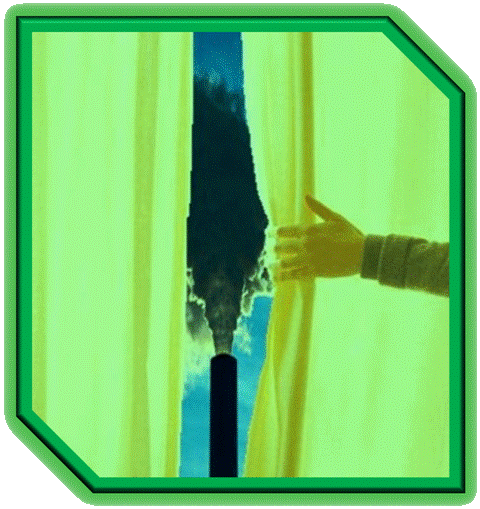
Just what is behind the LEED Green Curtain?
I do my very best to stay off the soap box when it comes to USGBC LEED and IEQ or more specifically IAQ. I usually stay clear of this topic but I just can’t avoid speaking up once again.
LEED v3 for New Construction IEQ Credit 3.2 (page 64)
<https://www.usgbc.org/ShowFile.aspx?DocumentID=8868>
Intent of this credit isn’t to confirm, as you may think, the buildings actual use of the USGBC prescribed Low-Emitting Materials described in IEQ Credit 4.1, but to reduce indoor air quality (IAQ) problems resulting from construction or renovation and to promote the comfort and well-being of construction workers and building occupants. As described in the LEED documents page 66,
It may sound the same but until the IEQ Credit 3.2 becomes a Prerequisite it just a nice thought that looks good in print.
If the requirement did become a Prerequisite the sampling method would then need to be enforced. Yes enforced. The use of a MiniRae PID in a few locations doesn’t even come close the the methods described in the USGBC .Rating System Updated February 2011.
I have been working with LEED from the very beginning and I have provided LEED
3.2 testing in accordance with the Rating System many times. I have provided many LEED and Indoor Air Quality presentations and discussions to USGBC Chapters and National Assoc. of Home Builders Chapters discussing these very issues. The concern with the builders and general contractors is paying for the testing that may actually show that the building has an elevation in one or more of the USGBC Rating System Contaminant Maximum Concentration limits. This actually happens much, much more that most would admit. The result is that most simply ignore if not avoid the 3.2 Credit option 2 Air Sampling.
As a result of this avoidance, due to recent developments, and even though USGBC officially does not endorse one method over another, the USGBC has allowed the use of handheld PID’s to measure TVOC’s. The USGBC does this even though they have been made aware that using photoionization detectors (PID’s) to measure TVOC’s in buildings does not meet the minimum 4-hour sampling period required in the Rating System page 65.
This was an effort on behalf of the USGBC to encourage more contractors to actually pursue the 1 point in the entire USGBC Rating System that can confirm the use of the USGBC prescribed Low-Emitting Materials. Something they are currently in serious need of confirming.
I continue to provide the LEED 3.2 point to my clients who are to actually wanting to earn the credit and confirm the buildings IEQ status using the USGBC required sampling methods.
I refuse to change my sampling protocols to those recently being used by others that require only a snapshot of the indoor environment using handheld PID samplers.
I choose not to provide anything less than the sampling methods that meet the USGBC’s Rating System requirements as described on page 65 of the LEED v3 LEED for New Construction launched on April 27, 2009, including an upgrade of LEED for New Construction under the suite of LEED 2009 rating systems. LEED for New Construction 2009 is served by the Green Building Design and Construction Reference Guide.
Pass or Fail the USGBC set their Standard. I only measure the indoor environment according to their standard and encourage all others to do the same thing.
Go ahead take a peek at what is actually behind the curtain.
The USGBC sampling is described as follows.
OPTION 2. Air Testing
Conduct baseline IAQ testing after construction ends and prior to occupancy using testing protocols consistent with the EPA Compendium of Methods for the Determination of Air Pollutants in Indoor Air and as additionally detailed in the LEED Reference Guide for Green Building Design and Construction, 2009 Edition.
Demonstrate that the contaminant maximum concentration levels listed below are not exceeded:
Contaminant Maximum Concentration
•Formaldehyde 27 parts per billion
•Particulates (PM10) 50 micrograms per cubic meter
•Total volatile organic compounds (TVOCs) 500 micrograms per cubic meter
•4-Phenylcyclohexene (4-PCH)* 6.5 micrograms per cubic meter
•Carbon monoxide (CO) 9 part per million and no greater than 2 parts per million above outdoor levels
For each sampling point where the maximum concentration limits are exceeded, conduct an additional flush-out with outside air and retest the non-compliant concentrations. Repeat until all requirements are met. When retesting non-compliant building areas, take samples from the same locations as in the first test, although it is not required.
Conduct the air sample testing as follows:
•All measurements must be conducted prior to occupancy, but during normal occupied hours with the building ventilation system started at the normal daily start time and operated at the minimum outside air flow rate for the occupied mode throughout the test.
•All interior finishes must be installed, including but not limited to millwork, doors, paint, carpet and acoustic tiles. Movable furnishings such as workstations and partitions should be in place for the testing, although it is not required.
•The number of sampling locations will depend on the size of the building and number of ventilation systems. For each portion of the building served by a separate ventilation system, the number of sampling points must not be less than 1 per 25,000 sq ft or for each contiguous floor area, whichever is larger.
•Include areas with the least ventilation and greatest presumed source strength.
•Air samples must be collected between 3 and 6 feet from the floor to represent the breathing zone of occupants, and over a minimum 4-hour period.
•John P. Lapotaire, CIEC
•Certified Indoor Environmental Consultant
•Microshield Environmental Services, LLC
•www.Microshield-ES.com
Share this with the #IAQS:
Leave a Comment » | Commercial IAQ, Residential IAQ | Tagged: air quality, ASTM, Chapter 468, ciec, Department of Business and Professional Regulation, Florida DBPR, Florida Statutes, HB 4171, healthy home, House Bill 713, IEQ 3.2, IESO, indoor air quality, Indoor Environmental Standard Organization, john lapotaire, John P. Lapotaire, LEED, microshield, mold, mold inspection, mold pretreatment, mold prevention, mold remediation, mold removal, mold testing, Mold-Related Services Licensing Program, new home mold, Part XVI, Residential Mold Assessment, SB 2214, Senate Bill 2234, USGBC | Permalink
Posted by John P. Lapotaire, CIEC
February 4, 2011
 Indoor Air 2011 will be a unique technical program that focuses on major challenges facing the indoor air community. Indoor Air 2011 will highlight future challenges that will reach beyond the traditional scope of indoor research. Examples: indoor air quality and climate change, the long-term implications of green building design on indoor air quality, indoor air chemistry and health, connections between local and regional outdoor air quality and the indoor environment, and emerging contaminants.
Read about the planning of Indoor Air 2011, now underway.
Download Conference Information and Preliminary Call for Abstracts
Important Dates:
Abstract submission: August 1 – October 8, 2010
Paper submission deadline: January 15, 2011
Final paper submission deadline: March 1, 2011
Registration open: December, 2010
Read about Student Opportunities.
More information about this event…
ISIAQ is an international, independent, multidisciplinary,scientific, non-profit organization whose purpose is to support thecreation of healthy, comfortable and productive indoor environments. Westrongly believe this is achievable by advancing the science andtechnology of indoor air quality and climate as it relates to indoorenvironmental design, construction, operation and maintenance, airquality measurement and health sciences.
As a Society, our major role is to facilitate internationaland interdisciplinary communication and information exchange bypublishing and fostering publication on indoor air quality and climate.We organize, sponsor and support initiatives such as meetings,conferences, and seminars on indoor air quality and climate; and wedevelop, adapt and maintain guidelines for theimprovement of indoor air quality and climate. We also cooperatewith government and other agencies and societies with interests in theindoor environment and climate.
To find out more about us, please click here.
New Web Site – Differences to note
•John P. Lapotaire, CIEC
•Certified Indoor Environmental Consultant
•Microshield Environmental Services, LLC
•www.Microshield-ES.com
Share this with the #IAQS:
Leave a Comment » | Commercial IAQ, Residential IAQ | Tagged: air quality, ASTM, Chapter 468, ciec, Department of Business and Professional Regulation, Florida DBPR, Florida Statutes, HB 4171, HB 5005, HB 5007, healthy home, House Bill 713, IEQ 3.2, IESO, indoor air quality, Indoor Environmental Standard Organization, john lapotaire, John P. Lapotaire, LEED, microshield, mold, mold inspection, mold pretreatment, mold prevention, mold remediation, mold removal, mold testing, Mold-Related Services Licensing Program, new home mold, Part XVI, PCB BCAS 11-01, Residential Mold Assessment, SB 1244, Senate Bill 2234, USGBC | Permalink
Posted by John P. Lapotaire, CIEC
February 4, 2011
 WE MADE IT BETTER!
RIA’s 2011 Annual Convention has been given a facelift, maximizing your learning and networking opportunities.
Thanks to the efforts of the Convention Planning Task Force, this new structure provides attendees with the opportunity to participate in more interactive and extended 90-minute sessions, allowing presenters and attendees to move beyond the simple ABC’s of topics and get into the heart of matters, bringing the concept of networking to a new level.

Click here to download a Registration Form.
Click here for a copy of the 2011 Convention Brochure.
Share this with the #IAQS:
Leave a Comment » | Commercial IAQ, Residential IAQ | Tagged: air quality, ASTM, Chapter 468, ciec, Department of Business and Professional Regulation, Florida DBPR, Florida Statutes, HB 4171, HB 5005, HB 5007, healthy home, House Bill 713, IEQ 3.2, IESO, indoor air quality, Indoor Environmental Standard Organization, john lapotaire, John P. Lapotaire, LEED, microshield, mold, mold inspection, mold pretreatment, mold prevention, mold remediation, mold removal, mold testing, Mold-Related Services Licensing Program, new home mold, Part XVI, PCB BCAS 11-01, Residential Mold Assessment, SB 1244, Senate Bill 2234, USGBC | Permalink
Posted by John P. Lapotaire, CIEC
February 4, 2011
 March 21- March 24, 2011
Hard Rock Hotel & Casino, Las Vegas, Nevada
NADCA’s Annual Meeting & Exposition represents the most productive and efficient opportunity for members of the HVAC system cleaning industry to connect – all in one place, all at one time. Annual Meeting attendees include the decision makers for our industry, and they play a central role in the purchasing process for their companies.
As the main event in the global HVAC Inspection, Maintenance and Restoration Industry, NADCA’s 2011 Annual Meeting & Exposition is a the best opportunity to gain knowledge in your field and meet with other members of the Association.
We hope you will join us in Las Vegas, Nevada, 2011 for this cutting-edge event!
Come and experience the Hard Rock Hotel & Casino’s reputation for being one of the best hotspots in Sin City. The property’s signature party attitude along with a jolt of sexy sophistication can be felt the moment you walk through the door. A boutique-style hotel according to Vegas standards, the Hard Rock offers a fabulous casino, poker lounge, numerous cocktail lounges, Rock Spa Fitness Center and various restaurants.
During your stay, dance the night away in Vanity or catch a show at The Joint. Dine at Nobu, recognized for its groundbreaking modern and authentic Japanese cuisine or at Rare 120 for a fabulous steak. For the more budget-conscience, stop by Mr. Lucky’s for standard diner fair, Johnny Smalls for small plates and shareable dishes or Pink Taco for traditional Mexican dishes with a California spin. In your free time, lounge by pool, a tropical paradise, home of the famous Rehab pool party. Browse the retail stores for that special souvenir of your stay at the Hard Rock Hotel & Casino.
Fly into McCarran International Airport (LAS). The hotel is 10-15 minutes from the airport and cab fare is approximately $10.
HOTEL RESERVATIONS
Reservations can be made by contacting the Hard Rock Hotel & Casino directly at (702) 693-5000, toll free (800) 473-7625. When making your room reservations, please be sure to identify yourself as attending the NADCA 2011 Annual Meeting & Exposition to receive the discounted group rate. Rooms are located in the Paradise Tower, one of the hotel’s newest towers.
$126 single/double – NOTE: Room rate includes resort fee.
Share this with the #IAQS:
Leave a Comment » | Commercial IAQ, Residential IAQ | Tagged: air quality, ASTM, Chapter 468, ciec, Department of Business and Professional Regulation, Florida DBPR, Florida Statutes, HB 4171, HB 5005, HB 5007, healthy home, House Bill 713, IEQ 3.2, IESO, indoor air quality, Indoor Environmental Standard Organization, john lapotaire, John P. Lapotaire, LEED, microshield, mold, mold inspection, mold pretreatment, mold prevention, mold remediation, mold removal, mold testing, Mold-Related Services Licensing Program, new home mold, Part XVI, PCB BCAS 11-01, Residential Mold Assessment, SB 1244, Senate Bill 2234, USGBC | Permalink
Posted by John P. Lapotaire, CIEC
February 4, 2011
 Buck Sheppard, ASCS
NADCA President on Dateline Duct Cleaning Expose
This week HVAC cleaning veteran Buck Sheppard will discuss HVAC cleaning issues and the recent Dateline NBC expose on duct cleaning bait and switch scams. The news release from NADCA states “NADCA participated in an undercover investigation by Chris Hanson and Dateline NBC to expose companies that use bait and switch tactics to take advantage of consumers. The investigation culminated in a segment that aired January 30, 2011, featuring NADCA President Buck Sheppard as the industry expert. After witnessing one of the scam operators in action, Sheppard was taken aback.”
Join IAQ Radio every Friday at noon to LEARN MORE about HVAC cleaning, bait and switch scams, what can be done to stop them and more on IAQ Radio!
Join Now
•John P. Lapotaire, CIEC
•Certified Indoor Environmental Consultant
•Microshield Environmental Services, LLC
•www.Microshield-ES.com
Share this with the #IAQS:
Leave a Comment » | Commercial IAQ, Residential IAQ | Tagged: air quality, ASTM, Chapter 468, ciec, Department of Business and Professional Regulation, Florida DBPR, Florida Statutes, HB 4171, HB 5005, HB 5007, healthy home, House Bill 713, IEQ 3.2, IESO, indoor air quality, Indoor Environmental Standard Organization, john lapotaire, John P. Lapotaire, LEED, microshield, mold, mold inspection, mold pretreatment, mold prevention, mold remediation, mold removal, mold testing, Mold-Related Services Licensing Program, new home mold, Part XVI, PCB BCAS 11-01, Residential Mold Assessment, SB 1244, Senate Bill 2234, USGBC | Permalink
Posted by John P. Lapotaire, CIEC
February 4, 2011
 What can I do now to prepare myself for licensure?
Because Chapter 468, Part XVI, Florida Statutes providing for licensure and grandfathering did not go into effect until July 1, 2010, the department did not have authority to approve any courses or examinations prior to that date. We have approved the Council for Accredited Certification (ACAC) exams and are now accepting course applications. To access the applications, click this APPLY link (or use the APPLY button on the navigation menu above).
To avoid the time and expense involved with taking a potentially unapproved course, it is recommended that persons wishing to become licensed should wait for the department’s approval of course applications before taking any steps toward licensing.
•John P. Lapotaire, CIEC
•Certified Indoor Environmental Consultant
•Microshield Environmental Services, LLC
•www.Microshield-ES.com
Share this with the #IAQS:
Leave a Comment » | Commercial IAQ, Residential IAQ | Tagged: air quality, ASTM, Chapter 468, ciec, Department of Business and Professional Regulation, Florida DBPR, Florida Statutes, HB 4171, HB 5005, HB 5007, healthy home, House Bill 713, IEQ 3.2, IESO, indoor air quality, Indoor Environmental Standard Organization, john lapotaire, John P. Lapotaire, LEED, microshield, mold, mold inspection, mold pretreatment, mold prevention, mold remediation, mold removal, mold testing, Mold-Related Services Licensing Program, new home mold, Part XVI, PCB BCAS 11-01, Residential Mold Assessment, SB 1244, Senate Bill 2234, USGBC | Permalink
Posted by John P. Lapotaire, CIEC
 The American Council for Accredited Certification (ACAC) requested that Florida Department of Business and Professional Regulation (DBPR) give guidance for those seeking Florida licensing for mold assessor or remediation – who missed the deadline for grandfathering – but have previously taken an ACAC certification examination. Their response:

















 Indoor Air Quality Solutions, IAQS