Workplace Air Quality: Sometimes Dust Is The Problem

July 7, 2012

July 03, 2012|By BARBARA NAGY, Conn. Health I-Team Writer, The Hartford Courant

The office workers, police officers, social workers and court employees Brian Sauvageau talks with have reached a breaking point.

They might come to work feeling OK, but soon develop chronic coughs and sneezing, scratchy throats, itchy eyes and even headaches. No one can find the mold they think is causing their symptoms. Unsympathetic colleagues say they feel just fine, so there can’t be anything wrong.

The problem is surprisingly simple, said Sauvageau, an occupational hygienist with CONN OSHA — the state Department of Labor’s Division of Occupational Safety and Health.

The culprit isn’t mold. It’s dust — the tiny particles of fiber, skin scales, insect parts, pollen, cobwebs and dirt that settle on surfaces everywhere.

Indoor air quality is a growing issue. Belt-tightening has reduced custodial staff and budgets. Time-pressed workers aren’t enthusiastic about cleaning their workspaces. And the growing number of extreme weather events makes for more leaks and flooding. Poor air circulation and blocked heating systems aggravate the problem.

The impact is staggering. The Environmental Protection Agency estimates that poor indoor air quality costs tens of billions of dollars annually in lost productivity and added health care. One study by the Lawrence Berkeley National Laboratory in 2010 concluded that improving workplace environments could save businesses $300 per worker each year.

In the past 14 months, Sauvageau has investigated 20 complaints filed by people who thought that mold was compromising the air quality in their workplaces. Of hundreds of samples that he collected, only one had mold levels that were considered significant.

“It seems invariably I find dust,” Sauvageau said. “In some cases it’s extremely bad — years of accumulation.”

Solutions require everyone in an office to work together in ways they haven’t had to do before, said Paula Schenck, assistant director of the Center for Indoor Environments and Health at the University of Connecticut Health Center. “It takes a team,” she said.

Workers, their union representatives, building owners, managers and cleaning staff all have to buy into the solution, said Ken Tucker, director of CONN OSHA.

“We do know air quality is a growing problem,” said Larry Dorman, a spokesman for Council 4 of the American Federation of State, County and Municipal Employees in New Britain. “It’s one of the hidden dangers of the workplace.”

The union has worked with the state and with several municipalities on air quality in buildings ranging from schools in Bridgeport to police headquarters in Hartford. Workers are often unaware of the hazards. “And employers don’t tend to be proactive on issues like that. Sometimes it’s not their fault,” he said, noting that the state leases much of its office space.

Often, employees don’t realize that there’s more to air quality than mold levels.

Mold can be highly hazardous, Schenck emphasized. But people should look first for more obvious culprits if they don’t smell mold, can’t see water stains on walls or ceilings, and aren’t aware of any dampness or water from leaks, seepage or humidity.

“People go nuts about mold because it’s been so publicized, and I appreciate the concern,” Schenck said. “I always talk about three things: ventilation, moisture and dirt/dust.” Mold, she said, is always related to a water problem. “What mold tells you is there’s water where it shouldn’t be, and a biological material is growing.”

Dust is such a prevalent problem, Sauvageau made it the topic of an article in CONN OSHA’s May newsletter ( http://www.ctdol.state.ct.us/osha/2012/qtly-may12.htm). There is no doubt about its irritating effects.

People have different tolerances for the mites, pollen and spores in dust that builds up. Those who are sensitive have allergic reactions. Those who aren’t might think that nothing is wrong. The location of people’s workspaces can also aggravate their symptoms.

None of this is a surprise to Ray Cassarino, owner of Cassarino Commercial Cleaning in Wethersfield.

“I go into an office and the women are sneezing, especially at the reception desk. It’s a haven for dust,” he said. Cassarino lifts the phones, looks at the wires behind the computers and checks under small equipment like fax machines. He can tell how long the dust has been there by how it clumps up. “It’s sick what I find,” he said.

Symptoms like itchy eyes, a runny nose and headaches can be caused inadequate ventilation and by dust and dirt because the respiratory system is being irritated. People feel better once they leave the environment, Schenck said. Asthma-like symptoms, such as difficulty breathing, are harder to diagnose as building-related. Breathing can be affected by a wide range of irritants — including mold. Prolonged exposure to some of the contaminants in dust can also cause asthma-like symptoms.

Sensitivity and exposure make all the difference. Schenck recalls one woman who complained that the vent above her desk was blowing air onto her. The custodian, trying to be helpful, diverted the flow with a piece of plastic. The woman became ill and couldn’t understand why — after all, the air wasn’t blowing on her anymore. A UConn hygienist took a “wipe” sample from the plastic and discovered that it was loaded with bacteria and mold.

When Sauvageau goes into workplaces, he finds congested offices and desks loaded with clutter. Storage spaces are too small, so supplies and equipment are piled in work areas. Heating and air conditioning equipment isn’t maintained and cleaned. The walls and floors behind heating units and desks are filthy. Furniture obstructs ventilation or makes it hard for the cleaning staff to do its work. People don’t want anything on their desks or shelves moved, which also makes cleaning difficult.

Some buildings — hospitals, factories and schools, for example — are now courthouses, town halls and offices. They weren’t designed for that use. Balancing the ventilation and keeping the space clean can be a tremendous challenge.

Cassarino said that many companies have cut back on spending for custodial services. They have unrealistic expectations of how much can be done in a limited time with a limited budget.

“It’s a bidding war,” Cassarino said. He suggests that businesses and building owners carefully evaluate not only cost, but the level of service they’ll receive.

Sauvageau wants employers to realize that poor air quality can affect employee attendance, productivity and morale. Some of the people who called CONN OSHA were facing disciplinary actions for missing work too often because of their illnesses. They had been diagnosed with sinus infections, bronchitis, allergies and asthma.

Building managers have a hard time because people like different temperatures and have different tolerances for air flow. Generally, Schenck said, it’s not good to cut down on ventilation. That lets contaminants accumulate. She also discourages the use of scented air fresheners because they irritate some people.

That, she said, is the kind of “joint responsibility” that’s required to create a healthy environment. For their part, workers need to be vigilant about their own spaces, and they need to make sure that what they do doesn’t diminish air quality for their co-workers.

If you are having problems, Schenck and Sauvageau suggest you:

• Act promptly, because prolonged exposure can lead to chronic symptoms.

• Start by defining and tracking your symptoms. What time of day do you have them, and where are you?

• Try to correct the problem through your supervisor and union representativess first. Consider breaking down the office and doing a thorough cleaning. When dust is the problem, symptoms often improve immediately.

This story was reported under a partnership with the Connecticut Health I-Team (www.c-hit.org).


• John P. Lapotaire, CIEC
• Certified Indoor Environmental Consultant
• Microshield Environmental Services, LLC
www.Microshield-ES.com


The Design Build Industry vs. The Remediation Industry

May 8, 2012

The oversight elements of the design build process that most fail to recognize, and are somewhat equivalent to the separation between assessment and remediation, are as follows. (That is unless you are in a state that requires nothing to build a home.)

Plan Review and Permit Application (Design Build Oversight pre-construction)

First and well before you actually begin bending nails, you will need either a Licensed Architect or a Licensed Engineer to review and approve your design before you can proceed to the next step.

You’ll then need to submit your plans to the City Building Department where the plans will again be reviewed and approved before you can proceed to the next step.

That alone eliminates any comparison between the unlicensed mold assessors providing an assessment on a home that he intends to remediate.

At this point and again well before you start bending nails the city will require most if not all of the following:

• Completed building permit application
• Site plan
• Footing plan
• Foundation plan
• Floor Plan
• Building Elevations
• Header schedule
• Framing Plan
• Truss and structural specifications
• Plumbing, Electrical and Mechanical Plans
• Engineered Septic plan
• Window and Door schedule
• Manufacturer’s Installation Procedures
• Energy Compliance Calculations

I pulled that list up from City of Rome just to provide an example of the hoops a design build contractor must jump through prior to the actual construction of the design build project.

The equivalent of the Mold Assessment.

Once you actually receive the Building Permit you must then receive the necessary inspections that are required.

Residential Inspection Schedule (Design Build Oversight during construction)
All applicable inspections listed below are mandatory and must be completed by a City of Rome Building Inspector prior to use or occupancy.

  1. FOOTINGS / POSTS
  2. FOUNDATION / PERIMETER DRAINS
  3. CONCRETE / UNDER SLAB
  4. ROUGH IN ELECTRICAL
  5. ROUGH IN PLUMBING
  6. FRAMING
  7. CHIMNEYS & FIREPLACES
  8. INSULATION
  9. FIRE SEPARATION
  10. BUILDING SYSTEMS
  11. FINAL ELECTRICAL & PLUMBING INSPECTIONS
  12. FINAL BUILDING INSPECTION
    Smoke Detector / Carbon Monoxide Detectors
    Interior and Exterior coverings in place
    Windows and doors operational.
    Railing / staircases / landings in place
    All mechanical systems operational
    911 House Number in Place

The equivalent of the Post Remediation Verification Inspection (Design Build Oversight post-construction)

There is one hell of a lot of oversight involved in the Design Build industry and unless there is separation between assessment and remediation there are none thats right 0 in the Mold industry.

The comparison between the Design Build industry and the Mold Remediation industry, Not a fair apples to apples comparison of industries or industry oversight.

The Mold Remediation industry would require only 2 points of oversight.

  1. The Independent Mold Assessment prior to mold remediation (Mold Remediation Oversight pre-remediation)
    Here in Florida by a State Licensed Mold Assessor when the mold affected area is greater than 10 square feet. The Mold Remediator cannot perform or offer to perform any mold remediation to a structure on which the mold remediation or the mold remediation’s company provided a mold assessment within the last 12 months.
  2. And the Independent Post Remediation Verification Inspection after mold remediation (Mold Remediation Oversight post-remediation)
    Here in Florida by a State Licensed Mold Assessor that cannot perform or offer to perform any mold assessment to a structure on which the mold assessor or the mold assessors company provided mold remediation within the last 12 months.

It just seems to be much easier than many want to make it out to be.

History and experience tell me that the remediator who skips the initial step of an assessment from a licensed assessor usually finds it just as easy to skip other steps durring remediation and usually also skip the last step of independent post remediation verification from a licensed assessor.

• John P. Lapotaire, CIEC
• Certified Indoor Environmental Consultant
• Microshield Environmental Services, LLC
www.Microshield-ES.com


IICRC board of directors votes to return to original name “The IICRC!”

March 19, 2012

The Institute of Inspection, Cleaning and Restoration Certification (IICRC) announced today that the Board of Directors has voted to return the formal name of the organization to the IICRC, keeping cleantrust as the service mark of the organization. The full details surrounding the transition will be announced at the Certification Council on April 22, 2012.

“We’ve heard the feedback from registrants over the past few months and considered many options,” said IICRC Chairman Darrell Paulson. “Ultimately, the board has decided to use the IICRC as the main brand and use the cleantrust as a service mark. This allows us to honor the 40-year history of our organization, while also working to gain more awareness with end-users. We are still working through all of the details and we thank the inspection, cleaning and restoration community for their patience during this process.”

The IICRC will retain the use of the updated logo, which represents the strength and breadth of the organization. The shape reflects a globe, symbolizing the IICRC’s international status. And like the organization, the logo is made up of many different parts that are working together in a unified pattern, depicting an organization that is deep in knowledge.

“Together, this powerful brand combination of IICRC and the cleantrust, will enable us to constantly work towards our mission of identifying and promoting an international standard of care that establishes and maintains the health, safety and welfare of the built environment,” said Paulson.

Updated materials with the new IICRC logo and an updated design will gradually rollout in the coming months, including ID cards, brochures, introductory video and a new website.

• John P. Lapotaire, CIEC
• Certified Indoor Environmental Consultant
• Microshield Environmental Services, LLC
www.Microshield-ES.com


Does the Home you want to rent have Hidden IAQ Indoor Air Quality Issues?

March 13, 2012

Microshield IAQ Landlord TenantIn today’s volatile and uncertain real estate market, many Florida families who would otherwise purchase a home are now turning to renting homes, condos, and apartments. For many, renting provides them the opportunity to rebound from their own dad real estate experience and for others it’s an opportunity to move into a property when the market is uncertain and financing may not be readily available.

It’s important for potential tenants to do their homework with regards to potential indoor environmental concerns at a property they are considering renting. This may include talking with the landlord, researching the building’s prior use and hiring an IEP Indoor Environmental Professional to perform an Indoor Environmental Assessment.


If you are in the market for a new rental home ask questions.  Landlords are bound to deal truthfully when discussing the property and any past issues.  Ask the Landlord about issues dealing with past leaks, flooding events, mold, sewage contamination, asbestos, lead, radon and vapor intrusion issues.

These questions and answers are all part of the IEP’s interview and will be a part of the written report you will receive if you decide to hire an IEP.  If you decide that you are ready to hire an IEP there are questions that you should ask to ensure you are receiving the best possible assessment of your family’s new home.

A professionally prepared Indoor Environmental or Indoor Air Quality Report should clearly answer the following questions:

  1. Is there an Indoor Environmental or Indoor Air Quality Concern in your home?
  2. What is the cause?
  3. Where is the source?
  4. What containment and cleaning is needed?
  5. What home repairs are needed to prevent future problems?

If you suspect that there is an indoor air problem in the home or office involving any unknown Allergens, Asthma Triggers, or Mold, in addition to the visual assessment of your home you may also need to know the following:

  1. Is Indoor Environmental Sampling Necessary?
  2. If Sampling is necessary why?
  3. Where? And
  4. Which Type of Sampling is recommended?

The Visual Inspection should provide a Sampling Plan specific to the findings in your home or office so you can then determine;

  1. If there is a mold, allergen, asthma trigger, or similar environmental problem in the home or office?
  2. If there is a problem, where is it and how big is it?
  3. What does the lab work indicate about the level of risk to occupants or workers?
  4. Are we looking at a “cosmetic-only” concern?
  5. What is the extent of remediation or cleaning necessary, and
  6. based on the lab results, what is the level of containment and care needed?
  7. What needs to be changed or repaired on the home or office so that problems don’t recur? And
  8. after the cleanup has been completed, was it proper and complete?

A professionally prepared Indoor Environmental Assessment should also an education on the 7 Seven Principles of Healthy Homes

Dry: Damp houses provide a nurturing environment for mites, roaches, rodents, and molds, all of which are associated with asthma.

Clean: Clean homes help reduce pest infestations and exposure to contaminants.

Pest-Free: Recent studies show a causal relationship between exposure to mice and cockroaches and asthma episodes in children; yet inappropriate treatment for pest infestations can exacerbate health problems, since pesticide residues in homes pose risks for neurological damage and cancer.

Safe: The majority of injuries among children occur in the home. Falls are the most frequent cause of residential injuries to children, followed by injuries from objects in the home, burns, and poisonings.

Contaminant-Free: Chemical exposures include lead, radon, pesticides, volatile organic compounds, and environmental tobacco smoke. Exposures to asbestos particles, radon gas, carbon monoxide, and second-hand tobacco smoke are far higher indoors than outside.

Ventilated: Studies show that increasing the fresh air supply in a home improves respiratory health.

Maintained: Poorly-maintained homes are at risk for moisture and pest problems. Deteriorated lead-based paint in older housing is the primary cause of lead poisoning, which affects some 240,000 U.S. children.

• John P. Lapotaire, CIEC
• Certified Indoor Environmental Consultant
• Microshield Environmental Services, LLC
www.Microshield-ES.com


Who’s Required to have a Florida Mold License?

March 13, 2012

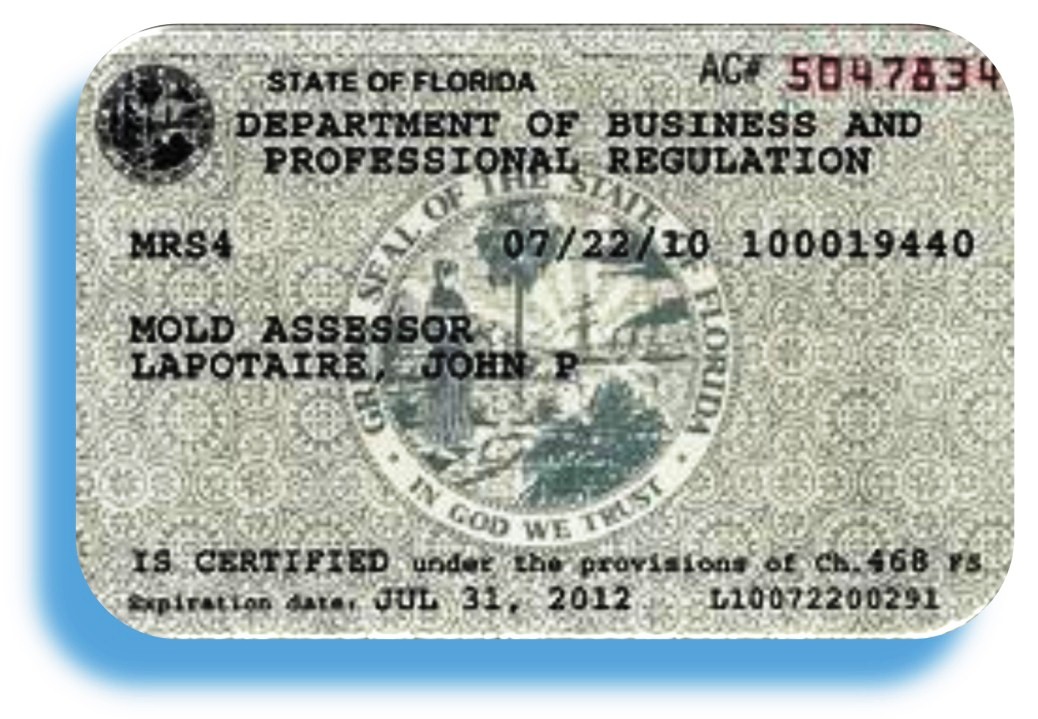
John Lapotaire CIEC Florida Licensed Mold AssessorI am often asked who in the State of Florida needs a license to preform Mold Assessments and/or Mold Remediation. At the top of the list are General Contractors, Home Inspectors, Duct Cleaners, and Air Conditioning Contractors.

Let’s start with why the state decided to require a license?

The Florida Legislature finds it necessary in the interest of the public safety and welfare, to prevent damage to real and personal property, to avert economic injury to the residents of this state, and to regulate persons and companies that hold themselves out to the public as qualified to perform mold-related services.

Now let’s get to the individuals that believe they don’t require a mold license.  First home inspectors and the answer is yes, a home inspector requires a mold assessor’s license to conduct a mold inspection and yes the collection of samples to identify the presence of mold requires a mold assessor’s license.

As for the duct cleaners and air conditioning contractors, the answer is also yes.  Anyone removing or identifying mold in a home or business requires a mold assessment or mold remediation license and that includes those in the air conditioning and duct cleaning business.

There are exceptions to the law and those are listed below. Which brings us to the general contractor?  Does the GC need a mold license? No. As the law currently states the prohibitions in the law do not apply to a Division 1 contractor as stated below.

468.8419 Prohibitions; penalties.—

(1) A person may not:

(d) Perform or offer to perform any mold assessment to a structure on which the mold remediator or the mold remediator’s company provided a mold remediation within the last 12 months. This paragraph does not apply to a certified contractor who is classified in s. 489.105(3) as a Division I contractor. However, the department may adopt rules requiring that, if such contractor performs the mold remediation and offers to perform the mold assessment, the contract for mold assessment provided to the homeowner disclose that he or she has the right to request competitive bids.

(d) Perform or offer to perform any mold remediation to a structure on which the mold assessor or the mold assessor’s company provided a mold assessment within the last 12 months. This paragraph does not apply to a certified contractor who is classified in s. 489.105(3) as a Division I contractor. However, the department may adopt rules requiring that, if such contractor performs the mold assessment and offers to perform the mold remediation, the contract for mold remediation provided to the homeowner disclose that he or she has the right to request competitive bids.

You may want to ensure that your GC is actually trained in Mold Assessment or Mold Remediation before you hire him. Currently the law requires nothing in the form of mold assessment or mold remediation training for a GC.

A Florida Licensed Mold Assessor or Mold Remediator must first take and pass one of the examinations approved by the department and administered by the American Council for Accredited Certification (ACAC).

The ACAC has certifications for both the Assessor and Remediator, such as the CIEC Council-certified Indoor Environmental Consultant Required: 8 years’ experience consulting on indoor environmental issues including asbestos, lead, HVAC, building science, chemicals, mold and microbial contamination, or the CMC Council-certified Microbial Consultant Required: 8 years’ experience in designing and conducting microbial sampling regimens, or the CMRS Council-certified Microbial Remediation Supervisor Required: 5 years’ experience remediating microbial issues in the indoor environment, and the CMR Council-certified Microbial Remediator Required: 2 years, experience remediating microbial issues in the indoor environment.

I would much prefer that my Mold Assessor or Mold Remediator be Licensed by the state and have the ACAC qualifications.

Mold assessment is a process performed by a mold assessor that includes the physical sampling and detailed evaluation of data obtained from a building history and inspection to formulate an initial hypothesis about the origin, identity, location, and extent of amplification of mold growth of greater than 10 square feet.

Mold remediation is the removal, cleaning, sanitizing, demolition, or other treatment, including preventive activities, of mold or mold-contaminated matter of greater than 10 square feet that was not purposely grown at that location; however, such removal, cleaning, sanitizing, demolition, or other treatment, including preventive activities, may not be work that requires a license under Chapter 489, Florida Statutes, unless performed by a person who is licensed under that chapter or the work complies with that chapter.

These items are offered as examples of services you do need to hire a person with a Florida license and services you do not need to hire a person with a Florida license. The list is not all inclusive. If you have specific questions, please contact the department at 850.487.1395 or review the rules for the profession at www.myfloridalicense.com. You should also check with your county or city to learn whether or not a local business tax receipt or certificate of competency is required for services that do not require a state license. Please visit our Unlicensed Activity page to learn more about how you can help us combat Unlicensed Activity.

Needs a License Does not need a License
Advertising or representing oneself to be a Mold Assessor or Remediator. A residential property owner who performs mold assessment on his or her own property.
Taking samples for purposes of testing for the presence of mold. A person who performs mold assessment on property owned or leased by the person, the person’s employer, or an entity affiliated with the person’s employer through common ownership. This exemption does not apply if the person, employer, or affiliated entity engages in the business of performing mold assessment for the public.
A person who performs mold assessment on property operated or managed by the person’s employer or an entity affiliated with the person’s employer through common ownership. This exemption does not apply if the person, employer, or affiliated entity engages in the business of performing mold assessment for the public.
A person working solely as an officer or employee of a governmental entity.


Here are some Florida Mold License FAQ’s Frequently Asked Questions and Answers.

What are the statutes and rules that govern the mold-related services Profession?

Chapter 468, Part XVI of the Florida Statutes and Rule 61-31 of the Florida Administrative Code.

What are the statutes and rules that govern the Home Inspection Profession?

Chapter 468 Part XV of the Florida Statutes and Rule 61-30 of the Florida Administrative Code.

Where can I obtain the laws and rules of the profession?

The laws and rules may be obtained on the website at http://www.MyFloridaLicense.com > Our Businesses & Professions > the license you are looking for > Statutes and Rules.

If you need further assistance, you may call the Customer Contact Center at 850.487.1395.

If my company does both Mold Assessments and Mold Remediations, will I be required to get two (2) licenses (one for Mold Assessor and one for Mold Remediator?

Yes, in addition, please note Section 468.8419(1)(d), F.S., provides that an assessor may not “perform or offer to perform any remediation to a structure on which the mold assessor or the assessor’s company provided a mold assessment within the last 12 months.” Section 468.8419(2)(d), F.S., provides that a remediator may not “perform or offer to perform any assessment to a structure on which the mold remediator or the remediator’s company provided a mold remediation within the last 12 months.”

Will there be additional requirements by DBPR to have an “applicators” license if the mold remediator applies chemicals to contaminated surfaces during a remediation?

No, please see the definition of remediators as it allows the remediator to treat and do preventive activities.

Is there a provision that would allow those licensed by the Construction Industry Licensing Board (CILB) to perform mold related services as long as they stay within the scope of their current licenses?

Yes, Section 468.841 F.S., exempts persons from the provisions of Chapter 468, Part XVI, when acting within their authorized scope of practice as licensed under Federal, state or local codes or statutes. Any person acting on this exemption must not hold himself or herself out for hire as a licensed assessor or remediator or any title implying licensure under Chapter 468, Part XVI.

468.8419 Prohibitions; penalties.—

(1) A person may not:

(a) Effective July 1, 2011, perform or offer to perform any mold assessment unless the mold assessor has documented training in water, mold, and respiratory protection under s. 468.8414(2).

(b) Effective July 1, 2011, perform or offer to perform any mold assessment unless the person has complied with the provisions of this part.

(c) Use the name or title “certified mold assessor,” “registered mold assessor,” “licensed mold assessor,” “mold assessor,” “professional mold assessor,” or any combination thereof unless the person has complied with the provisions of this part.

(d) Perform or offer to perform any mold remediation to a structure on which the mold assessor or the mold assessor’s company provided a mold assessment within the last 12 months. This paragraph does not apply to a certified contractor who is classified in s. 489.105(3) as a Division I contractor. However, the department may adopt rules requiring that, if such contractor performs the mold assessment and offers to perform the mold remediation, the contract for mold remediation provided to the homeowner disclose that he or she has the right to request competitive bids.

(e) Inspect for a fee any property in which the assessor or the assessor’s company has any financial or transfer interest.

(f) Accept any compensation, inducement, or reward from a mold remediator or mold remediator’s company for the referral of any business to the mold remediator or the mold remediator’s company.

(g) Offer any compensation, inducement, or reward to a mold remediator or mold remediator’s company for the referral of any business from the mold remediator or the mold remediator’s company.

(h) Accept an engagement to make an omission of the assessment or conduct an assessment in which the assessment itself, or the fee payable for the assessment, is contingent upon the conclusions of the assessment.

(2) A mold remediator, a company that employs a mold remediator, or a company that is controlled by a company that also has a financial interest in a company employing a mold remediator may not:

(a) Perform or offer to perform any mold remediation unless the remediator has documented training in water, mold, and respiratory protection under s. 468.8414(2).

(b) Perform or offer to perform any mold remediation unless the person has complied with the provisions of this part.

(c) Use the name or title “certified mold remediator,” “registered mold remediator,” “licensed mold remediator,” “mold remediator,” “professional mold remediator,” or any combination thereof unless the person has complied with the provisions of this part.

(d) Perform or offer to perform any mold assessment to a structure on which the mold remediator or the mold remediator’s company provided a mold remediation within the last 12 months. This paragraph does not apply to a certified contractor who is classified in s. 489.105(3) as a Division I contractor. However, the department may adopt rules requiring that, if such contractor performs the mold remediation and offers to perform the mold assessment, the contract for mold assessment provided to the homeowner disclose that he or she has the right to request competitive bids.

(e) Remediate for a fee any property in which the mold remediator or the mold remediator’s company has any financial or transfer interest.

(f) Accept any compensation, inducement, or reward from a mold assessor or mold assessor’s company for the referral of any business from the mold assessor or the mold assessor’s company.

(g) Offer any compensation, inducement, or reward to a mold assessor or mold assessor’s company for the referral of any business from the mold assessor or the mold assessor’s company.

(3) Any person who violates any provision of this section commits:

(a) A misdemeanor of the second degree for a first violation, punishable as provided in s. 775.082 or s. 775.083.

(b) A misdemeanor of the first degree for a second violation, punishable as provided in s. 775.082 or s. 775.083.

(c) A felony of the third degree for a third or subsequent violation, punishable as provided in s. 775.082, s. 775.083, or s. 775.084.


468.841 Exemptions.—

(1) The following persons are not required to comply with any provisions of this part relating to mold assessment:

(a) A residential property owner who performs mold assessment on his or her own property.

(b) A person who performs mold assessment on property owned or leased by the person, the person’s employer, or an entity affiliated with the person’s employer through common ownership, or on property operated or managed by the person’s employer or an entity affiliated with the person’s employer through common ownership. This exemption does not apply if the person, employer, or affiliated entity engages in the business of performing mold assessment for the public.

(c) An employee of a mold assessor while directly supervised by the mold assessor.

(d) Persons or business organizations acting within the scope of the respective licenses required under part XV of this chapter, chapter 471, part I of chapter 481, chapter 482, or chapter 489 1are acting on behalf of an insurer under part VI of chapter 626, or are persons in the manufactured housing industry who are licensed under chapter 320, except when any such persons or business organizations hold themselves out for hire to the public as a “certified mold assessor,” “registered mold assessor,” “licensed mold assessor,” “mold assessor,” “professional mold assessor,” or any combination thereof stating or implying licensure under this part.

(e) An authorized employee of the United States, this state, or any municipality, county, or other political subdivision, or public or private school and who is conducting mold assessment within the scope of that employment, as long as the employee does not hold out for hire to the general public or otherwise engage in mold assessment.

(2) The following persons are not required to comply with any provisions of this part relating to mold remediation:

(a) A residential property owner who performs mold remediation on his or her own property.

(b) A person who performs mold remediation on property owned or leased by the person, the person’s employer, or an entity affiliated with the person’s employer through common ownership, or on property operated or managed by the person’s employer or an entity affiliated with the person’s employer through common ownership. This exemption does not apply if the person, employer, or affiliated entity engages in the business of performing mold remediation for the public.

(c) An employee of a mold remediator while directly supervised by the mold remediator.

(d) Persons or business organizations that are acting within the scope of the respective licenses required under chapter 471, part I of chapter 481, chapter 482, chapter 489, or part XV of this chapter, are acting on behalf of an insurer under part VI of chapter 626, or are persons in the manufactured housing industry who are licensed under chapter 320, except when any such persons or business organizations hold themselves out for hire to the public as a “certified mold remediator,” “registered mold remediator,” “licensed mold remediator,” “mold remediator,” “professional mold remediator,” or any combination thereof stating or implying licensure under this part.

(e) An authorized employee of the United States, this state, or any municipality, county, or other political subdivision, or public or private school and who is conducting mold remediation within the scope of that employment, as long as the employee does not hold out for hire to the general public or otherwise engage in mold remediation.


• John P. Lapotaire, CIEC
• Certified Indoor Environmental Consultant
• Microshield Environmental Services, LLC
www.Microshield-ES.com


USGBC LEED public comment period open!!!

March 12, 2012

Microshield IAQ LEED USGBCThe U.S. Green Building Council (USGBC) LEED 2012 draft focuses on providing a simple-to-use, technically advanced, and more robust system.

The U.S. Green Building Council (USGBC) has announced that the third public comment period for the proposed 2012 update to its LEED green building program opens March 1, 2012. The comment period, which will close on March 20, marks the start of the LEED 2012 program delivery process.

This third draft of LEED has been refined to address technical stringency and rigor, measurement and performance tools, and an enhanced user experience. The technical changes have been informed by market data, stakeholder-generated ideas, expert engagement, and advances in technology. Additional performance-based management features will help projects measure and manage energy and water usage, site and building material selection, and indoor environmental quality.

LEED 2012 extends itself as a long-term engagement tool for organizations and projects, enabling a focus on continuous improvement. Programs aimed at helping organizations use LEED to benchmark building performance in preparation for certification and for tracking performance of their buildings post-certification provide opportunities for ongoing engagement between project teams and USGBC both before certification and after the plaque is awarded.

For LEED projects outside of the United States, LEED 2012 will offer a new global perspective. Through modified language, new requirements and options that increase flexibility, LEED 2012 makes it easier for the international community to engage. In an effort to redefine and enhance the user experience, LEED credit requirements have been rewritten to better align with documentation already required by the architecture and construction fields. Improvements to submittals, documentation paths and LEED Online improve LEED usability.

As the LEED program evolves to address the dynamic needs of the building industry, the development process is based on principles of transparency, openness, and inclusiveness, and includes multiple comment periods where input received is incorporated into LEED. The third public comment documents, including technical refinements, scorecards, and responses to comments from the previous public comment period, will be available on usgbc.org/LEED2012 beginning March 1. Members of the public can comment on any substantive changes made since the second public comment period, which ran from Aug. 1 through Sept. 14, 2011.

Once the comment period process concludes, LEED 2012 will be balloted in June and launch in November. To vote in the ballot, USGBC members must opt-in to the Consensus Body beginning April 2. The Consensus Body is made up of employees of USGBC national member organizations in good standing, and ensures ballot participation from the full diversity of members who are using LEED in the marketplace. To be eligible to join the Consensus Body and vote in the LEED 2012 ballot, members must be in good standing by March 1, and be maintained throughout the balloting period.


• John P. Lapotaire, CIEC
• Certified Indoor Environmental Consultant
• Microshield Environmental Services, LLC
www.Microshield-ES.com


HVAC EVALUATION STANDARD FROM IESO/RIA APPROVED BY ANSI

March 12, 2012

On February 15, 2012, the American National Standards Institute (ANSI) notified the Indoor Environmental Standards Organization (IESO) of the approval of the IESO/RIA 6001-2011 Evaluation of Heating, Ventilation and Air Conditioning (HVAC) Interior Surfaces to Determine the Presence of Fire-Related Particulate as a Result of a Fire in a Structure. This is the first ANSI-approved standard for IESO. It was produced in close cooperation with a committee convened by the Restoration Industry Association (RIA). “The completion of this standard represents the efforts and expertise of many individuals, and we would like to acknowledge the IAQA and IESO Boards of Directors who provided the funding, leadership, staffing and guidance necessary to achieve this important milestone,” said Brad Harr, chairman of the IESO Consensus Body. The standard has been in development since early 2009 and will be used in the field to help determine if fire-related residues have been deposited on HVAC interior surfaces.


The DNA of a serial killer does NOT kill you!

March 12, 2012

Recently a very well respected PhD Wei Tang Lab Director at QLab, posted the following in the IAQA LinkedIn Group about microbial DNA testing.  It was in response to a question regarding the presentation he gave at the IAQA Annual Conference in Las Vegas.

The DNA of a serial killer does NOT kill you!

Someone asked me about DNA testing in one of my presentations yesterday. Here are my thoughts on this subject.
 
The detection of DNA in indoor environmental samples demonstrates the history of the presence of biological organisms (e.g. a serial killer, mold, bacteria, etc.). It may not represent the current biological hazard/risk. Pathogens need to be viable to be infectious. The molecular structures of allergens (mold and others) and toxins that cause allergic and toxic reactions, respectively, need to be well preserved in order to cause health effects. Assessment based on DNA testing alone overestimates the risk of biological agents on human health in indoor environment.
 
Surrogate components testing (DNA, ATP, enzymes) does not test for the “real thing”. The detection of those components of an organism does not equal to the detection of components of the same organism that can cause health effects. Direct microscopic examination of fungal biomass (spores and hyphae) detects and demonstrates the presence of intact fungal cell structure and it has a better correlation to the presence of fungal cell components that can possibly cause health effects. Of course, there are many tests can detect each components individually, but the cost will be very high. Culture analysis can tell you whether VIABLE (culturable) fungi and bacteria are present or not. Those methods will still be the most common and cost efficient methods for IEQ assessment for many years to come.
 
DNA testing doesn’t tell you when the organism has become non-viable or if the cell structure has been destroyed or not. If the remediation company need to remove, clean, kill, and destroy every pieces of DNA left behind, the cost will be way too high. DNA-free environment is unnecessary for residential, commercial and most industrial buildings.
 
DNA testing is a power tool and has its time and place, especially for academic research. For field applications, I believe we are still in early stage of research and development.

 
• John P. Lapotaire, CIEC
• Certified Indoor Environmental Consultant
• Microshield Environmental Services, LLC
www.Microshield-ES.com


Better Science Means More Toxic Mold Lawsuits

March 12, 2012

Microshield IAQ Mold Lawsuit

By Stephanie Rabiner, Esq. at FindLaw.com

Mon Mar 12, 2012 6:35am EDT

Toxic mold lawsuits have historically been met with speculation. Much of this was the result of the science — differing opinions on causation and whether visible mold automatically implies the presence of toxins. Some even went so far as to claim mold litigation was based on “junk science and hysteria.”

However, a recent ruling from a New York appeals court suggests that prevailing opinions about mold science may have changed. At least when it comes to the courts.

Brenda Cornell had sued her ex-landlord for respiratory illnesses developed as the result of 6 long years of mold exposure. The trial court had dismissed her suit, relying on the appellate court’s 2008 ruling in Fraser v. 301-52 Townhouse Corp.

In Fraser, the court declined to accept scientific evidence connecting the plaintiff’s illness with mold. The plaintiff failed to prove that the scientific theory connecting mold and dampness to illness is generally accepted by the scientific community.

Cornell’s toxic mold lawsuit did not meet this roadblock. Fraser, the court wrote, does not preclude all such suits. The plaintiffs were able to prove that Cornell’s former apartment was above a mold-infested basement and that mold was growing under her floorboards. Medical experts testified and relied on a number of studies.

Those studies, wrote the court, were “statistically significant” and demonstrated “that exposure to mold caused the identified ill-health effects.” The court further concluded that “it is undisputed that exposure to toxic molds is capable of causing the types of ailments from which plaintiff suffers.”

This conclusion is an important one for plaintiffs bringing toxic mold lawsuits. It implies mold science may have finally reached a point where it helps, as opposed to hinders, litigation.

Related Resources:

  • Toxic Mold / Black Mold (FindLaw)
  • Get Legal Help with a Toxic Mold Case (FindLaw)
  • Can Toxic Mold Kill You? (FindLaw’s Common Law)


• John P. Lapotaire, CIEC
• Certified Indoor Environmental Consultant
• Microshield Environmental Services, LLC
www.Microshield-ES.com

Understand the new rules about lead paint dust

February 20, 2012

If your home was built before 1978, a new regulation could affect your remodeling or renovation project.  A new federal law requires remodeling contractors who could possibly disturb lead paint during a renovation to be certified and use certain procedures to minimize your exposure.

Q: Why is lead poisoning considered so dangerous?

A: Lead can affect a child’s brain and developing nervous system, lowering their IQ and causing learning disabilities, hearing problems, behavioral problems and slowed growth.

In adults, low levels of lead can lead to high blood pressure and hypertension and can cause damage to the brain, nervous system, stomach and kidneys.

There may be no noticeable symptoms of lead poisoning before the blood level becomes very high and has caused irreversible damage.

Q: How big of a problem is lead poisoning here in Iowa?

A: In Iowa, one out of every 16 children entering school have an elevated blood level for lead poisoning. This is four times the national average. This may be due, in large part, to the large number of houses in our state that were built before 1950.

Q: How do I know if there is lead-based paint in my home?

A: It is estimated that 24 percent of homes built between 1960 and 1978 have some lead, that 69 percent of homes built between 1940 and 1960 do, and that as many as 87 percent of homes built before 1940 do.  ” Some homes, even built as recently as 1985, have turned up with large amounts of lead paint.” Although lead paint was outlawed for residential use in 1978, it is still used extensively in commercial paints.

You can hire a certified inspector to find out if there is lead in your home and where it is located.

Q: How is someone exposed to lead in their home?

A: Lead gets into the body when it is either swallowed or inhaled. Low levels can build up in your body over a long period of time.

The most common way to get lead poisoning is from dust. You can see how a home remodeling project could easily disturb some lead-based paint, even if it’s under layers of latex paint. The dust from sanding and other demolition work can be filled with dangerous lead dust.

Q: What types of home renovations are covered by the new lead paint law?

A: Any time more than one square foot of a lead-painted surface is disturbed, the contractor must be certified and follow the new procedures. The new law applies to even small jobs, like window replacements. “Even an electrician that would cut in as few as three electrical boxes would need to be certified,” “It doesn’t take much to meet the requirement.”

Q: What kind of training do remodelers need?

A: An eight-hour class is required with a written test at the end. Then the contractor must apply to the state of Iowa for certification. Every three years they must take a refresher course. For most home renovation projects, the contractor and at least one worker must be certified.

Q: What extra work is required?

A: Contain the work area, sealing off the door to that room and the heating/cooling vents. Avoid renovation activities that create a lot of dust. Clean up well afterward.

Sources:  National Association of Home Builders, WebMD

For more information online:

Renovate Right brochure:

www.epa.gov/lead/pubs/renovaterightbrochure.pdf


• John P. Lapotaire, CIEC • Certified Indoor Environmental Consultant • Microshield Environmental Services, LLC • www.Microshield-ES.com