 The move to repeal the current mold licensing law is working its way through committee. Below is the list of appearances and voting results.
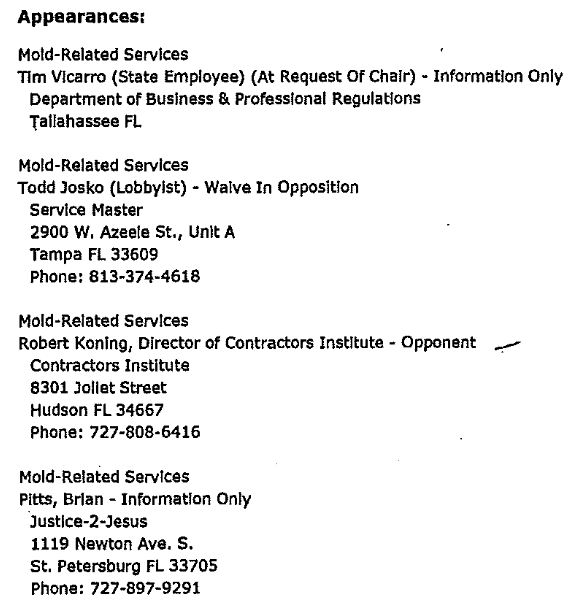
|
||||||||||||||||||
|
||||||||||||||||||
|
| Bill History: | ||||||||||||||||||||||||||||||||||||||||||
|
||||||||||||||||||||||||||||||||||||||||||
The move to repeal the current mold licensing law is working its way through committee. Below is the list of appearances and voting results.
|
||||||||||||||||||
|
||||||||||||||||||
|
| Bill History: | ||||||||||||||||||||||||||||||||||||||||||
|
||||||||||||||||||||||||||||||||||||||||||
 Leave a Comment » |
  Commercial IAQ, Residential IAQ | Tagged: ASTM, Chapter 468, ciec, Department of Business and Professional Regulation, Florida DBPR, Florida Statutes, HB 4171, HB 5005, HB 5005. air quality, healthy home, House Bill 713, IEQ 3.2, IESO, indoor air quality, Indoor Environmental Standard Organization, john lapotaire, John P. Lapotaire, LEED, microshield, mold, mold inspection, mold pretreatment, mold prevention, mold remediation, mold removal, mold testing, Mold-Related Services Licensing Program, new home mold, Part XVI, Residential Mold Assessment, SB 1244, Senate Bill 2234, USGBC |
  Permalink
 Posted by John P. Lapotaire, CIEC
 New Edition! Manual 18 Moisture Control in Buildings: The Key Factor
in Mold Prevention: 2nd Edition
Twenty-eight comprehensive chapters focus on the major issues involved in the process of moisture resistive construction. This one-of-a-kind publication provides the latest and most important information relating to moisture problems in buildings.
Three new chapters have been added to make this the ultimate publication on moisture control:
Four sections cover fundamentals, applications, construction principles and recommendations, and implementation.
Order your copy today!
•John P. Lapotaire, CIEC
•Certified Indoor Environmental Consultant
•Microshield Environmental Services, LLC
•www.Microshield-ES.com
Leave a Comment » | Commercial IAQ, Residential IAQ | Tagged: air quality, ASTM, Chapter 468, ciec, Department of Business and Professional Regulation, Florida DBPR, Florida Statutes, HB 4171, healthy home, House Bill 713, IEQ 3.2, IESO, indoor air quality, Indoor Environmental Standard Organization, john lapotaire, John P. Lapotaire, LEED, microshield, mold, mold inspection, mold pretreatment, mold prevention, mold remediation, mold removal, mold testing, Mold-Related Services Licensing Program, new home mold, Part XVI, Residential Mold Assessment, SB 1244, Senate Bill 2234, USGBC | Permalink
Posted by John P. Lapotaire, CIEC
 A newly approved standard, ASTM D7338, Guide for the Assessment of Fungal Growth in Buildings, has been developed to provide a go-to reference for anyone testing for mold in buildings. The new standard was developed by Subcommittee D22.08 on Sampling and Analysis of Mold, part of ASTM International Committee D22 on Air Quality.
•John P. Lapotaire, CIEC
•Certified Indoor Environmental Consultant
•Microshield Environmental Services, LLC
•www.Microshield-ES.com
1 Comment | Commercial IAQ, Residential IAQ | Tagged: air quality, ASTM, Chapter 468, ciec, Department of Business and Professional Regulation, Florida DBPR, Florida Statutes, HB 4171, healthy home, House Bill 713, IEQ 3.2, IESO, indoor air quality, Indoor Environmental Standard Organization, john lapotaire, John P. Lapotaire, LEED, microshield, mold, mold inspection, mold pretreatment, mold prevention, mold remediation, mold removal, mold testing, Mold-Related Services Licensing Program, new home mold, Part XVI, Residential Mold Assessment, SB 2214, Senate Bill 2234, USGBC | Permalink
Posted by John P. Lapotaire, CIEC
 There was wide spread shock among the Mold Professionals, both inspectors and remediators, when Representative Grant introduced HB 4171 in an effort to repeal the current legislation requiring anyone providing mold related services to obtain a license to either preform mold inspections or mold remediation.
You see for the past 7 months both mold inspectors and mold remediators have been working to obtain their mold license. Some individuals spending hundreds of dollars and some companies thousands. All in an effort to improve our industry and comply with the current licensing law.
Those who proudly work in the mold industry are eager to improve themselves through education, licensing, and continued education, as required by the current licensing law. We do this to help provide our client the best possible service in what is almost always a traumatic time of need.
We all submit to finger printing and licensing to show our clients that it is safe to allow us into their home and that they are free to look at our history and report and wrongful acts on our part to either the or their property.
Becoming licensed according to the current licensing law will not make anyone more ethical or force them to provide a better service.
•It does ensure to Citizens of Florida that anyone they are wanting to hire has met the minimal requirements currently required by the State to preform either a Mold Assessment or Mold Remediation on in their home.
•It does provide the Citizens of Florida a window into any licensed mold professionals history as recorded by the State.
•It does provide the Citizens of Florida with a means of reporting wrongful acts committed by a mold professional.
•It does provide a means and a way for the Citizens of Florida to be Informed and Empowered Consumers.
So I have to ask Representative Grant why he wants to repeal the Current Licensing Law.
Who’s interest is he looking out for?
•John P. Lapotaire, CIEC
•Certified Indoor Environmental Consultant
•Microshield Environmental Services, LLC
•www.Microshield-ES.com
1 Comment | Commercial IAQ, Residential IAQ | Tagged: ASTM, Chapter 468, ciec, Department of Business and Professional Regulation, Florida DBPR, Florida Statutes, HB 4171, HB 5005, HB 5005. air quality, healthy home, House Bill 713, IEQ 3.2, IESO, indoor air quality, Indoor Environmental Standard Organization, john lapotaire, John P. Lapotaire, LEED, microshield, mold, mold inspection, mold pretreatment, mold prevention, mold remediation, mold removal, mold testing, Mold-Related Services Licensing Program, new home mold, Part XVI, Residential Mold Assessment, SB 2214, Senate Bill 2234, USGBC | Permalink
Posted by John P. Lapotaire, CIEC
 Finally, we have regulation in the mold industry. The mold industry had been an unregulated industry for many years and the citizens of Florida suffered as they were exposed to fraud, scams, and scare tactics. The citizens of Florida have been preyed upon by mold inspectors who inspect flood and storm damaged property and assesses thousands of dollars of damage that requires their immediate remediation.
There have been many arrests of fraudulent mold contractors as recently as this past February 21st. It took 29 complaints to the Department of Environmental Protection before action was taken to stop the contractor. If 1 or 2 complaints had been registered and confirmed by the Florida Department of Business and Professional Regulation FDBPR. I feel it safe to assume that most Floridians would not hire the contractor. None would surely hire him after 10 or 20 registered complaints let alone 29. By 10 the FDBPR would have taken action revoking the contractor’s license protecting the next 19 from fraud.
Under the current Florida Licensing Law a Licensed Mold Inspector CANNOT provide Mold Remediation. As of July 1, 2010 the state of Florida Prohibits anyone from performing or offering to perform any mold remediation to a structure on which the mold assessor or the mold assessor’s company provided a mold assessment within the last 12 months
The current Florida Mold Related Services Licensing Law provides a means of reporting these crooked and fraudulent Inspector/Remediators so that the citizens of Florida can be informed about the history of any Mold Inspector or Mold Remediator they hire.
The Florida State Mold Law Legislative purpose.–The Legislature finds it necessary in the interest of the public safety and welfare, to prevent damage to real and personal property, to avert economic injury to the residents of this state, and to regulate persons and companies that hold themselves out to the public as qualified to perform mold-related services.
It’s important for this information to be shared due the recent submittal of HB 4171 February 16th, by Representative James W Grant, District 47. Representative Grant filed the bill in an effort to repeal the current legislation requiring mold remediators and mold assessors to obtain a state license. The bill was introduced 7 months after the current law took effect and after approximately 3000 individuals became licensed as either mold remediators or mold inspectors. With hundreds of additional applicants currently awaiting their license.
The current legislation provides both a means for the Citizens of Florida to report fraudulent acts by mold inspectors and mold remediators and a way for the Citizens of Florida to review the history of any Mold Inspector or Mold Remediator before they make their decision of who to hire.
An Informed Consumer and an industry that can now be held accountable. Floridians, with the current licensing law, can now self-protect against fraud by either reporting a fraudulent mold inspector or remediator or simply by choosing not to hire a mold inspector or remediator based on the mold inspectors or remediators history of complaints.
I have to ask Representative Grant just what it is about an informed consumer that he is opposed to. Or could it be someone in the industry that Representative Grant feels should be protected from accountability?
The Mold Related Services Industry is fully in favor of the current Florida Mold Licensing Law. Thousands of Mold Inspectors and Mold Remediators have spent the last seven months obtaining the necessary training, certification, and insurance necessary to obtain their individual State Mold Assessor License and Mold Remediator License.
There is a push by the Florida Home Builders Association to either repeal the current law or amend the current law to allow licensed general contractors to provide mold inspection and mold remediation without the need for an additional mold inspection or mold remediation license. I find this very interesting as builders have to be additionally licensed to plumb, roof, provide electric or HVAC service on the homes they build. Hence the term general contractor. The General Contractor simply needs to hire a Licensed Professional to perform the mold related services required for the homes they build. Licensing a Mold Inspector or Mold Remediator is no different than any other trade in the state that is currently required to have a license.
It seems that when it comes to anything resulting from or associated with a possible building or construction flaw the general contractors would rather self police. I’m sure that their homeowners don’t feel the same way. The homeowners that I’ve spoken to prefer an independent licensed professional.
Follow the money is the key with the push to repeal the current legislation.
Who hired the Lobbyist?
Who was the Lobbyist?
What is the relationship between the Lobbyist and Representative Grant?
Most important is the “WHY” repeal the New Mold Related services Law? and,
“WHO” benefits most from the repeal?
I would have to say clearly not the Citizens of Florida who lose their ability to report fraudulent mold inspectors and remediators and make informed decisions regarding who to hire based on the states recorded history of all licensed contractors. Clearly not the thousands of individuals and businesses involved in the mold related services industry who have already paid for and given their time to become appropriately trained according to the current licensing law and have paid for and obtained the necessary insurance to comply with the current licensing law.
So I ask Representative Grant just “Who’s” Special Interest are you looking out for?
•John P. Lapotaire, CIEC
•Certified Indoor Environmental Consultant
•Microshield Environmental Services, LLC
•www.Microshield-ES.com
7 Comments | Commercial IAQ, Residential IAQ | Tagged: ASTM, Chapter 468, ciec, Department of Business and Professional Regulation, Florida DBPR, Florida Statutes, HB 4171, HB 5005, HB 5005. air quality, healthy home, House Bill 713, IEQ 3.2, IESO, indoor air quality, Indoor Environmental Standard Organization, john lapotaire, John P. Lapotaire, LEED, microshield, mold, mold inspection, mold pretreatment, mold prevention, mold remediation, mold removal, mold testing, Mold-Related Services Licensing Program, new home mold, Part XVI, Residential Mold Assessment, SB 2214, Senate Bill 2234, USGBC | Permalink
Posted by John P. Lapotaire, CIEC
 The old adage “an ounce of prevention is worth a pound of cure” applies when referring to indoor air quality. So remember to look for low VOC or VOC free choices when purchasing common household products. Currently there’s no standard labeling system for VOCs, but many manufacturers offer a low or no VOC option. Formaldehyde, one of the best known VOCs, is surprisingly common in new home construction. Luckily, it happens to be one of the few indoor air pollutants that can be readily measured. Air monitoring is one approach that can help prevent adverse effects of exposure to volatile organic compounds.
One study on formaldehyde and VOC levels utilizing air monitoring found that “the levels of volatile organic compounds (VOCs) in new homes decreased markedly after 1 year”. This is due primarily to the off-gassing process which diminishes over time. If you don’t happen to have expensive air monitoring equipment lying around, you could always use your sense of smell. Just remember that not all VOCs are detectable with the human nose.
Preventing Exposure to VOCs
Identify, and if possible, remove the source. If it’s not possible to remove, reduce exposure by using a low or no VOC sealant on surfaces and other furnishings emitting chemicals. You should always increase ventilation during the period of VOC off gassing and consider using an air purifier.
Potentially hazardous products often have warnings aimed at reducing exposure to the user. Many people, however, don’t bother to read the label before every use (guilty as charged). If a label states to use the product in a well-ventilated area, go outdoors, open the windows or work in areas equipped with an exhaust fan. You should always provide the maximum amount of clean air flow possible. This rule applies when you are using petroleum-based products, fuels, hydraulic fluids, paint, thinners, cleaning agents and the like. This also applies to your new carpet, new car, air fresheners and a variety of other surprising sources.
Other preventative measures
Safely disposing of empty containers or those with very little product remaining. – Using products according to the manufacturer’s directions. – Buying in quantities that you may consume quickly to prevent additional exposure from seepage or vapors, like paint VOCs, that may escape from poorly sealed containers. – Keeping products out of the reach of children and pets. – Making every effort to utilize integrated pest management techniques when using pesticides. – Never mixing products unless directed on the label. – Choosing low VOC or VOC free products.
Via the Eco Evaluator
Leave a Comment » | Commercial IAQ, Residential IAQ | Tagged: air quality, ASTM, Chapter 468, ciec, Department of Business and Professional Regulation, Florida DBPR, Florida Statutes, HB 4171, healthy home, House Bill 713, IEQ 3.2, IESO, indoor air quality, Indoor Environmental Standard Organization, john lapotaire, John P. Lapotaire, LEED, microshield, mold, mold inspection, mold pretreatment, mold prevention, mold remediation, mold removal, mold testing, Mold-Related Services Licensing Program, new home mold, Part XVI, Residential Mold Assessment, SB 2214, Senate Bill 2234, USGBC | Permalink
Posted by John P. Lapotaire, CIEC
 The American Council for Accredited Certification (ACAC) requested that Florida Department of Business and Professional Regulation (DBPR) give guidance for those seeking Florida licensing for mold assessor or remediation – who missed the deadline for grandfathering – but have previously taken an ACAC certification examination. Their response:
Any applicant, who has taken the ACAC proctored examination and passed in any of the categories already approved by Florida as meeting the Florida standards, will be accepted. However, in order to obtain a Florida license in Mold profession, they must also meet the rest of the Florida requirements as stated in Statute Chapter 468, Part XVI, Florida Statutes
The categories of ACAC proctored examinations approved are the CIE, CIEC and CMC for the Florida Mold Assessor and CMR, CMRS and CIES for the Florida Mold Remediator.
Please call the ACAC staff toll-free at 888-808-8381 for additional information.
Leave a Comment » | Commercial IAQ, Residential IAQ | Tagged: air quality, ASTM, Chapter 468, ciec, Department of Business and Professional Regulation, Florida DBPR, Florida Statutes, HB 4171, healthy home, House Bill 713, IEQ 3.2, IESO, indoor air quality, Indoor Environmental Standard Organization, john lapotaire, John P. Lapotaire, LEED, microshield, mold, mold inspection, mold pretreatment, mold prevention, mold remediation, mold removal, mold testing, Mold-Related Services Licensing Program, new home mold, Part XVI, Residential Mold Assessment, SB 2214, Senate Bill 2234, USGBC | Permalink
Posted by John P. Lapotaire, CIEC
 An easy, no-cost credit
Like the similar credit, IEQc4.1: Low-Emitting Materials: Adhesives and Sealants, it shouldn’t cost you anything extra to earn this credit—it will just take some work. Your first priority should be to specify only paints and coatings that comply with the credit’s VOC limits, and enforce those specifications on the jobsite. Research low-VOC paints and coatings before construction begins and provide lists of acceptable materials to contractors to help ensure that the right products are used.
Performance should not be an issue
Major manufacturers offer paints and coatings that are just as durable and perform just as well as their higher-VOC…
Verify Your Information
Don’t allow the use of products that merely claim to be “low VOC.” Everyone specifying and purchasing products must actually find the products’ VOC content in grams per liter (g/L), which is usually found on the product’s technical data sheet or material safety data sheet, and compare that number with VOC limits listed for different uses determined by the South Coast Air Quality Management District (SCAQMD) Rule #1113 and Green Seal GS-11 and GS-03.
Only 20% of product cut sheets selected at random need to be uploaded to LEED Online to document this credit although it is best to keep all product cut sheets on file in case the credit is audited.
•John P. Lapotaire, CIEC
•Certified Indoor Environmental Consultant
•Microshield Environmental Services, LLC
•www.Microshield-ES.com
Leave a Comment » | Commercial IAQ, Residential IAQ | Tagged: air quality, ASTM, Chapter 468, ciec, Department of Business and Professional Regulation, Florida DBPR, Florida Statutes, HB 4171, healthy home, House Bill 713, IEQ 3.2, IESO, indoor air quality, Indoor Environmental Standard Organization, john lapotaire, John P. Lapotaire, LEED, microshield, mold, mold inspection, mold pretreatment, mold prevention, mold remediation, mold removal, mold testing, Mold-Related Services Licensing Program, new home mold, Part XVI, Residential Mold Assessment, SB 2214, Senate Bill 2234, USGBC | Permalink
Posted by John P. Lapotaire, CIEC
 Do It Yourself Mold Test Kits Earn a Not Recommended Rating from Consumer Reports.
If you see or smell mold, you don’t need a test kit to tell you it’s there. Generally, it’s not necessary to identify the species of mold growing in your home, according to the national Centers for Disease Control and Prevention.
If mold covers an area less than 10 square feet, you may be able to eliminate the problem yourself. Larger areas require a pro. When we tested the kits below for our report, we found significant shortcomings in all of them, flaws that were serious enough to earn each a “Not Recommended” Rating.

1 Comment | Commercial IAQ, Residential IAQ | Tagged: air quality, ASTM, Chapter 468, ciec, Department of Business and Professional Regulation, Florida DBPR, Florida Statutes, HB 4171, healthy home, House Bill 713, IEQ 3.2, IESO, indoor air quality, Indoor Environmental Standard Organization, john lapotaire, John P. Lapotaire, LEED, microshield, mold, mold inspection, mold pretreatment, mold prevention, mold remediation, mold removal, mold testing, Mold-Related Services Licensing Program, new home mold, Part XVI, Residential Mold Assessment, SB 2214, Senate Bill 2234, USGBC | Permalink
Posted by John P. Lapotaire, CIEC
 Grandfathering Ended Yesterday!
If you didn’t apply for your Florida Mold License under the Grandfathering clause you’ve run out of time.
The requirements for grandfathering as amended by House Bill 713 include submission of an application to the department by March 1, 2011, whether postmarked or delivered by that date. Applicants must meet the following licensure requirements:
Applicants applying for their Florida Mold Assessor or Mold Remediator License will now be required to either apply through Exam or Endorsement.
1. Mold Assessor – Initial License by Examination
This application is used by individuals who have passed at least one of the examinations offered by The American Council for Accredited Certification (ACAC). The department has approved the following examinations: Council-certified Indoor Environmentalist (CIE) examination, Council-certified Indoor Environmental Consultant (CIEC) examination, and Council-certified Microbial Consultant (CMC) examination.
Application Requirements:
• EXAMINATION: Individuals seeking licensure as a mold assessor must first take and pass one of the examinations approved by the department and administered by the American Council for Accredited Certification (ACAC), in computer based testing format. To contact the American Council for Accredited Certification please call 1-888-808-8381 or go to the website at http://www.acac.org. Please refer to the application instructions for information regarding the administration of the examination.
• EDUCATION/EXPERIENCE: A copy of a transcript is required demonstrating an Associate of Arts degree or higher with at least 30 credit hours in microbiology, engineering, architecture, industrial hygiene or occupational safety or related field of science from an accredited institution. The applicant must also demonstrate a minimum of 1 year of documented field experience in microbial sampling or investigations, and documented training in water, mold and respiratory protection;
or
a high school diploma and 4 years of experience under the supervision of a Florida licensed mold assessor or remediator. This is not a complete listing of educational and experience requirements. Please see the application instructions page for complete information.
• FINGERPRINTS: An applicant must have a background check as part of the licensing process. To learn more about fingerprinting, please visit our fingerprint FAQs.
• INSURANCE: Applicants for a Mold Assessor license are required to attest that they have obtained general liability and errors and omissions insurance for both preliminary and post remediation mold assessment in the amount of no less than $1 million dollars as determined by statute.
• FEE: Pay the required fee as provided in the application, payable to the Department of Business and Professional Regulation.
• APPLICATION: Complete the application by clicking on the “Printable Application” link at the bottom of the page.
• MORE INFORMATION: Learn more about this profession’s application requirements (use the back button or arrow to return to this page).
2. Mold Assessor – Initial License for Out-of-state Applicants (Endorsement)
This application is used by individuals who qualify for licensure by having passed a certification examination offered by a nationally recognized organization that is substantially equivalent to Florida’s examination; or hold a valid license by another state or territory of the United States whose criteria for licensure are substantially equivalent to Florida’s licensing requirements.
Application Requirements:
• DEFINITION: Endorsement is licensure of individuals who hold a valid license in another state and would like to become licensed in Florida based on their out-of-state license or provide proof of passing a certification examination offered by a nationally recognized organization that certifies persons in mold remediation or assessment, and the examination has been approved by the department as substantially equivalent to Florida’s examination.
• OUT-OF-STATE LICENSE: Submit proof of licensure in another state whose criteria for licensure are substantially equivalent to Florida’s requirements
or
NATIONALLY RECOGNIZED ORGANIZATION: Provide proof of passing a certification examination offered by a nationally recognized organization that is substantially equivalent to Florida’s examination that is recognized by the department. If you passed a certification examination by a nationally recognized organization that is substantially equivalent to the Florida’s examination and you do not have an out-of-state license, then you must submit:
• a copy of a transcript demonstrating an Associate of Arts degree or higher in microbiology, engineering, architecture, industrial hygiene or occupational safety or related field of science from an accredited institution. The applicant must also demonstrate a minimum of 1 year of documented field experience in microbial sampling or investigations;
or
• a high school diploma and provide proof of 4 years experience under the supervision of a Florida licensed mold assessor or remediator; This is not a complete listing of educational and experience requirements. Please see the application instructions page for complete information.
• EDUCATION/EXPERIENCE: If you passed a certification examination by a nationally recognized organization that is substantially equivalent to the Florida’s examination and you do not have an out-of-state license, then you must submit a copy of a transcript demonstrating an Associate of Arts degree or higher in microbiology, engineering, architecture, industrial hygiene or occupational safety or related field of science from an accredited institution. The applicant must also demonstrate a minimum of 1 year of documented field experience in microbial sampling or investigations;
or
a high school diploma and provide proof of 4 years experience under the supervision of a Florida licensed mold assessor or remediator. This is not a complete listing of educational and experience requirements. Please see the application instructions page for complete information.
• FINGERPRINTS: An applicant must have a background check as part of the licensing process. To learn more about fingerprinting, please visit our fingerprint FAQs.
• INSURANCE: Applicants for a Mold Assessor license are required to attest that they have obtained general liability and errors and omissions insurance for both preliminary and post remediation mold assessment in the amount of $1 million dollars as determined by statute.
• FEE: Pay the required fee as provided in the application, payable to the Department of Business and Professional Regulation.
• APPLICATION: Complete the application by clicking on the “Printable Application” link at the bottom of the page.
• MORE INFORMATION: Learn more about this profession’s application requirements (use the back button or arrow to return to this page).
•John P. Lapotaire, CIEC
•Certified Indoor Environmental Consultant
•Microshield Environmental Services, LLC
•www.Microshield-ES.com
Leave a Comment » | Commercial IAQ, Residential IAQ | Tagged: air quality, ASTM, Chapter 468, ciec, Department of Business and Professional Regulation, Florida DBPR, Florida Statutes, HB 4171, healthy home, House Bill 713, IEQ 3.2, IESO, indoor air quality, Indoor Environmental Standard Organization, john lapotaire, John P. Lapotaire, LEED, microshield, mold, mold inspection, mold pretreatment, mold prevention, mold remediation, mold removal, mold testing, Mold-Related Services Licensing Program, new home mold, Part XVI, Residential Mold Assessment, SB 2214, Senate Bill 2234, USGBC | Permalink
Posted by John P. Lapotaire, CIEC
 Microshield Indoor Air Quality IAQ


 Indoor Air Quality Solutions, IAQS