Florida Mold Law Update

March 4, 2010

Florida House Bill HB713 is a proposal to accept any national association’s certifications with 3 years verifiable experience and 60 hours of verified training. The Florida Legislature goes into session next week and this bill should be voted on quickly.

This is a very good thing for the consumer. I receive dozens of calls from consumers who have had a “Mold Inspection” only to have the inspector hand the consumer a lab report with no summary of findings. You can read more about that in this article. http://activerain.com/blogsview/1438130/the-home-inspector-mold-test-buyer-beware- That is the reason we truly need the new law and a stiff standard.

Point to remeber

Certification vs Certificate of Training

Many who hold a private, IAQ-related credential, will be surprised to learn that it may be nothing more than a training certificate.

Unfortunately there are many training programs that are not a recognized ANSI/NOCA professional certification but rather only a certificate of training. Many won’t meet the requirements of the new HB713 where you would be required to have 60hrs of training and 3 years of experience and a certification from a national association. You can read more about that in this article. http://activerain.com/blogsview/1272700/is-your-mold-or-iaq-inspector-really-certified-

Remember that HB713 is not a law yet. It still has to be voted in.

You can read more about what is in a Professional Mold Inspection Report in this article. http://activerain.com/blogsview/1516548/what-is-a-professional-and-informative-mold-report-

John P. Lapotaire, CIEC
Certified Indoor Environmental Consultant
Microshield Environmental Services, LLC
www.Microshield-ES.com


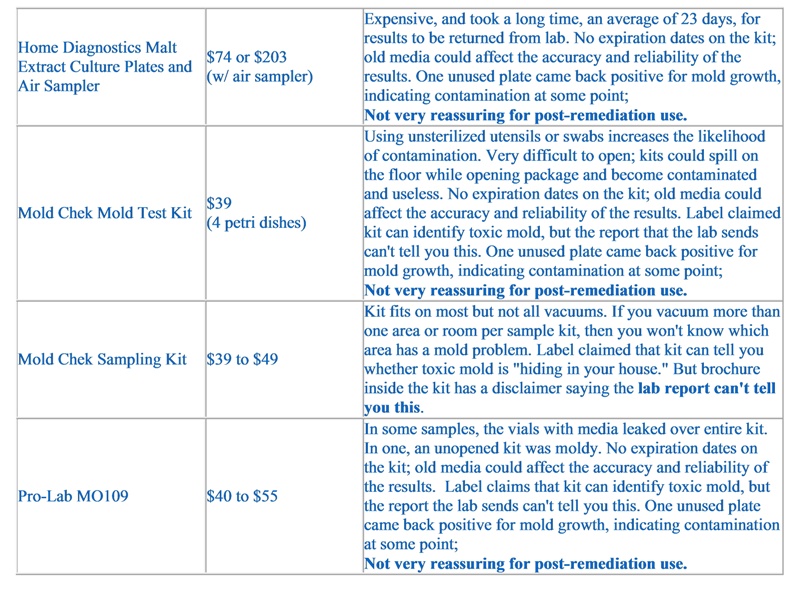
Do It Yourself Mold Test Kits, Use Them or Lose Them?

March 4, 2010

Do It Yourself Mold Test Kits Earn a Not Recommended Rating from Consumer Reports.

If you see or smell mold, you don’t need a test kit to tell you it’s there. Generally, it’s not necessary to identify the species of mold growing in your home, according to the national Centers for Disease Control and Prevention.

If mold covers an area less than 10 square feet, you may be able to eliminate the problem yourself. Larger areas require a pro. When we tested the kits below for our report, we found significant shortcomings in all of them, flaws that were serious enough to earn each a “Not Recommended” Rating.

John P. Lapotaire, CIEC
Certified Indoor Environmental Consultant
Microshield Environmental Services, LLC
www.Microshield-ES.com


National Nonprofits Plan to Combine Forces to Advance Healthy Homes and Communities

March 4, 2010

Washington, DC -The National Center for Healthy Housing (NCHH) and the Alliance for Healthy Homes (Alliance) today announced their plans to join forces. The consolidated organization will continue to operate as the National Center for Healthy Housing, led by Rebecca Morley, with offices in Columbia, Maryland and Washington, DC. Patrick MacRoy, former executive director of the Alliance, will lead NCHH’s Community-Based Initiatives. The merger will consolidate all aspects of healthy homes within a single organization – research and evaluation, policy advocacy, consumer education, training, and assistance to local governments and community-based organizations. Nearly 5.7 million families live in substandard housing conditions placing millions of children at risk for asthma, cancer, lead poisoning, and injuries. As a unified organization, the groups will be able to better serve the interest of these families.

For further information see the full press release and information on the upcoming conference.

RBc: For more information on healthy housing see these articles:

1.Current State of the Science: Health Effects and Indoor Environmental Quality
2.Elements That Contribute to Healthy Building Design
3.Toxic homes, toxic bodies

John P. Lapotaire, CIEC
Certified Indoor Environmental Consultant
Microshield Environmental Services, LLC
www.Microshield-ES.com


ASHRAE Technology Awards Highlight Outstanding Building Projects

March 4, 2010

ORLANDO, Fla.–Designers of systems for two office buildings, a warehouse and college library are recognized by ASHRAE for incorporating elements of innovative building design.

First place recipients of the ASHRAE Technology Awards were recognized at the Society’s 2010 Winter Conference, held this week in Orlando, Fla. The recipients have applied ASHRAE standards for effective energy management.

The first place winners in their respective categories are:

1. The Terry Thomas (Michael Hedrick, Thomas Marseille, P.E. and Long Lam; Stantec Consulting; Seattle, Wash)

2. Sobey’s Warehouse (Martin Roy, P.Eng.; Martin Roy et Associés, Inc.; Deux-Montagnes, Québec, Canada)

3. IDeAs Design Facility (Peter Rumsey, P.E., Fellow ASHRAE; Rumsey Engineers; Oakland, Calif)

4. The Richard J. Klarcheck Information Commons Building (Donald McLauchlan, P.E., Steven Maze and David Lavan; Elara Energy Services, Inc.; Hillside, Ill.)

For further information on these projects contact:

Amanda Dean
Public Relations
678-539-1216
adean (at) ashrae.org

RBc: Congratulations to the winners and of special note is the use of hydronics and floor heating in all the outstanding building projects.

John P. Lapotaire, CIEC
Certified Indoor Environmental Consultant
Microshield Environmental Services, LLC
www.Microshield-ES.com


New guidance for achieving enhanced IAQ now available from ASHRAE

January 16, 2010

New guidance for achieving enhanced IAQ is available from five leading building industry associations and the U.S. Environmental Protection Agency.

The Indoor Air Quality Guide: Best Practices for Design, Construction and Commissioning is collaboration between ASHRAE, the American Institute of Architects, the Building Owners and Managers Association International, U.S. Environmental Protection Agency, the Sheet Metal and Air Conditioning Contractors of North America and the U.S. Green Building Council.
The book describes 40 strategies for achieving critical IAQ objectives related to moisture management, ventilation, filtration and air cleaning and source control. It also highlights how design and construction teams can work together to ensure good IAQ strategies are incorporated from initial design through project completion.
A summary document of the Indoor Air Quality Guide – ideal for a general understanding of the importance of major IAQ issues can be downloaded for free at http://www.ashrae.org/iaq. The full publication complete with a CD that contains detailed guidance essential for practioners to design and achieve good IAQ is available in hard copy or electronically for $29.

To order, contact ASHRAE Customer Service at 1-800-527-4723 (United States and Canada) or 404-636-8400 (worldwide), fax 404-321-5478, or visit http://www.ashrae.org/bookstore

www.microshield-es.com


Whats in the Air You Breathe?

December 7, 2009

Are your allergies bothering you in your home or office? Does your asthma get triggered when you enter a room? Maybe it’s time for the professionals at Microshield Environmental Services help you isolate and identify the allergens or asthma triggers in your home or office. Microshield can then help you eliminate those allergens and triggers and improve your Indoor Air Quality.
Call Microshield Today 407-383-9459
www.Microshield-ES.com


Check out the new Microshield Website.

December 7, 2009

http://www.Microshield-ES.com


2009 Oviedo Lock Up: John Lapotaire, CIEC

September 29, 2009

2009 Oviedo Lock Up: John Lapotaire, CIEC

Shared via AddThis


Formaldehyde Council recommends testing homes for formaldehyde

August 25, 2009

The Formaldehyde Council, Inc. (FCI) engaged an industrial hygienist to explain formaldehyde testing methods. Larry Newton, CIH, CSP, has performed over 400 indoor air quality investigations.

Newton expressed concern that some modern homes do not bring in adequate fresh air. He agreed with our statement, “lack of fresh air allows chemical contaminants to concentrate inside the home”.

Newton explained how he tested homes for formaldehyde in the 1980s.

When I began indoor investigations, I used a CEA 555 continuous environmental analyzer (CEA) based on the wet chemistry of pararosaniline. This chemistry is highly specific and sensitive (< 100 ppb) to formaldehyde…The CEA 555 monitor not only allowed me to obtain real-time ambient formaldehyde concentrations I was able to sniff out sources by placing the probe between walls; inside cabinets and drawers; beneath the floor; and at surfaces of suspected emitters. Whenever possible, I used the chromotropic acid method as my referee method. You used your Interscan 4160 in the same manner I did.

Technology has progressed in the decades since Newton measured formaldehyde in homes. The Interscan 4160 formaldehyde meter is considerably more accurate than the CEA 555. Sample collection for laboratory analyses is simpler than in the old days.

We used the Interscan 4160 extensively to confirm that many new homes have elevated formaldehyde in room air. Our data indicate that well-sealed homes are more likely to concentrate formaldehyde, just as Newton expected.

The Interscan 4160 serves well to locate formaldehyde sources in homes where clients are ill. As Newton recommended, we use the Interscan 4160 to identify cabinets, furniture items, and building materials that emit formaldehyde.

The Interscan 4160 is a direct read meter that measures concentration in air. It does not provide a written record of test results. We recommend laboratory analysis when clients are preparing for litigation.

A South Bay woman had health problems soon after her kitchen cabinets were refaced. She suspected formaldehyde from the MDF facing material was responsible for her illness. However, her contractor was adversarial and refused to replace the material that made her ill.

The Interscan 4160 confirmed the facing material emitted considerable formaldehyde. A lab test confirmed the formaldehyde concentration in the woman’s kitchen was high enough to make her ill. Combining the two test methods, she has adequate evidence to support her suit against the recalcitrant contractor.

August 24, 8:24 AM San Jose Environmental Health Examiner Linda Kincaid, MPH, CIH


http://www.microshield-es.com


Remodeling and Indoor Air Quality

August 21, 2009

You may not have realized that your remodeling project may be creating unhealthy indoor environment. These 8 questions and answers will help you understand the possible concerns of a remodeling and your indoor air quality.

Q 1: What remodeling hazards should I be concerned about?

A: Asbestos, formaldehyde and other organic solvents, and leaded paint dust are the main ones. These hazardous materials can be released into the air when you remove paint, hang cabinets or disturb other existing products that contain these materials. Paints, stripping and finishing products, and adhesives can also create indoor air pollution.

Q 2: By remodeling with products that don’t include these hazardous materials, won’t that minimize my exposure?

A: Not necessarily. Lead and asbestos were commonly used in home building until the late 1970s. Remodeling or attempting to remove these materials from a building can actually increase your risk of exposure. Often it’s better to leave the lead- or asbestos-containing materials in place, but cover or seal them to reduce exposure. If you suspect these materials are in your home, seek professional help before remodeling. If you remodel, remember that careful clean-up is important to control exposure.

Q 3: What does asbestos come from? Why should I be concerned?

A: Major sources of asbestos are deteriorating, damaged or disturbed asbestos-containing insulation, fireproofing or acoustical materials, and floor tiles. In isolated cases, asbestos could be found in vermiculite attic insulation. Exposure to asbestos in the air during renovation or maintenance on asbestos containin gmaterials may cause irritation reactions. Asbestos can also cause cancer and chronic lung diseases. Smokers are at higher risk of developing asbestos-induced lung doseases. If you need to work on or remove asbestos containing materials, use a professionally certified contractor.

Q 4: What should I do if I have vermiculite attic insulation?

A: According tothe U.S. Environmental Protection Agency’s recommendations, DO NOT DISTURB IT. Any disturbance has the potential to release asbestos fibers into the air. Limiting the number of trips you make to your attic and shortening the length of those trips can help limit your potential exposure. EPA and ATSDR (Agency for Toxic Substances and Disease Registry) strongly recommend that: Vermiculite insulation be left undisturbed in your attic. Due to the uncertainties with existing testing techniques, it is best to assume that the material may contain asbestos. Limit trips to the attic,if possible. You should not store boxes or other items in you attic if retrieving the material will disturb the insulation. Children should not be allowed to play in an attic with open areas of vermiculite insulation. If you plan to remodel or conduct renovations that would disturb the vermiculite, hire professionals trained and certified to handle asbestos to safely remove the material. You should never attempt to remove the insulation yourself. Hire professionals trained and certified to safely remove the materials.

Q 5: What does formaldehyde come from? Why should I be concerned?

A: Formaldehyde is an important industrial chemical used to make other chemicals, building materials and household products. It is used in glues, pressed-wood products (such as plywood and particle oard), preservtives, permanent presss fas a preservative or as an adhesive in pressed wood products, such as paneling and particle-board, and furniture. Formaldehyde causes eye, nose and throat irritations; wheezing and coughing; fatigue; skin rashes; headaches; loss of coordination; nausea; damage to liver, kidneys and the central nervous system; and severe allergic reactions. It has been linked to cancer.

Q 6: How can I detect whether myhome has significant concentrations of formaldehyde?

A: You may be able to detect it by its odor. Also, environmential testing firms, listed in the yellow pages of the phone directory, should be able to test for formaldehyde levels. Since such tests are costly, you should learn whether your home has possible sources of formaldehyde. Also, do-it-yourself test kits are available, but there is some question about their accuracy.

Q 7: What can I do to reduce formaldehyde problems?

A: In most cases, formaldehyde does not penetrate completely sealed plastic laminate and is at least partly blocked by coatings. Varnishes and special formaldehyde sealants are also available. Apply these coatings to all exposed edges and surfaces, such as the undersides of countertops, cabinet interiors and drawers. High humidity and elevated temperatures cause formaldehyde release, so you might want to control humidity through air conditioning and properly used and maintained dehumidifiers. Also, increase ventilation, particularly after bringing new sources of formaldehyde into the home. When remodeling and in new construction, select low formaldehyde materials.

Q 8: What about other chemicals used in remodeling, such as paints, wood strippers and finishes, adhesives, waxes and cleaners?

A: The products to watch for are those containing volatile organic compounds (VOCs), which are organic solvents that easily evaporate into the air. Some may be flammable. Following are some of the compounds listed on product labels: petroleum distillates, mineral spirits, chlorinated solvents, carbon tetrachloride, methylene chloride, trichloroethane, toluene and formaldehyde. Other remodeling products can be a hazard if they are used improperly.


http://www.microshield-es.com