Some industries balk at giant deregulation bill in Florida House

March 15, 2011

Florida House of Representatives Microshield IAQBy Jason Garcia, Orlando Sentinel4:46 p.m. EDT, March 15, 2011

In their zeal to slash red tape this spring, Florida lawmakers are going so far that they have begun making even the state’s biggest businesses nervous.

A committee in the Florida House of Representatives unveiled and approved a sweeping plan on Tuesday to eliminate state-government oversight of more than two-dozen professions and industries, from telemarketers and travel agents to home inspectors and auto mechanics.

The 281-page bill is the most far-reaching attempt at deregulation yet undertaken in a year in which Republican leaders from Gov. Rick Scott to House Speaker Dean Cannon of Winter Park have repeatedly vowed to reduce government bureaucracy and make Florida more accommodating to businesses.

But the measure immediately drew opposition from many of those same industries that boosters say they are attempting to help. More than 30 lobbyists and professionals from various industries testified before the House Business and Consumer Affairs Subcommittee, with the vast majority of them urging lawmakers to preserve the current state’s regulatory schemes.

“Sometimes, regulation can be productive,” Nancy Stewart, of the Federation of Manufactured Home Owners of Florida, said as she urged the committee to remove provisions from the bill that would abolish the state agency that oversees condominiums, time shares and mobile homes. “We all know that we have better behavior when someone’s watching.”

Boosters of the bill said many regulations help existing businesses stifle competition. Lifting those rules, they argued, would make it easier for new businesses to set up shop in Florida and, ultimately, they hope, create jobs in a recession-wracked state still weighed down by a 12 percent unemployment rate.

“One of the beauties of our country is that an individual can sit in their living room and draw up a business plan and then go to work. But it’s sad to know that the moment they walk out that door, there are obstacles presented,” said Rep. Esteban Bovo, R-Hialeah and committee chairman, who sponsored of the legislation. “At the end of the day, the goal is to give people the power to start their own businesses and then let them move forward and compete.”

Even by the standards already set this year in Tallahassee — where dozens of bills lifting one regulation or another are rapidly advancing through the Legislature — the legislation introduced Tuesday is breathtaking.

One section, for instance, would abolish entirely Florida’s 23-year-old “Sellers of Travel” law. More than 6,500 travel agencies and independent agents are currently registered under the law, which was initially passed to protect consumers from unscrupulous agents peddling phony vacations.

Among other provisions, the current law requires that a travel agency post a surety bond of up to $50,000 so the state can use it to refund travelers should they be sold a fraudulent vacation package or if the seller goes bankrupt before customers take their trips.

Florida has received more than 13,000 complaints about sellers of travel during the past five years, according to the state Department of Agriculture and Consumer Affairs, which administers the law.

Other sections of the bill, meanwhile, would cut state oversight of the time-share industry. No more, for instance, would government regulators review offering documents by time-share builders to ensure they include adequate disclosures for consumers or in advertising materials to ensure they aren’t misleading.

It was enough to bring even Florida’s best-known employer — Walt Disney World — out in opposition.

Brian Bibeau, a lobbyist for the resort, pointed out that the state began regulating the time-share industry in the 1980s to weed out shady developers who gave the industry a seedy reputation that it has spent years trying to shed.

Disney owns a time-share business, Disney Vacation Club, which is based in Central Florida and has properties in four states.

“Florida has what some people would call a colorful history of land fraud that goes back 100 years. Others would call it a lurid history of land fraud,” Bibeau said. “The division [of condominiums, time shares and mobile homes] was put together to force the bad actors out of these areas of activity. We think it’d be a terrible mistake for you all to deregulate those areas of the division. We strongly oppose it.”

Many other industries expressed similar concerns. The Florida Association of Professional Geologists said state licensing is vital to ensure that geologists have the appropriate technical skills and education levels. The Automotive Service Associations said the state’s regulatory scheme helps resolve complaints with consumers unhappy with car-repair jobs. The Florida Association of Realtors said home buyers need the assurance that comes with state oversight of home inspectors.

“Realtors believe it’s in the public interest to keep those folks accountable to the state and the public,” said Trey Price, a lobbyist for the Realtors association. The Florida Home Inspectors Council, too, testified in support of the state’s current regulations.

Not everyone, however, was critical.

Allen Douglas, a lobbyist for the National Federation of Independent Businesses, which represents small businesses in the state, said many of Florida’s myriad rules and regulations are obstacles for new businesses.

“A lot of these laws are legit. But a lot of them are to limit competition,” Douglas said.

Indeed, much of Tuesday’s three-hour hearing was consumed by dueling testimony from in-state and out-of-state interior designers over whether to lift licensing requirements for commercial interior designers.

Analysts said 255 state-government jobs could be cut if all of the regulations targeted in the legislation were repealed.

The bill ultimately advanced on a 10-5, party-line vote, with outnumbered Democratic lawmakers criticizing what they called “unbridled” deregulation.

“I’m worried that the message we’re going to be sending is not that Florida is business friendly, but that Florida is the wild, wild West,” said Rep. Darryl Rouson, D-St. Petersburg.

Jason Garcia can be reached at jrgarcia@orlandosentinel.com or 407-420-5414.


Florida makes BIG move to De-Regulate Florida Licensed Professional Services

March 14, 2011

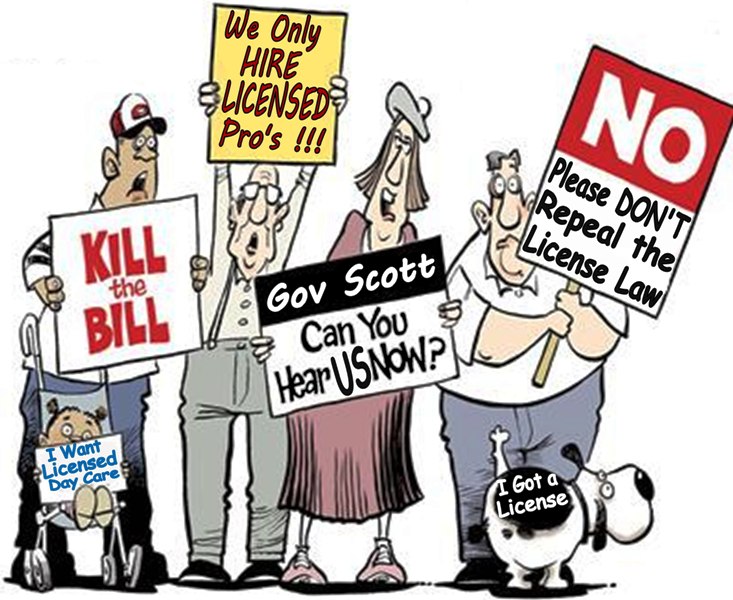
Governor Scott isCan You Hear Us NOW! doing all that he can to provide Jobs to Floridians but some would say he is going about it in all the wrong ways.

Ensuring that your Florida professional service provider is Licensed and Insured is the most important piece of information that the Citizens of Florida require  from any Legitimate Florida Professional Service Provider prior to hiring and receiving any professional service in the State of Florida.

This would include all professional services from your Licensed Barber or Cosmetologist to the Licensed Home or Mold Inspector you hire to inspect your home before you make the most important purchase of your life.

The idea that eliminating the States requirement for licensing could ever be a good thing is simply ridicules.

A Florida License ensures that Florida professionals meet a minimum requirement necessary to obtain a license Prior to providing their services.

A Florida License means that Floridians have a means of reviewing a licensee’s history prior to hiring and a way of reporting a licensee’s poor or negligent performance if necessary.

A Florida License creates an Informed and Empowered Florida Consumer.

A lack of a Florida License presents a real financial danger to the citizens of Florida.

The Governors’ idea is to de-regulate professional services making it easier for Floridians to get a job.  I don’t know about the rest of you but I don’t want an unemployed engineer (for example) cutting my hair just so he has a job.

I do know that the regulating of professions is what separates us from the old Wild, Wild West.  It’s what protects Floridians from Fraud, Scams, and Unqualified Contractors.

I do know it is what sets a standard to ensure Floridians receive a trained, insured, and licensed professional services and not the proposed legislation that might as well be labeled HB 101 Caveat Emptor or “Let the buyer beware”.

The introduction of PCB BCAS 11-01 (proposed committee bill) is being heard tomorrow morning in the House Business & Consumer Services Subcommittee.

This is the introduction of a proposed Bill that is “An act relating to the deregulation of professions and occupations; amending s. 20.165, F.S.;”

This is an attempt to deregulate professions from Auctioneers, Barbers, Home Inspectors, Interior Designers, Mold-Related Services, Surveyors and many, many more.

Check to see if you may no longer need your professional license in the proposed legislation.
http://www.myfloridahouse.gov/SEctions/Documents/

http://www.myfloridahouse.gov/SEctions/Committees/

Committee members who need to be contacted to STOP the madness.
Bovo, Jr., Esteban L. (R) Chair, Roberson, Kenneth L. (R) Vice Chair, Abruzzo, Joseph (D) Democratic Ranking Member, Ahern, Larry (R), Artiles, Frank (R), Crisafulli, Steve (R), Eisnaugle, Eric (R), Goodson, Tom (R), Jones, Mia L. (D), Nuñez, Jeanette M. (R), Patronis, Jimmy (R), Rouson, Darryl Ervin (D), Slosberg, Irving (D), Stafford, Cynthia A. (D), Young, Dana D. (R)

John P. Lapotaire, CIEC
•Certified Indoor Environmental Consultant
•Microshield Environmental Services, LLC
www.Microshield-ES.com


Who would want to repeal the current Florida Mold Licensing Law & Why?

March 12, 2011

You have to be thinking the same thing I am.  Who would want to repeal the current Mold Licensing Law that protects Floridians from fraud and scams?

The current Law helps Floridians by providing them with a minimum standard that must be met ensuring that when they hire a licensed mold inspector or remediator they will be experienced and trained.

Any Floridian can check the history of a licensed mold inspector or remediator by going to the Florida Department of Business and Professional Regulation, FDBPR.

Any Floridian can also file a complaint against any licensed mold inspector or remediator with the FDBPR helping to protect the next Floridian by providing information on the licensed mold inspectors or remediators performance.

That’s all a true benefit to Floridians, Right?

Mold Professionals are now being held accountable; must meet a minimum standard, carry adequate insurance, and the consumer can either report misconduct or review prior misconduct by any licensed mold professional they want to hire.

So why would Representative Grant and Senator Norman file HB 4171 and SB 1244 in an effort to repeal the current Mold-related Services Licensing Law?

Maybe this will help clear the air a bit.

The Lobbying firm of Florida Capitol Advocates which includes former Sen. John Grant, was hired by the founder of the franchise Mycelium Holdings, Jason Earle.  Mycelium Holdings is a New Jersey based Franchise with no current franchises in Florida.

“Our franchise operation is 1-800-GOT-MOLD?, not Mycelium Holdings.” Jason Earle Added 3/14/11

Florida Capitol Advocates lobbied Representative James W Grant, District 47 who introduced the bill as HB 4171 February 16th.  Senator Norman filed the sister bill in the Senate SB 1244. February 21st.

The Mycelium Holdings founder Jason Earle stated, in a phone interview, that he feels the current licensing law inhibits the ability of Mycelium Holdings to rapidly sell franchises and expand into Florida which is why New Jersey based Mycelium Holdings is interested in repealing the current mold licensing law.

Jason Earle stated in an email sent to me today that corrections to his position regarding the repeal of the current mold licensing law are as follows. “the law would inhibit our ability to expand our business in a state which needs to create jobs, not restrict commerce. We are opposed to the educational and experiential prerequisites” Jason also stated ” I made it clear that I’m in favor of regulation and enforcement in the mold industry.” Added 3/14/11

Mycelium Holdings also markets the Got Mold? Test Kit http://www.gotmoldtestkit.com/

It has been brought to our attention that Mycelium Holdings provides the “Positive” results from their Got Mold? Test Kit to mold remediation franchisees.

Jason Earle also stated“We DO NOT provide anything related to the GOT MOLD? Test Kit to mold remediation firms. That would be a conflict of interest. We simply offer the consumer the chance to deduct the initial purchase price of the test kit from the cost of a professional mold inspection through 1-800-GOT-MOLD?, our franchise division, which only performs assessments and remediation consulting, but does NOT perform remediation or have financial relationships with mold remediation firms. Please be clear. This is a gross misrepresentation and should be corrected.” Added 3/14/11

If Mycelium Holdings receives any compensation or franchise fee for the referral of positive test results from their Got Mold? Test Kit then Mycelium Holdings is in violation of the current law of section 468.8419 Prohibitions; penalties.

Mycelium Holdings would then have until July 1, 2011 to successfully repeal the current law or be in violation of section 468.8419 Prohibitions; penalties.  You see the Penalty Section of the current Law does not go into effect until July.

Now that would be motivation for Mycelium Holdings to hire Florida Capitol Advocates and attempt to repeal the current mold licensing law, wouldn’t it?

So if the current law is repealed via Rep. Grant and Sen. Norman Mycelium Holdings up in New Jersey makes big bucks selling franchises to wealthy business men who can then hire anyone off the street to inspect your home.

Jason wanted it pointed out that “You(John lapotaire) conveniently forgot to mention that we (1-800 Got-Mold) have the most robust two-week training program and support structure in the industry.”Added 3/24/11

After all Mycelium Holdings will be providing the franchisee with a rescued Labrador mold sniffing dog.  So why need the business owner or mold inspector to be licensed?  Just make sure the dog has it shots and inspect away……….

Who Loses if the Current Law is Repealed?
The real losers will be the Floridians who will once again be subjected to unlicensed and unregulated scam artist inspecting and finding mold in their homes and offering to quickly provide an estimate to remediate.

Before the current law was in place it took 29 complaints to stop a mold inspector who also provided mold remediation.  29! That’s 29 Floridians scammed out of hard earned money.  With the current law Floridians have a means and a way of reporting and ridding the state of mold inspector/remediator scam artist.

Without the Current Law Floridians Lose!

Who wins if the Current Law is Repealed?
Mycelium Holdings up in New Jersey and a few rescue labs that get to live it large in Florida.


Post Update 3/14/11

The above inserted updates are a result of recent and open communication between myself and Jason Earle.

The facts are always important and I in no way want to misrepresent the facts in this controversial issue.  The above is a clear view of both sides without getting into specific details of who can provide the best inspection.

After all that decision in best made not by or customer but by our customers referrals.

John P. Lapotaire, CIEC
•Certified Indoor Environmental Consultant
•Microshield Environmental Services, LLC
www.Microshield-ES.com


Repeal of Mold-Related Services Law Threatens Floridians

March 12, 2011

Fellow Floridians

I am sending you this message in the hope that you will help prevent the repeal of the current mold licensing law by sending a personal request to NOT repeal the current mold licensing law to both your District Representatives and Senators.

It is very important for everyone you know to do the same.  Please share the need to send emails and make calls to everyone you know that would be impacted by the repeal of this law.  Send to the media, news papers, radio and TV stations, mold assessors, mold remediators, adjustors, family and friends that will benefit from a licensed mold professional.

With all that was done to create the current legislation and set a mold industry standard for our state it would be a shame and a devastating blow to our industry to see the law repealed.
Please include your current license number and a personal request to NOT repeal the current mold licensing law.

Link to Florida Representatives
http://www.myfloridahouse.gov/SEctions/Representatives/representatives.aspx

Link to Florida Senators
http://www.flsenate.gov/Senators/


Recent post regarding the current proposed legislation.
The Push to Repeal the Florida Mold Licensing Law
Licensing and Regulating the Florida Mold Industry
Florida Mold Licensing Law Update


John P. Lapotaire, CIEC
•Certified Indoor Environmental Consultant
•Microshield Environmental Services, LLC
www.Microshield-ES.com


HB 4171 Mold Related Services Repeal

March 10, 2011

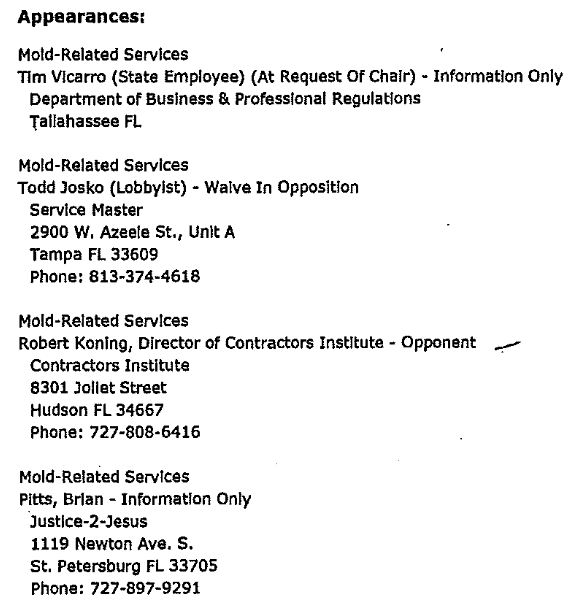
The move to repeal the current mold licensing law is working its way through committee.  Below is the list of appearances and voting results.


Bill Number: 4171
Bill Name: HB 4171
Action: Favorable
Committee: Business & Consumer Affairs Subcommittee
Location: 12 HOB
Duration: 2.00
Date: 3/8/2011 1:00:00 PM
Sponsor: Grant
Subject: Mold-Related Services
Y  Abruzzo Y  Bovo Y  Goodson Y  Patronis Y  Slosberg
Y  Ahern Y  Crisafulli N  Jones Y  Roberson, K. N  Stafford
Y  Artiles Y  Eisnaugle Y  Nuñez N  Rouson Y  Young
Total Yeas: 12 Total Nays: 3 Total Missed: 0 Total Votes: 15


Bill History:
Event Time Member Committee
Now in Economic Affairs Committee Wednesday, March 09, 2011 11:38 AM Economic Affairs Committee
Reported out of Business & Consumer Affairs Subcommittee Wednesday, March 09, 2011 11:38 AM Business & Consumer Affairs Subcommittee
1st Reading Tuesday, March 08, 2011 10:24 PM
Favorable by Business & Consumer Affairs Subcommittee Tuesday, March 08, 2011 3:00 PM Business & Consumer Affairs Subcommittee
Added to Business & Consumer Affairs Subcommittee agenda Friday, March 04, 2011 4:06 PM Business & Consumer Affairs Subcommittee
Now in Business & Consumer Affairs Subcommittee Thursday, March 03, 2011 9:50 AM Business & Consumer Affairs Subcommittee
Referred to Economic Affairs Committee Thursday, March 03, 2011 9:50 AM Economic Affairs Committee
Referred to Business & Consumer Affairs Subcommittee Thursday, March 03, 2011 9:50 AM Business & Consumer Affairs Subcommittee
Filed Wednesday, February 16, 2011 2:41 PM Grant


ASTM Manual on Moisture Control in Buildings NEW EDITION!

March 10, 2011

New Edition! Manual 18 Moisture Control in Buildings: The Key Factor
in Mold Prevention: 2nd Edition

Twenty-eight comprehensive chapters focus on the major issues involved in the process of moisture resistive construction. This one-of-a-kind publication provides the latest and most important information relating to moisture problems in buildings.
Three new chapters have been added to make this the ultimate publication on moisture control:

  • Details and Practice
  • Quality Management in Design and Construction
  • Development of Methods for Assessment of Moisture-Originated Damage

Four sections cover fundamentals, applications, construction principles and recommendations, and implementation.
Order your copy today!


John P. Lapotaire, CIEC
•Certified Indoor Environmental Consultant
•Microshield Environmental Services, LLC
www.Microshield-ES.com


New ASTM Fungal Growth Standard Provides Go-To Reference for Mold Assessment in Buildings

March 10, 2011

A newly approved standard, ASTM D7338, Guide for the Assessment of Fungal Growth in Buildings, has been developed to provide a go-to reference for anyone testing for mold in buildings. The new standard was developed by Subcommittee D22.08 on Sampling and Analysis of Mold, part of ASTM International Committee D22 on Air Quality.
“The lack of consensus standards in the fungal sampling and analysis practice was the driving force behind establishing D22.08,” says its chairman, Lisa Rogers, president, Mycometer Inc. “All of our efforts are focused on bringing consistency, reliability and accuracy to the practice.”
Rogers notes that ASTM D7338 will be useful to a wide range of stakeholders concerned with mold, including consultants, educators, building owners, insurers, lawyers and others.
In addition to ASTM D7338, D22.08 previously developed ASTM D7391, Test Method for Categorization and Quantification of Airborne Fungal Structures in an Inertial Impaction Sample by Optical Microscopy. Two other proposed new standards developed by the subcommittee are currently on ballot: ASTM WK17177, Test Method for Examination of Fungal Structures on Tape Lift Samples by Optical Microscopy, and ASTM WK22872, Practice for Collection of Total Airborne Fungal Spores via Inertial Impaction Methodology.
“We encourage everyone who has an interest in indoor air quality or mold/fungal assessment, remediation and analysis to get involved in D22.08,” says Rogers. “The work ASTM does in D22 has impact around the world.”
To purchase ASTM standards, visit www.astm.org and search by the standard designation number, or contact ASTM Customer Relations (phone: 610-832-9585; service@astm.org).  ASTM International welcomes and encourages participation in the development of its standards. For more information on becoming an ASTM member, visit www.astm.org/JOIN.
ASTM
Committee D22 Next Meeting: April 10-13, April Committee Week, Anaheim, Calif.
Technical Contact: Lisa Rogers, Mycometer, Inc., Tampa, Fla., Phone: 813-831-6511; lrogers@mycometer.com
ASTM Staff Contact: David Bradley, Phone: 610-832-9681; dbradley@astm.org
ASTM PR Contact: Barbara Schindler, Phone: 610-832-9603; bschindl@astm.org
Release #8788
February 9, 2011

John P. Lapotaire, CIEC
•Certified Indoor Environmental Consultant
•Microshield Environmental Services, LLC
www.Microshield-ES.com


The Push to Repeal the Florida Mold Licensing Law

March 9, 2011

There was wide spread shock among the Mold Professionals, both inspectors and remediators, when Representative Grant introduced HB 4171 in an effort to repeal the current legislation requiring anyone providing mold related services to obtain a license to either preform mold inspections or mold remediation.

You see for the past 7 months both mold inspectors and mold remediators have been working to obtain their mold license.  Some individuals spending hundreds of dollars and some companies thousands.  All in an effort to improve our industry and comply with the current licensing law.

Those who proudly work in the mold industry are eager to improve themselves through education, licensing, and continued education, as required by the current licensing law.  We do this to help provide our client the best possible service in what is almost always a traumatic time of need.

We all submit to finger printing and licensing to show our clients that it is safe to allow us into their home and that they are free to look at our history and report and wrongful acts on our part to either the or their property.

Becoming licensed according to the current licensing law will not make anyone more ethical or force them to provide a better service.

•It does ensure to Citizens of Florida that anyone they are wanting to hire has met the minimal requirements currently required by the State to preform either a Mold Assessment or Mold Remediation on in their home.

•It does provide the Citizens of Florida a window into any licensed mold professionals history as recorded by the State.

•It does provide the Citizens of Florida with a means of reporting wrongful acts committed by a mold professional.

•It does provide a means and a way for the Citizens of Florida to be Informed and Empowered Consumers.

So I have to ask Representative Grant why he wants to repeal the Current Licensing Law.


Who’s interest is he looking out for?


John P. Lapotaire, CIEC
•Certified Indoor Environmental Consultant
•Microshield Environmental Services, LLC
www.Microshield-ES.com


Licensing and Regulating the Florida Mold Industry

March 9, 2011

Finally, we have regulation in the mold industry.  The mold industry had been an unregulated industry for many years and the citizens of Florida suffered as they were exposed to fraud, scams, and scare tactics.  The citizens of Florida have been preyed upon by mold inspectors who inspect flood and storm damaged property and assesses thousands of dollars of damage that requires their immediate remediation.

There have been many arrests of fraudulent mold contractors as recently as this past February 21st.  It took 29 complaints to the Department of Environmental Protection before action was taken to stop the contractor.  If 1 or 2 complaints had been registered and confirmed by the Florida Department of Business and Professional Regulation FDBPR.  I feel it safe to assume that most Floridians would not hire the contractor.  None would surely hire him after 10 or 20 registered complaints let alone 29.  By 10 the FDBPR would have taken action revoking the contractor’s license protecting the next 19 from fraud.

Under the current Florida Licensing Law a Licensed Mold Inspector CANNOT provide Mold Remediation.  As of July 1, 2010 the state of Florida Prohibits anyone from performing or offering to perform any mold remediation to a structure on which the mold assessor or the mold assessor’s company provided a mold assessment within the last 12 months

The current Florida Mold Related Services Licensing Law provides a means of reporting these crooked and fraudulent Inspector/Remediators so that the citizens of Florida can be informed about the history of any Mold Inspector or Mold Remediator they hire.

The Florida State Mold Law Legislative purpose.–The Legislature finds it necessary in the interest of the public safety and welfare, to prevent damage to real and personal property, to avert economic injury to the residents of this state, and to regulate persons and companies that hold themselves out to the public as qualified to perform mold-related services.

It’s important for this information to be shared due the recent submittal of HB 4171 February 16th, by Representative James W Grant, District 47.  Representative Grant filed the bill in an effort to repeal the current legislation requiring mold remediators and mold assessors to obtain a state license.  The bill was introduced 7 months after the current law took effect and after approximately 3000 individuals became licensed as either mold remediators or mold inspectors.  With hundreds of additional applicants currently awaiting their license.

The current legislation provides both a means for the Citizens of Florida to report fraudulent acts by mold inspectors and mold remediators and a way for the Citizens of Florida to review the history of any Mold Inspector or Mold Remediator before they make their decision of who to hire.

An Informed Consumer and an industry that can now be held accountable.  Floridians, with the current licensing law, can now self-protect against fraud by either reporting a fraudulent mold inspector or remediator or simply by choosing not to hire a mold inspector or remediator based on the mold inspectors or remediators history of complaints.

I have to ask Representative Grant just what it is about an informed consumer that he is opposed to.  Or could it be someone in the industry that Representative Grant feels should be protected from accountability?

The Mold Related Services Industry is fully in favor of the current Florida Mold Licensing Law.  Thousands of Mold Inspectors and Mold Remediators have spent the last seven months obtaining the necessary training, certification, and insurance necessary to obtain their individual State Mold Assessor License and Mold Remediator License.

There is a push by the Florida Home Builders Association to either repeal the current law or amend the current law to allow licensed general contractors to provide mold inspection and mold remediation without the need for an additional mold inspection or mold remediation license.  I find this very interesting as builders have to be additionally licensed to plumb, roof, provide electric or HVAC service on the homes they build.  Hence the term general contractor.  The General Contractor simply needs to hire a Licensed Professional to perform the mold related services required for the homes they build.  Licensing a Mold Inspector or Mold Remediator is no different than any other trade in the state that is currently required to have a license.

It seems that when it comes to anything resulting from or associated with a possible building or construction flaw the general contractors would rather self police.  I’m sure that their homeowners don’t feel the same way.  The homeowners that I’ve spoken to prefer an independent licensed professional.

Follow the money is the key with the push to repeal the current legislation.

Who hired the Lobbyist?

Who was the Lobbyist?

What is the relationship between the Lobbyist and Representative Grant?

Most important is the “WHY” repeal the New Mold Related services Law?  and,

“WHO” benefits most from the repeal?

I would have to say clearly not the Citizens of Florida who lose their ability to report fraudulent mold inspectors and remediators and make informed decisions regarding who to hire based on the states recorded history of all licensed contractors.  Clearly not the thousands of individuals and businesses involved in the mold related services industry who have already paid for and given their time to become appropriately trained according to the current licensing law and have paid for and obtained the necessary insurance to comply with the current licensing law.

So I ask Representative Grant just “Who’s” Special Interest are you looking out for?


John P. Lapotaire, CIEC
•Certified Indoor Environmental Consultant
•Microshield Environmental Services, LLC
www.Microshield-ES.com


VOC Off Gassing – It’s as bad as it sounds

March 4, 2011

The old adage “an ounce of prevention is worth a pound of cure” applies when referring to indoor air quality. So remember to look for low VOC or VOC free choices when purchasing common household products. Currently there’s no standard labeling system for VOCs, but many manufacturers offer a low or no VOC option. Formaldehyde, one of the best known VOCs, is surprisingly common in new home construction. Luckily, it happens to be one of the few indoor air pollutants that can be readily measured. Air monitoring is one approach that can help prevent adverse effects of exposure to volatile organic compounds.

One study on formaldehyde and VOC levels utilizing air monitoring found that “the levels of volatile organic compounds (VOCs) in new homes decreased markedly after 1 year”. This is due primarily to the off-gassing process which diminishes over time. If you don’t happen to have expensive air monitoring equipment lying around, you could always use your sense of smell. Just remember that not all VOCs are detectable with the human nose.

Preventing Exposure to VOCs

Identify, and if possible, remove the source. If it’s not possible to remove, reduce exposure by using a low or no VOC sealant on surfaces and other furnishings emitting chemicals. You should always increase ventilation during the period of VOC off gassing and consider using an air purifier.

Potentially hazardous products often have warnings aimed at reducing exposure to the user. Many people, however, don’t bother to read the label before every use (guilty as charged). If a label states to use the product in a well-ventilated area, go outdoors, open the windows or work in areas equipped with an exhaust fan. You should always provide the maximum amount of clean air flow possible. This rule applies when you are using petroleum-based products, fuels, hydraulic fluids, paint, thinners, cleaning agents and the like. This also applies to your new carpet, new car, air fresheners and a variety of other surprising sources.

Other preventative measures

Safely disposing of empty containers or those with very little product remaining. – Using products according to the manufacturer’s directions. – Buying in quantities that you may consume quickly to prevent additional exposure from seepage or vapors, like paint VOCs, that may escape from poorly sealed containers. – Keeping products out of the reach of children and pets. – Making every effort to utilize integrated pest management techniques when using pesticides. – Never mixing products unless directed on the label. – Choosing low VOC or VOC free products.

Via the Eco Evaluator