Should You Test for Mold?

March 4, 2010

When we get calls for mold testing, we conduct a very thorough client interview to help get us acquainted with the client and to help determine the client’s individual needs. In some cases the client simply needs to have air samples collected to find out if there is a presence of a known allergen in their home or office. In other cases they need to know why there is mold in their home or office and how to stop it from growing and how to get rid of what has already grown.

And far too often we are asked to interpret the laboratory report for samples that were collected by a “Mold Inspector”.

Most of the reports that we are called out to help with are incomplete and do little more that repeat what the lab report states. There were Aspergillus/Penicillium spores found etc…..etc…..

This information is of little value to the client if you don’t know what caused the mold to grow in the first place and even less value if you can’t provide a solution to that initial cause. That’s just a basic “Cause and Origin” report and requires no testing. I consider that part of my assessment as Step 1. No testing yet.

To provide the cause and origin requires a solid visual inspection which is the most important aspect of a mold inspection. The purpose of the visual inspection is to identify visual mold contamination or conditions that may be conducive to microbial growth. The visual inspection should also include the collection of indoor environmental conditions such as temperature, humidity, carbon dioxide, carbon monoxide, and particulate levels.

When the source of mold is hidden the use of a particulate counter is essential in locating areas of a home or office that have elevated airborne particulate matter and possible areas that require further investigation. Still no testing.

At this point I feel comfortable in my ability to answer the following questions that will become the foundation of my report.

1.Is there a mold or IAQ problem?
2.What was the cause?
3.Where is the problem source?
4.What is the extent of any wet and damaged material?
5.What building repairs are needed to prevent a reoccurrence?
6.Will I need an S-520 based protocol?
7.Will I need to provide local containment?

A mold test, surface or air, can’t answer any of those questions and would not alter the answers to any of those question. A lab report can produce a lot of information but if it doesn’t answer any of those questions why would I be testing?

If the mold testing results will not affect what you do, then you probably don’t need mold testing.

I believe that you may only need the visual inspection and a mold remediation protocol that is then followed by the testing to establish that the structure, contents or systems of your home or office have been returned to a normal fungal ecology or S-520 Condition 1.

Having said all that there are times when you may simply want to know what is in the air you breathe and whether or not there is an unusual amount of mold spores in you air. You may need to show that the mold growing on a surface is in fact airborne and causing negative health affects to the building occupants. You may want to know if the elevated particulate levels in the building are mold spores from the visible mold growth to ensure that the IAQ improvements that you recommend will address all of the airborne particulate matter and not miss something.

Remember mold tests are not perfect. False negative and false positive results do sometimes occur. Mold testing results are one piece of information, sometimes an important piece. But other pieces of information are also needed and in my mind much more important and should always take precedence over the mold testing and laboratory results.

If a mold inspector begins his inspection with the suggestion of sampling I believe I can safely say he missed a step. Step 1

In many cases that I review the only thing the mold inspector provides his client with is the laboratory report of the testing that he preformed. No summary of findings, no cause and origin, no indoor environmental measurements, no history, nothing but a lab report.

If you have signed an agreement with your inspector take a close look at it. Most if not all mold inspector agreements that I have reviewed contain a statement such as;

The client is solely responsible for the use and interpretation of the test results and reports requested from home inspector. The inspector is not able to assess the degree of any potential hazard resulting from the materials and areas analyzed. Therefore, we respectfully suggest that you review this report with your personal physician or health care person(s) for information that may affect the inhabitants of the home.

Which is sad and ironic because the laboratory report will contain a statement such as;

The Laboratory bears no responsibility for sample collection activities or analytical method limitations. Interpretation and use of test results are the responsibility of the client

Or

The client is solely responsible for the use and interpretation of these recommended action guidelines.

So who does that leave to interpret the results? What did the client pay for? How does this information help you? What is it telling you?

Many inspectors and believe that testing and sampling will somehow tell you were there is hidden mold. I just don’t believe that. There are just too many variables in air samples and spore counts to justify that statement. You still need to look for and find the mold, identify the cause and the origin, and provide a plan to repair the cause and return the home to its pre loss condition. Any good inspector should be able to do that without starting a pump.

John P. Lapotaire, CIEC
Certified Indoor Environmental Consultant
Microshield Environmental Services, LLC
www.Microshield-ES.com


Florida Mold Law Update

March 4, 2010

Florida House Bill HB713 is a proposal to accept any national association’s certifications with 3 years verifiable experience and 60 hours of verified training. The Florida Legislature goes into session next week and this bill should be voted on quickly.

This is a very good thing for the consumer. I receive dozens of calls from consumers who have had a “Mold Inspection” only to have the inspector hand the consumer a lab report with no summary of findings. You can read more about that in this article. http://activerain.com/blogsview/1438130/the-home-inspector-mold-test-buyer-beware- That is the reason we truly need the new law and a stiff standard.

Point to remeber

Certification vs Certificate of Training

Many who hold a private, IAQ-related credential, will be surprised to learn that it may be nothing more than a training certificate.

Unfortunately there are many training programs that are not a recognized ANSI/NOCA professional certification but rather only a certificate of training. Many won’t meet the requirements of the new HB713 where you would be required to have 60hrs of training and 3 years of experience and a certification from a national association. You can read more about that in this article. http://activerain.com/blogsview/1272700/is-your-mold-or-iaq-inspector-really-certified-

Remember that HB713 is not a law yet. It still has to be voted in.

You can read more about what is in a Professional Mold Inspection Report in this article. http://activerain.com/blogsview/1516548/what-is-a-professional-and-informative-mold-report-

John P. Lapotaire, CIEC
Certified Indoor Environmental Consultant
Microshield Environmental Services, LLC
www.Microshield-ES.com


Should I have my home tested for mold?

March 4, 2010

This is a question I get asked a lot and I find myself often posting about the subject. To clarify its not that I don’t feel that mold should be adressed, its just that I don’t believe that the flavor of the mold will change anything that takes place regarding the removal of the mold and the necessary repairs to stop the mold from growing.

I believe you should have the mold in your home assessed to determine what steps should be taken to safely remove the mold to ensure thit it wont return. When the mold inspector has completed his inspection and assessment he should be able to tell you what is causing the mold growth, how extensive the growth is, whether or not you will need a protocol, and whether or not you should contain what is there to stop the immediate exposure to you and your family until the more permanent repairs and remediation can take place.

I do believe that there are times when you should test for mold and I probably test more than these post imply but I lean much more on my visual inspection and test much less than the majority of the mold inspectors that I meet and even less than the majority of IAQ professionals that I meet. Maybe this is due to my ackground as a home builder, regardless I just don’t feel the need to depend or rely on a lab test to tell me if there is something hidden. I simply look.

I will give you a very real world example of my issues with over testing. Bear in mind that this really did happen and it happens often.

I received a call from a home buyer that had hired a mold inspector to determine if an occupied home had a mold problem. The mold inspector showed up collected two air samples in the home, one in the living room and one in the master bedroom. He also collected another air sample outside.

So far according to many this is a typical inspection for mold and most feel we are looking good. We just need to see what the results are and wala we are done. Right?

The results came back and the mold inspector told his client that the living room and master bedroom had high mold spore counts with the living room being “really high”. He wasn’t sure where the mold was growing so he wanted to return and re-sample. This time he wanted to sample every room in the home at a substantial cost. The mold inspector informed the home buyer that this sampling would determine once and for all where and in which room of the home the “hidden” mold was growing.

Again, so far a typical inspection for mold. We just need to see what the results are and wala we are done and we will know where the “hidden” mold is growing. Right?

The results came back and the mold inspector told the home buyer that the results showed nothing at all. No high spore counts and nothing inside that wasn’t outside. He then told the home buyer that he had done everything he could to help the buyer but he just didn’t know what else to do and suggest the home buyer hire a professional air quality expert.

What? Isn’t that what the home buyer hired when he hired the mold inspector?

I can tell you the home buyer told me he did in fact think he was hiring a professional mold and indoor air quality professional because that is exactly what is said on the mold inspectors website and business card.

The home buyer and now my Client sent me everything to review until I could get to the home the next day for an assessment. I received everything the mold inspector provided my Client which consisted of two laboratory reports and nothing else. Not a single photo, not a single measurement of temperature or humidity. No moisture scans of the plumbing areas of the home, no client interview, and no history of the home. Nice……..

When I got to the home I found a nice well maintained home that was occupied by a retired couple and one small dog. They had lived in the home since it was built and had never had a water intrusion event either from a typical Florida storm or from a pluming leak. No elevated particulate matter, no elevated humidity.

This was a recent inspection and there have been some real cold weeks here in Florida.

The wife had a wonderful hobby. She loved her plants. When I conducted my “Visual Inspection” I found nothing out of the ordinary with only one exception. Remember I had no idea of the conditions during the mold inspector’s inspection (sample collection) of the home.

So I asked the home owners and the home buyer if the mold inspection was during the freezing weather we had just experienced? They informed me that it actually was. I then asked if all of the plants just outside the 12 foot wide sliding glass door and inside the large screened in pool enclosure were moved inside to keep them from freezing.

The wife proudly told me she had in fact moved all of her prized plants inside including the ones in rather large pots, and she proudly informed me that she lost none to the freeze. Good for her!

I asked, to clarify, if the plants were right here in the living room during the mold inspection? The answer was yes.

The hunt for the “hidden” mold was over and the home closed with a happy seller and a happy buyer.

Cost of the first mold inspection $275

The cost of the sampling of every room in the home $1250

A good visual inspection with no sampling……… Priceless!

As far as whether or not I would want to know what type of mold I am dealing with to make some of the decisions I claim can be done visually.

I will simply quote the EPA, NYCDH, CDC, FDH, and the AIHA.

New York City Department of Health & Mental Hygiene
Sampling can be expensive. The results are also difficult to interpret partially because we have very limited information about what level of mold exposure is associated with health effects. In some cases, knowing the type of mold that is present can be helpful, but for most cases, sampling is unnecessary. Overall, the best practice regardless of the type or amount of mold is to promptly clean up any mold growth in your home and to correct the water problem that caused it.

Any extensive indoor mold growth should be treated as a potential health concern and removed as soon as practical no matter what species of mold is present. Identify and correct the source of moisture so that mold will not grow back.
http://www.health.state.ny.us/environmental/indoors/air/mold.htm

Centers for Disease Control and Prevention
Generally, it is not necessary to identify the species of mold growing in a residence, and CDC does not recommend routine sampling for molds. Current evidence indicates that allergies are the type of diseases most often associated with molds. Since the susceptibility of individuals can vary greatly either because of the amount or type ofmold, sampling and culturing are not reliable in determining your health risk. If you are susceptible to mold and mold is seen or smelled, there is a potential health risk; therefore, no mold what type of mold is present, you should arrange for its removal.
http://www.cdc.gov/mold/faqs.htm

Florida Department of Health
Indoor mold growth can usually be seen or smelled. In most cases, if visible mold growth is present, sampling is not needed. There are no health or exposure-based standards that you can use to evaluate a mold sampling result. The Florida Department of Health does not recommend mold testing or sampling to see if you have a mold problem, or to see what kind of mold might be growing.
http://www.doh.state.fl.us/ENVIRONMENT/COMMUNITY/indoor-air/mold.htm

American Industrial Hygiene Association
Should I test my home for mold? Probably not. Looking for evidence of water damage and visible mold growth should be your first step. Testing for mold is expensive, and you should have a clear reason for doing so. In addition, there are no standards for “acceptable” levels of mold in the indoor environment. When testing is done, it is usually to compare the levels and types of mold spores found inside the home with those found outdoors. If you know you have a mold problem, it is more important to spend time and resources getting rid of the mold and solving the moisture problem causing the moldy conditions.

Click to access Facts%20about%20Mold.pdf

John P. Lapotaire, CIEC
Certified Indoor Environmental Consultant
Microshield Environmental Services, LLC
www.Microshield-ES.com


Do It Yourself Mold Test Kits, Use Them or Lose Them?

March 4, 2010

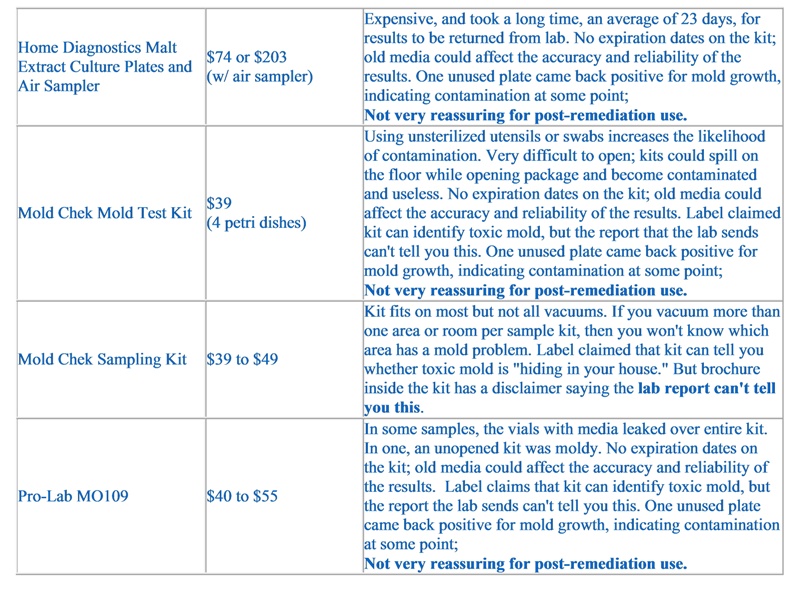
Do It Yourself Mold Test Kits Earn a Not Recommended Rating from Consumer Reports.

If you see or smell mold, you don’t need a test kit to tell you it’s there. Generally, it’s not necessary to identify the species of mold growing in your home, according to the national Centers for Disease Control and Prevention.

If mold covers an area less than 10 square feet, you may be able to eliminate the problem yourself. Larger areas require a pro. When we tested the kits below for our report, we found significant shortcomings in all of them, flaws that were serious enough to earn each a “Not Recommended” Rating.

John P. Lapotaire, CIEC
Certified Indoor Environmental Consultant
Microshield Environmental Services, LLC
www.Microshield-ES.com


National Nonprofits Plan to Combine Forces to Advance Healthy Homes and Communities

March 4, 2010

Washington, DC -The National Center for Healthy Housing (NCHH) and the Alliance for Healthy Homes (Alliance) today announced their plans to join forces. The consolidated organization will continue to operate as the National Center for Healthy Housing, led by Rebecca Morley, with offices in Columbia, Maryland and Washington, DC. Patrick MacRoy, former executive director of the Alliance, will lead NCHH’s Community-Based Initiatives. The merger will consolidate all aspects of healthy homes within a single organization – research and evaluation, policy advocacy, consumer education, training, and assistance to local governments and community-based organizations. Nearly 5.7 million families live in substandard housing conditions placing millions of children at risk for asthma, cancer, lead poisoning, and injuries. As a unified organization, the groups will be able to better serve the interest of these families.

For further information see the full press release and information on the upcoming conference.

RBc: For more information on healthy housing see these articles:

1.Current State of the Science: Health Effects and Indoor Environmental Quality
2.Elements That Contribute to Healthy Building Design
3.Toxic homes, toxic bodies

John P. Lapotaire, CIEC
Certified Indoor Environmental Consultant
Microshield Environmental Services, LLC
www.Microshield-ES.com


ASHRAE Technology Awards Highlight Outstanding Building Projects

March 4, 2010

ORLANDO, Fla.–Designers of systems for two office buildings, a warehouse and college library are recognized by ASHRAE for incorporating elements of innovative building design.

First place recipients of the ASHRAE Technology Awards were recognized at the Society’s 2010 Winter Conference, held this week in Orlando, Fla. The recipients have applied ASHRAE standards for effective energy management.

The first place winners in their respective categories are:

1. The Terry Thomas (Michael Hedrick, Thomas Marseille, P.E. and Long Lam; Stantec Consulting; Seattle, Wash)

2. Sobey’s Warehouse (Martin Roy, P.Eng.; Martin Roy et Associés, Inc.; Deux-Montagnes, Québec, Canada)

3. IDeAs Design Facility (Peter Rumsey, P.E., Fellow ASHRAE; Rumsey Engineers; Oakland, Calif)

4. The Richard J. Klarcheck Information Commons Building (Donald McLauchlan, P.E., Steven Maze and David Lavan; Elara Energy Services, Inc.; Hillside, Ill.)

For further information on these projects contact:

Amanda Dean
Public Relations
678-539-1216
adean (at) ashrae.org

RBc: Congratulations to the winners and of special note is the use of hydronics and floor heating in all the outstanding building projects.

John P. Lapotaire, CIEC
Certified Indoor Environmental Consultant
Microshield Environmental Services, LLC
www.Microshield-ES.com


New guidance for achieving enhanced IAQ now available from ASHRAE

January 16, 2010

New guidance for achieving enhanced IAQ is available from five leading building industry associations and the U.S. Environmental Protection Agency.

The Indoor Air Quality Guide: Best Practices for Design, Construction and Commissioning is collaboration between ASHRAE, the American Institute of Architects, the Building Owners and Managers Association International, U.S. Environmental Protection Agency, the Sheet Metal and Air Conditioning Contractors of North America and the U.S. Green Building Council.
The book describes 40 strategies for achieving critical IAQ objectives related to moisture management, ventilation, filtration and air cleaning and source control. It also highlights how design and construction teams can work together to ensure good IAQ strategies are incorporated from initial design through project completion.
A summary document of the Indoor Air Quality Guide – ideal for a general understanding of the importance of major IAQ issues can be downloaded for free at http://www.ashrae.org/iaq. The full publication complete with a CD that contains detailed guidance essential for practioners to design and achieve good IAQ is available in hard copy or electronically for $29.

To order, contact ASHRAE Customer Service at 1-800-527-4723 (United States and Canada) or 404-636-8400 (worldwide), fax 404-321-5478, or visit http://www.ashrae.org/bookstore

www.microshield-es.com


Whats in the Air You Breathe?

December 7, 2009

Are your allergies bothering you in your home or office? Does your asthma get triggered when you enter a room? Maybe it’s time for the professionals at Microshield Environmental Services help you isolate and identify the allergens or asthma triggers in your home or office. Microshield can then help you eliminate those allergens and triggers and improve your Indoor Air Quality.
Call Microshield Today 407-383-9459
www.Microshield-ES.com


Check out the new Microshield Website.

December 7, 2009

http://www.Microshield-ES.com


2009 Oviedo Lock Up: John Lapotaire, CIEC

September 29, 2009

2009 Oviedo Lock Up: John Lapotaire, CIEC

Shared via AddThis